Why Your Competitors Own the ChatGPT Shortlist While You Are Stuck in Google Page 2
June 23, 2026
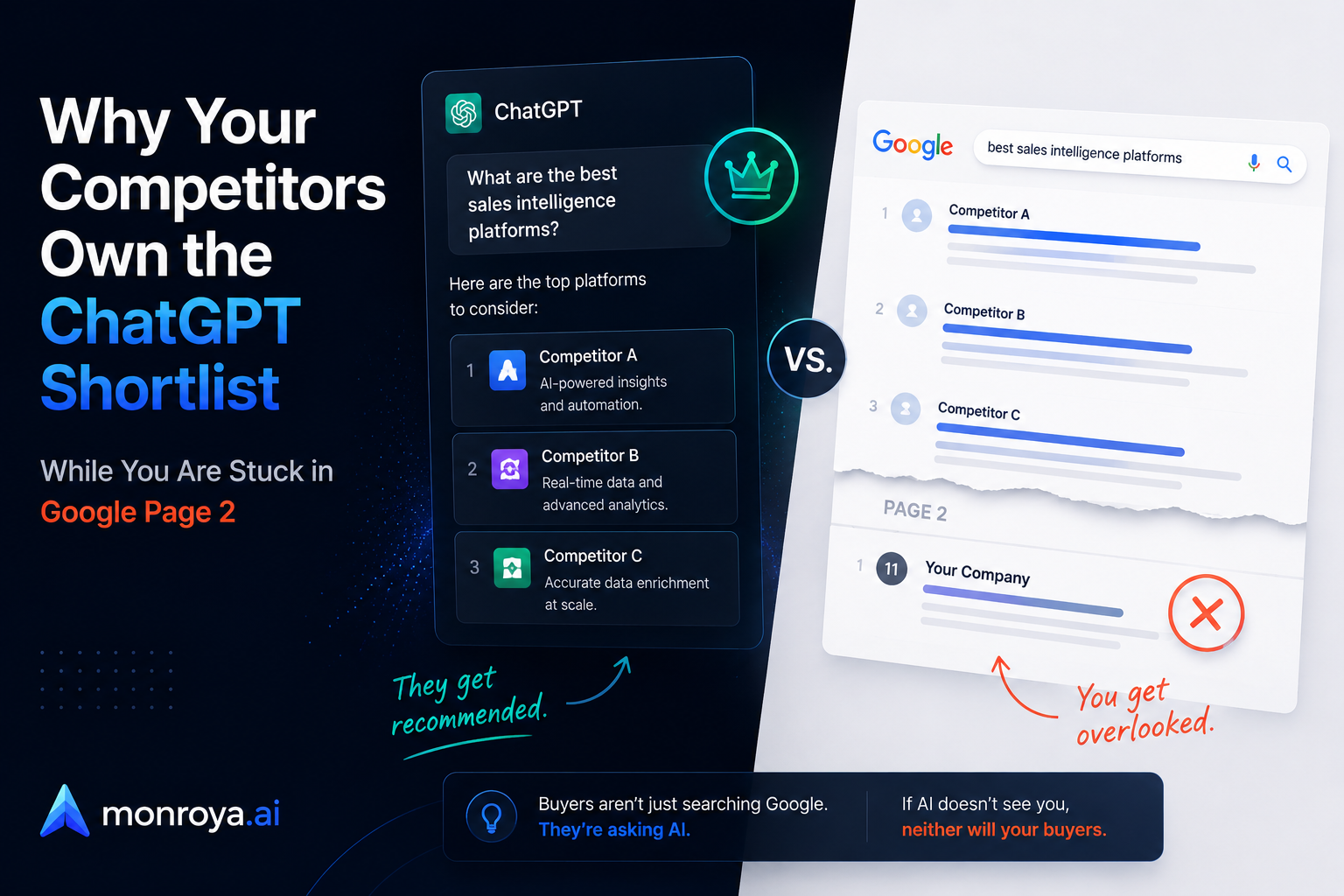
B2B buyers have stopped clicking through ten blue links to build their vendor shortlists, moving instead to AI assistants like ChatGPT and Perplexity to summarize entire software categories in seconds. To win in this new environment, companies must shift from keyword density to entity-based Generative Engine Optimization (GEO) that prioritizes high-authority citations and direct technical comparisons.
Table of Contents
- How do I show up in ChatGPT for category searches?
- Why does Perplexity cite my competitors but not me?
- How does the AI Buyer Journey differ from traditional SEO?
- What is the difference between AI visibility across different LLMs?
- How do I improve my AI citation rate using technical documentation?
- Key Takeaways
- FAQ
How do I show up in ChatGPT for category searches?
To show up in ChatGPT, you must establish your brand as a "named entity" within the training data and real-time search indices by securing mentions in high-authority third-party sources like Gartner, G2, and niche trade publications. ChatGPT prioritizes consensus; if multiple authoritative sources categorize you as a "Top CRM for Mid-Market," the LLM will mirror that classification in its response.
The shift from SEO to AI visibility is fundamental. In traditional search, you optimize for a crawler. In AI search, you optimize for an inference engine. When a VP of Sales asks ChatGPT, "Which sales engagement platforms integrate best with Salesforce and have the highest mid-market satisfaction?" the LLM isn't looking for the page with the most backlinks. It is looking for the most consistent answer across its indexed knowledge base.
By 2026, 80% of B2B buying interactions will occur in digital channels, with AI assistants acting as the primary filter for vendor selection (Gartner, 2024).
If your company is missing from these summaries, you aren't just losing traffic; you are being excluded from the consideration set before the buyer ever visits a website. monroya.ai helps teams identify these gaps by scanning ChatGPT, Claude, Gemini, and Perplexity to see which competitors are being recommended and why.
Why does Perplexity cite my competitors but not me?
Perplexity cites competitors because they have higher "citation density" in the specific sources Perplexity’s RAG (Retrieval-Augmented Generation) engine prioritizes, such as Reddit, LinkedIn, and technical documentation. Perplexity relies heavily on real-time web indexing, meaning it values recent, structured data and community sentiment over legacy blog posts or gated whitepapers.
For example, if a user asks Perplexity for "the best alternative to HubSpot for a 200-person company," the engine will scan recent reviews and comparison tables. If your competitor has a detailed "HubSpot vs. [Competitor]" page that uses clear H2 headings and objective data points, Perplexity is significantly more likely to scrape that content and cite it as a source.
Companies that optimize for generative engines see a 40% increase in brand mentions within AI-generated summaries compared to those using traditional SEO alone (Monroya Data, 2024).
To fix this, you must move beyond top-of-funnel fluff. Perplexity prefers "hard" data. If your pricing is hidden and your features are described in vague marketing adjectives, the LLM cannot parse your value proposition. Use monroya.ai to track your AI Share of Voice and see exactly which URLs are feeding the answers that exclude you.
How does the AI Buyer Journey differ from traditional SEO?
The AI Buyer Journey is non-linear and compressed, moving from "Discovery" to "Evaluation" within a single prompt session rather than across multiple weeks of searching. In this journey, the LLM acts as a trusted advisor, filtering out marketing noise and presenting a synthesized view of the market based on consensus and technical specifications.
| Feature | Traditional SEO | AI Buyer Journey (GEO) |
|---|---|---|
| Primary Goal | Rank #1 for a specific keyword | Become the recommended solution in a prompt |
| Content Type | Long-form blogs, keyword-stuffed | Structured data, FAQs, comparison tables |
| Success Metric | Click-through rate (CTR) | AI citation rate & Mention rate |
| User Intent | Information gathering via links | Direct answer and shortlist generation |
| Authority Source | Backlink profile (DR/DA) | Entity consensus and technical accuracy |
In the traditional model, you might win a lead because your blog post on "Sales Strategy" ranked well. In the AI model, you win because when the buyer asks "Which tool has the best API for custom reporting?" the LLM cites your developer docs. This is why monroya.ai focuses on the entire Buyer Journey, from initial category discovery to the final decision-making prompts.
What is the difference between AI visibility across different LLMs?
AI visibility varies because each LLM—ChatGPT, Claude, Gemini, and Perplexity—uses different training sets, update frequencies, and retrieval methods. ChatGPT relies on a mix of training data and Bing search; Claude prioritizes reasoning and long-context comprehension; Gemini integrates deeply with Google’s Knowledge Graph; and Perplexity functions as a real-time search engine.
75% of B2B buyers now use at least one AI tool during their vendor research process to summarize reviews and feature sets (Forrester, 2024).
For instance, Gemini might favor your brand if you have strong Google Business Profile data and YouTube content, as it pulls heavily from the Google ecosystem. Claude, however, might give a more nuanced comparison of your product’s architecture if you have comprehensive, high-quality documentation that it can "reason" through.
You cannot use a one-size-fits-all strategy. You need to monitor how your brand appears across all four major providers. The monroya.ai Intelligence tier provides a unified dashboard to track these discrepancies and provides the specific drafts needed to correct misinformation in each model.
How do I improve my AI citation rate using technical documentation?
You improve your AI citation rate by transforming your technical documentation into a "source of truth" that LLMs can easily parse, using clear hierarchies, schema markup, and objective comparison tables. LLMs are trained to find the most "correct" answer; technical docs are perceived as higher-signal than marketing blogs because they contain specific parameters, integrations, and requirements.
- Audit your current mentions: Use monroya.ai to see which of your pages are currently being cited by ChatGPT and Perplexity.
- Implement FAQ Schema: Add JSON-LD FAQ schema to every product and feature page to provide clear Q&A pairs for LLMs to ingest.
- Create "Versus" Pages: Build objective comparison pages (e.g., "Our Product vs. Competitor X") using tables rather than paragraphs.
- Publish to High-Authority Aggregators: Ensure your product specs are updated on G2, Capterra, and Crunchbase, as these are primary training sources.
- Simplify Language: Replace marketing adjectives with technical nouns. Instead of "seamless integration," use "REST API with OAuth 2.0 support."
By following these steps, you increase the likelihood that an LLM will pull your specific data points when a buyer asks a technical question. This is the core of B2B AI search optimization. You are no longer just writing for humans; you are writing for the machines that advise those humans.
The transition from traditional search to AI-driven discovery is the most significant shift in B2B marketing since the move to mobile. If you are not actively managing your AI visibility, you are letting the models—and your competitors—define your brand's narrative.
Find out where AI ranks you — then fix it.
Key Takeaways
- Entity over Keyword: LLMs care about who you are (entities) and what you do, not just the keywords on your page.
- Consensus is King: If multiple high-authority sites say the same thing about your product, the AI will treat it as a fact.
- Technical Docs are Assets: Your documentation is often a stronger driver of AI citations than your marketing blog.
- Multi-Model Monitoring: You must track ChatGPT, Claude, Gemini, and Perplexity separately, as their data sources and "opinions" differ.
FAQ
How do I show up in ChatGPT?
To show up in ChatGPT, you must ensure your brand is consistently mentioned across high-authority domains like industry news sites, review platforms, and technical forums. ChatGPT uses both its training data and real-time web browsing to identify market leaders. Providing structured, factual content on your own site helps the model categorize your business accurately during the Buyer Journey.
What is Generative Engine Optimization (GEO)?
Generative Engine Optimization (GEO) is the process of optimizing content to increase visibility in AI-generated responses from tools like ChatGPT and Perplexity. Unlike traditional SEO, which focuses on ranking in search results, GEO focuses on being cited as a source and included in the synthesized summaries that AI models provide to users during their research.
Why is my competitor mentioned in Perplexity but I am not?
Your competitor is likely mentioned because they have a higher citation rate in the specific sources Perplexity prioritizes, such as Reddit or structured review sites. Perplexity’s RAG engine looks for objective data and community consensus. If your competitor has more detailed public-facing documentation or comparison pages, the AI will find them more "useful" to cite.
How does monroya.ai help with AI visibility?
monroya.ai tracks how your brand is described across ChatGPT, Claude, Gemini, and Perplexity. It identifies where you are being left out of the conversation or where competitors are being favored. Beyond monitoring, the platform provides actionable playbooks and drafted content to help you improve your AI Share of Voice and secure more citations in AI search.
Does traditional SEO help with AI search ranking?
Traditional SEO provides a foundation, but it is not sufficient for AI search ranking. While backlinks still matter for discovery, LLMs prioritize the "meaning" and "structure" of content. High-quality SEO content that is vague or fluffy will be ignored by an LLM in favor of structured data, clear comparisons, and factual documentation that provides a direct answer.
What are the pricing tiers for monroya.ai?
monroya.ai offers three tiers: a 7-day free Trial to test the platform, a Starter tier at $79/month, a Growth tier at $199/month, for scaling companies, and an Intelligence tier at $299/month for deep competitive analysis and full Buyer Journey tracking. Each tier is designed to help B2B companies move from being invisible to being the most cited brand in their category. Check monroya.ai/pricing for details.