Most tools tell you what happened. We tell you what to do.
Monroya is the only AI visibility platform that closes the loop from detection to action to verified outcome — with the draft already written before you click anything.
Updated: September 2026
Why does it matter that AI mentions your company?
When a buyer asks ChatGPT "what's the best CRM for a 50-person sales team," they get three names back. If yours isn't one of them, the shortlist is already set before they ever visit your website.
Buyers are forming opinions about your category, your competitors, and your company before they click a single link. By the time they arrive on your site they may already have a shortlist — and a story about why you are or aren't on it.
Most companies are completely invisible to this process. Not because their product is worse. Because the content they've published, the sources AI tools trust, and the way their brand is described across the web hasn't been built for how AI answers questions. Monroya fixes that.
Why isn't monitoring your AI visibility enough?
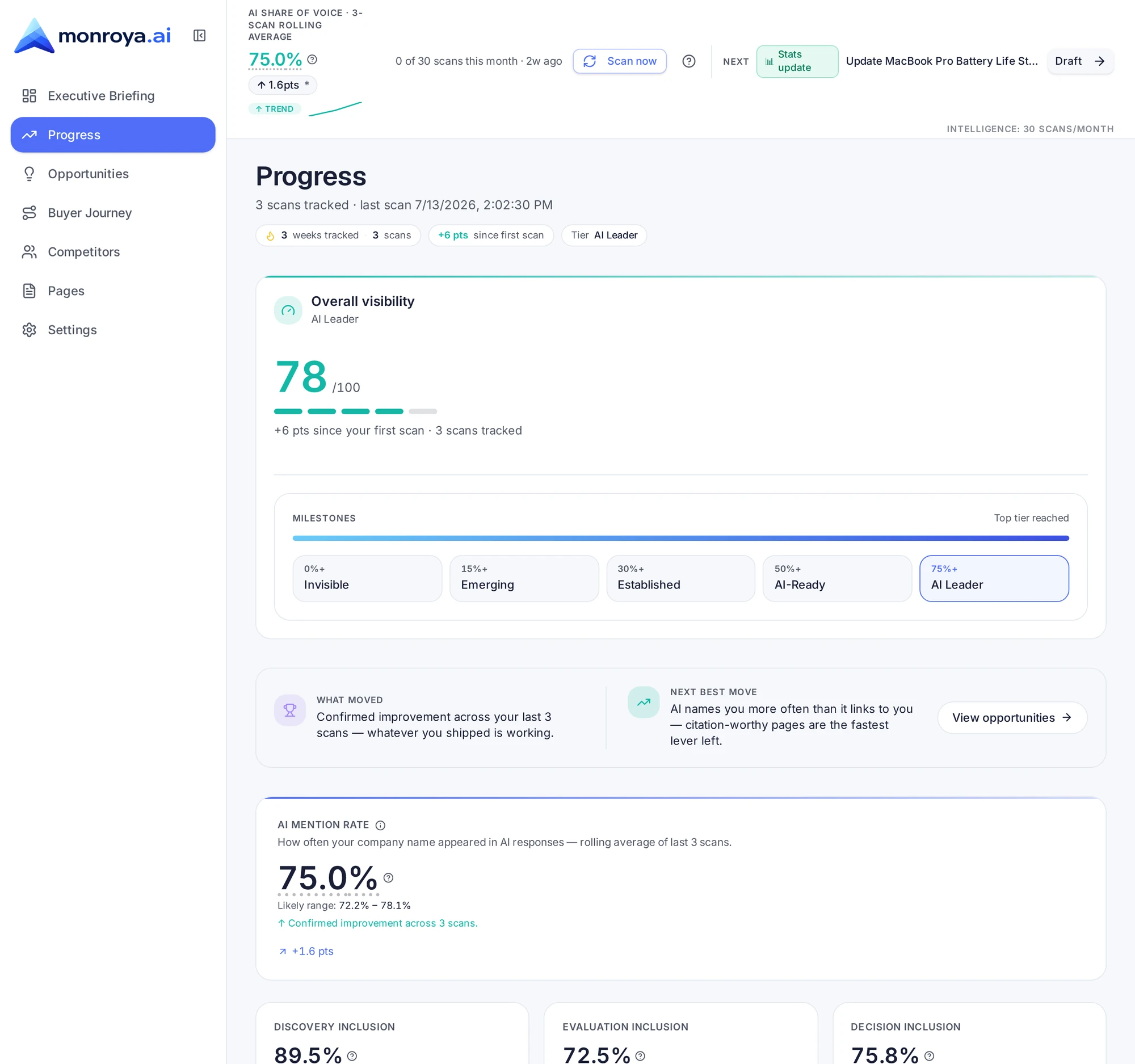
Every other tool in this category tells you where you stand. None of them tell you what to do about it — and almost none of them write the content for you.
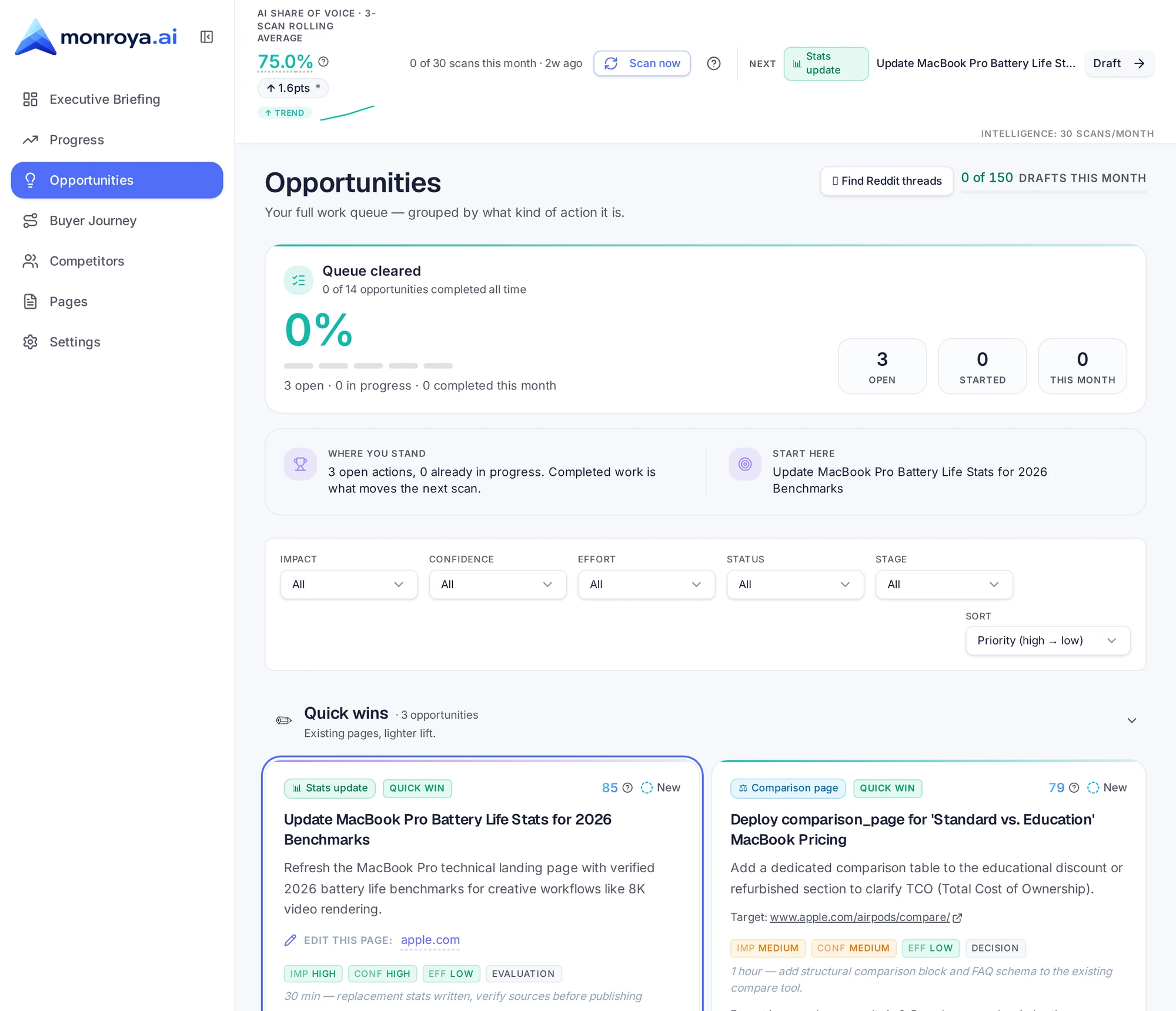
A dashboard that shows you "Crestline appears in 74% of evaluation-stage responses and you appear in 12%" is useful for about 30 seconds. After that, you need to know what to do. Which source is being cited that you're not in. Which specific page on your site is being ignored. What to write. How long it will take to show up. Whether it worked.
That's the gap Monroya closes. You get the monitoring — and then you get the prioritized queue, the written draft, and the verified outcome that shows whether it moved the needle.
| Capability | Monroya | Otterly | Profound | AthenaHQ |
|---|---|---|---|---|
| Multi-provider scanning (ChatGPT, Claude, Gemini, Perplexity) | ✓ | ✓ | ✓ | ✓ |
| Multi-run statistical sampling per prompt | ✓ | — | — | — |
| Mention vs citation distinction | ✓ | ✓ | — | — |
| Buyer journey stage matrix | ✓ | — | — | — |
| Prioritized action queue with scoring | ✓ | — | — | ✓ |
| AI-optimized draft generation (all formats) | ✓ | — | Limited | — |
| Journey-stage calibrated drafts | ✓ | — | — | — |
| Brand voice matching from site crawl | ✓ | — | — | — |
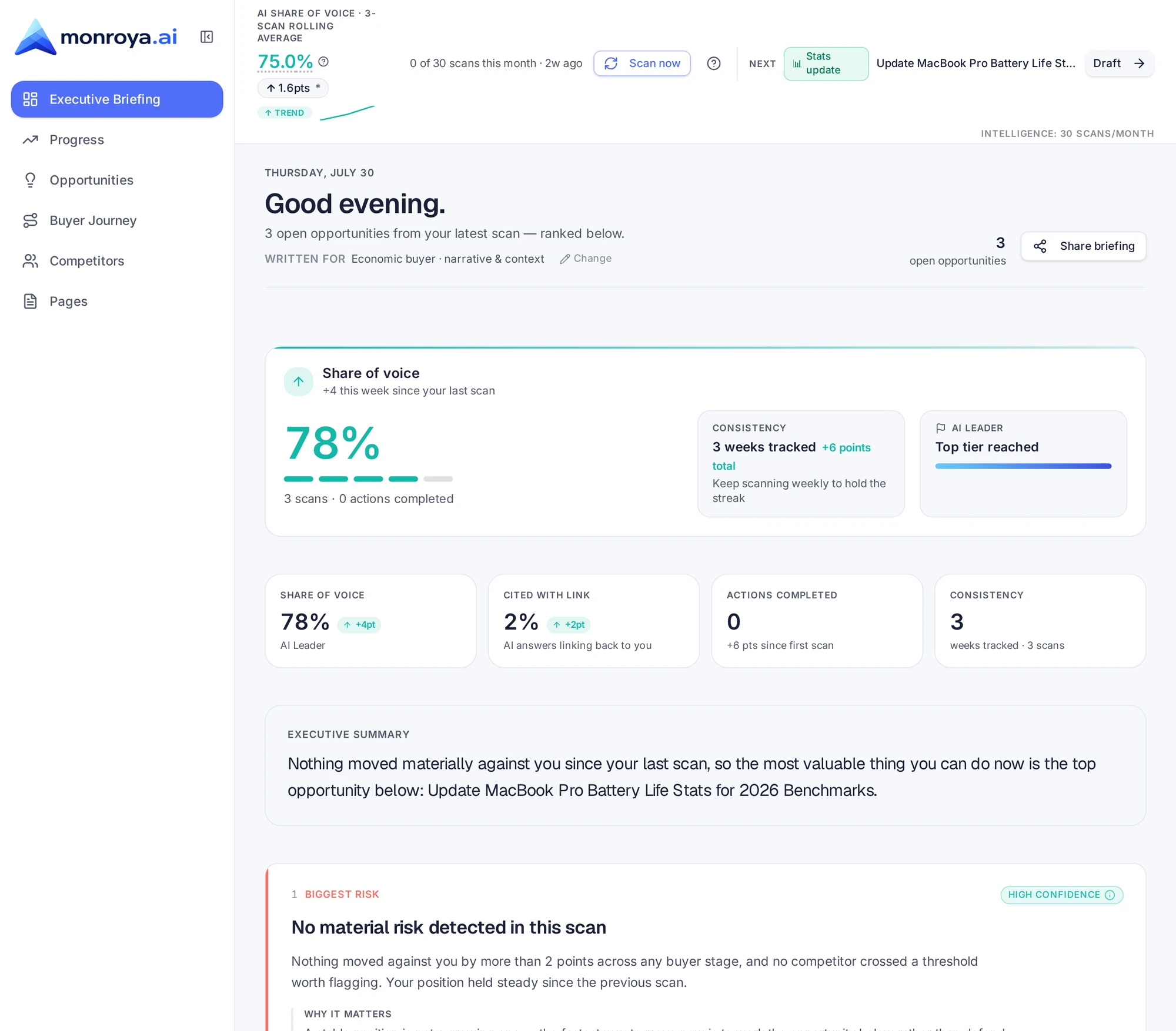
| Verified-outcome playbook (re-weights recommendations) | ✓ | — | — | — |
| Hallucination-checked drafts | ✓ | — | — | — |
| Self-serve under $300/month | ✓ | ✓ | — | ✓ |
What does Monroya do that no other platform does?
Six things that are genuinely different — not features every competitor has under a different name.
Polling, not snapshots
Every prompt runs 3× per provider per scan. One response isn't data — it's a coin flip. Three runs gives you a mention rate with confidence intervals. "You appeared in 7 of 9 ChatGPT responses" is a signal. "You appeared" is noise.
Mention vs citation — tracked separately
ChatGPT mentioning your name and Perplexity linking to your pricing page are completely different signals. Citation rate is the traffic signal. Mention rate is the awareness signal. Most tools conflate them. We don't.
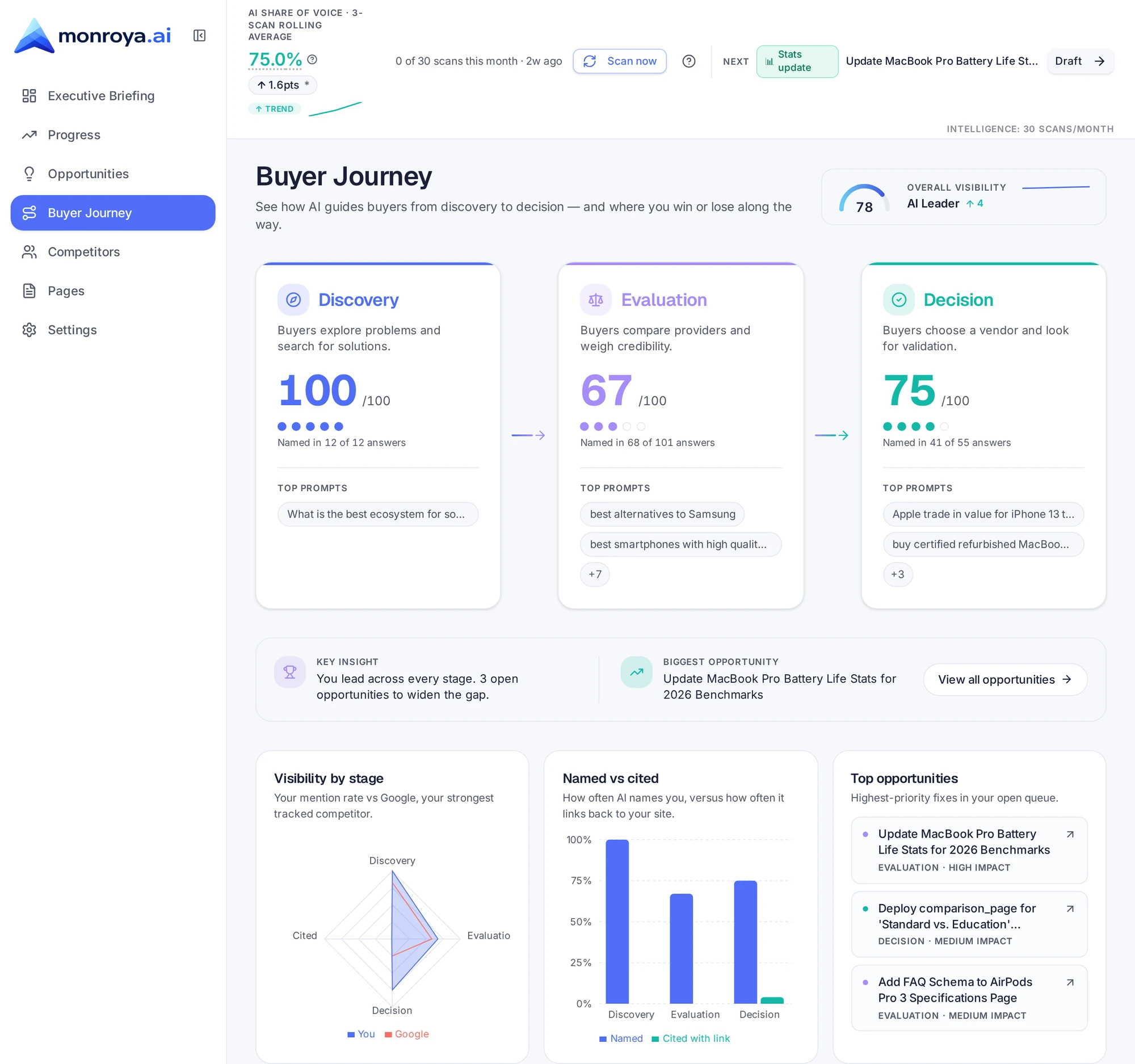
Buyer journey matrix
Discovery, Evaluation, Decision — tracked separately for you and every competitor. You see exactly which stage you're losing, to whom, and in which provider. That's the chart that goes in a board deck.
Draft ready before you ask
Every opportunity has a Draft button. Click it and you get a complete, AI-optimized, journey-stage-calibrated piece of content in your brand voice — not a template, not a brief. Ready to publish.
Persona-framed scanning
Each prompt is prefixed with buyer context before it's sent to providers — "I'm a VP Marketing evaluating options in this category." Real buyers frame their searches this way. Scanning cold gives unrealistic results.
Hallucination detection on every draft
Every generated draft is checked for statistical claims, attribution, and source freshness before it lands in your queue. If a stat can't be sourced, it's flagged — not silently shipped. You edit with confidence, not with a fact-check tab open.
Your playbook learns from your outcomes
When you complete an opportunity and the follow-up scan confirms movement, Monroya records that outcome by action type, format, and buyer stage. After 3+ measured outcomes in the same combo, future recommendations get re-weighted — boosted for what's working, suppressed for what hasn't. Visible on your Progress page.
What does the first week with Monroya actually look like?
Most companies see their competitive gap clearly within minutes of completing onboarding. Here's the typical first week.
- 1Day 0 — 60-90 secondsOnboarding completes, first scan runs automatically
Add your company, competitors, and the questions your buyers actually ask. Monroya crawls your site, runs queries across ChatGPT, Claude, Gemini, and Perplexity, and generates your first briefing. You don't do anything — the briefing arrives.
- 2Day 0 — 3-5 minutesYou see the competitive gap for the first time
The Buyer Journey matrix shows you and every competitor across Discovery, Evaluation, and Decision. Amber cells show where competitors appear and you don't. Most first briefings surface at least one moment that's immediately alarming.
- 3Day 0 — 5-7 minutesYour first draft is ready to review
The top opportunity already has a Draft button. Click it and receive a complete, publication-ready piece — blog post, comparison page, FAQ section, Reddit reply, schema update, source pitch — written in your brand voice, calibrated to the buyer stage, with schema JSON-LD included.
- 4Days 1–3Publish one fast-impact action
Monroya surfaces quick wins first — schema updates, FAQ additions, existing page improvements, source inclusion pitches to articles already being cited. These can show scan improvement within 2–5 days, not weeks.
- 5Days 5–7Run your second scan, see movement
If you published something in the first 3 days, the second scan often shows measurable change — a prompt where you now appear that you didn't before, a citation rate uptick, a stage where your mention rate improved.
Is Monroya built for my team?
Monroya is built for B2B marketing teams at growth-stage companies where AI search is becoming real but nobody has owned it yet.
The typical Monroya user is a VP Marketing or Director of Demand Gen at a company between $2M and $50M ARR. They're being asked by their CEO what the company is doing about AI search. They don't have time to become a GEO expert. They need a system that tells them what to do and helps them do it.
Monroya is not for enterprise analytics teams who want a dashboard to present to a data committee. Those teams have Profound. Monroya is for the person who wants to ship something this week and see it work.
Good fit: Series A–C B2B SaaS. Marketing teams of 2–8 people. Companies where the VP Marketing is also doing the work, not just directing it. Companies whose competitors are already showing up in AI responses. Companies who just had a prospect say "ChatGPT recommended someone else."
Not the right fit: Solo freelancers who need basic mention tracking (Otterly at $29 is a better start). Enterprise companies that need SOC 2, procurement cycles, and dedicated account managers (Profound is built for that). Ecommerce brands focused on shopping recommendations (AthenaHQ has purpose-built ecommerce features).
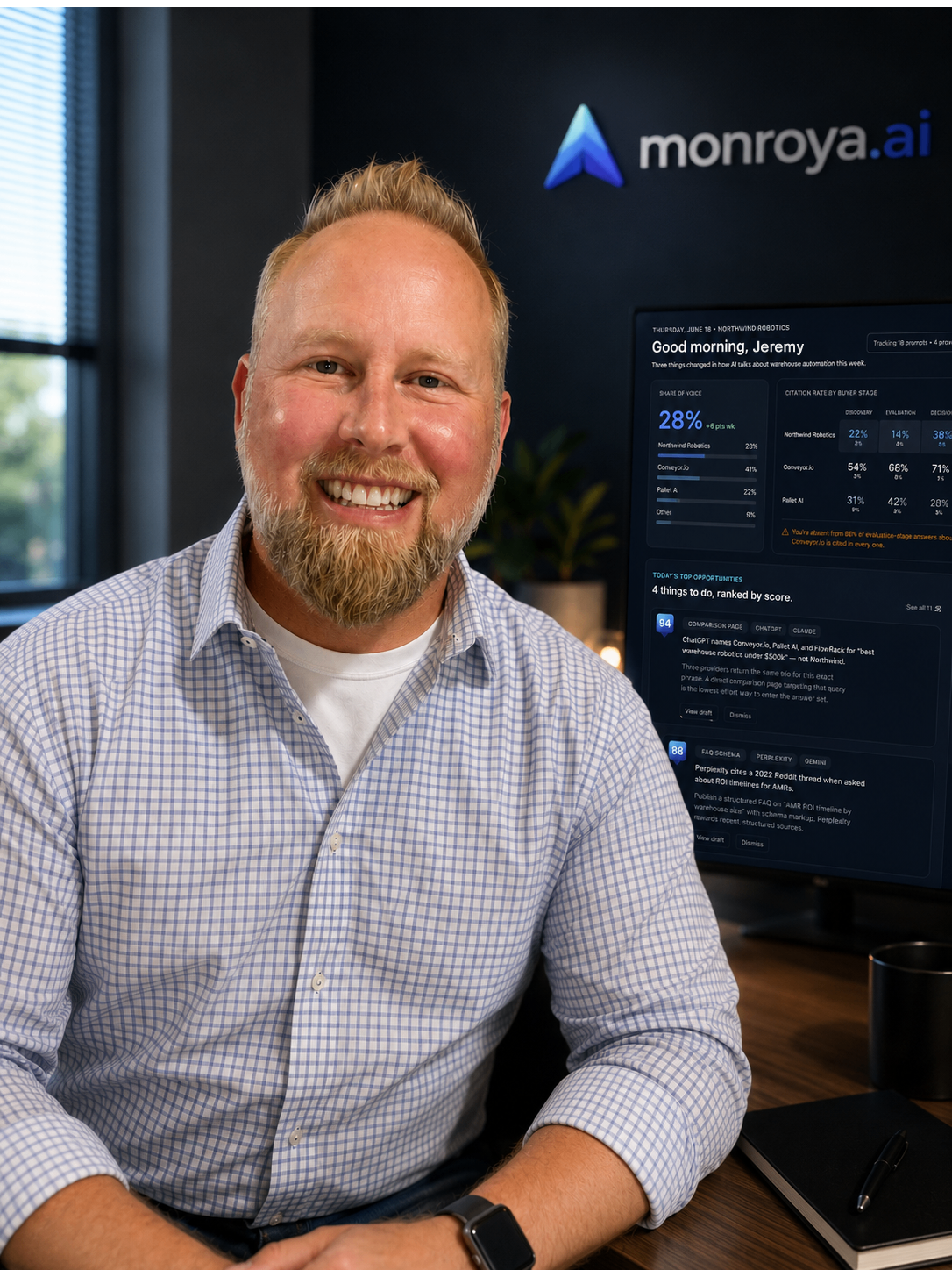
Why I started Monroya
I've spent the better part of the last 25 years in marketing. In that time I've watched nearly every major shift our industry has gone through — search engines, social media, marketing automation, the data explosion. Every change forced marketers to adapt. Nothing compares to what's happening now.
For the first time, buyers aren't just searching Google — they're asking AI. Instead of clicking through ten blue links, they're asking ChatGPT, Claude, Gemini, and Perplexity for recommendations, comparisons, and buying advice. Those systems are becoming the first impression many companies make.
The challenge is that very few businesses understand how those recommendations happen. Unlike traditional SEO, there isn't a single algorithm to optimize for. Every model cites different sources, weighs authority differently, and changes constantly. The landscape is evolving faster than most marketing teams can realistically keep up with.
I've lived through enough technology shifts to know one thing: companies that understand the change early win.
While leading marketing for a SaaS startup, one frustration never went away. We were constantly creating content, updating pages, adjusting messaging, investing in SEO and demand gen. We had analytics. We had dashboards. What we didn't have was confidence. When pipeline improved, was it the content we published three months ago? A homepage change? A comparison page? Something completely unrelated? Marketing often felt like making educated guesses, waiting weeks, and hoping we moved the needle.
Today, AI has made that blind spot even larger. Companies are asking why competitors are being recommended instead of them. Why AI mentions one brand but ignores another. Why certain sources get cited while others don't. Why one content investment produces results while another disappears into the noise. Most teams simply don't know.
That's the gap I wanted to solve. I didn't build Monroya because I wanted to build another AI company. I built it because I wanted the platform I wished I'd had throughout my marketing career — one that shows how a company is represented across the AI landscape, what's being cited, what narratives are being reinforced, where visibility is being won or lost, and what actions are most likely to improve future recommendations.
Marketing shouldn't be about guessing. It should be about understanding.
We're entering a world where AI increasingly influences what buyers discover, who they trust, and ultimately who they choose to do business with. Companies need more than rankings or traffic reports — they need intelligence about how AI is shaping perception long before a prospect ever visits their website.
That's why I started Monroya. Not because AI is the future — because it's already changing the buyer journey today, and marketers deserve better visibility into what's driving those outcomes than simply hoping their latest content worked.
— Jeremy
We're a small team. We talk to every customer.
Write to us at sales@monroya.ai — we reply. Set up takes less time than your next meeting; your first briefing arrives automatically.
What do people ask before they sign up?
- How is Monroya different from just running prompts manually in ChatGPT?
- Manual checks tell you what one model said once. Monroya runs every prompt 3× per provider across all four major AI tools, so you get a mention rate (appeared in 7 of 9 responses) not a binary yes/no. It also runs on a schedule, compares results across scans, surfaces the gap as a prioritized action, and writes the content. Manual checking doesn't scale and doesn't tell you what to do.
- How quickly will I see results after taking action?
- It depends on the action type. Schema updates and existing page improvements can show scan improvement in 2-5 days. Source inclusion pitches (getting added to an article already being cited) often show results within a week. New blog posts take a median of 6.8 days for first citation. Original research and long-form content compounds for 6-12 months. Monroya shows you the expected timeline for every opportunity before you start.
- Does Monroya replace my SEO tools?
- No — and it doesn't try to. Traditional SEO tools measure Google rankings. Monroya measures AI visibility, which is a different signal tracked differently. Overlap between Google's top results and AI-cited sources has dropped from 70% to below 20% — you can rank #1 on Google and be invisible to ChatGPT. Monroya sits alongside your SEO stack, not instead of it.
- What's the difference between a mention and a citation?
- A mention is when AI says your company name in a response. A citation is when AI includes a clickable link to your domain. Perplexity and ChatGPT Search provide links in 77%+ of responses — those links drive actual traffic. A mention builds awareness. A citation drives clicks. Monroya tracks both separately and shows them as distinct signals, because they have completely different implications for what you should do next.
- What does "the draft is already written" mean exactly?
- Every opportunity in your queue has a Draft button. Click it and receive a complete, publication-ready piece of content written specifically for the opportunity — blog post, comparison page, FAQ section, Reddit reply, schema update, press pitch, source inclusion email, or any of 25+ formats. The draft is calibrated to your buyer's journey stage, written in your brand voice (detected from your site), and formatted with the structural elements that AI tools prefer to cite: question headings, 40-60 word answer blocks, FAQ schema, inline citations. Not a template. A finished first draft.
- How does Monroya know what my competitors are doing in AI responses?
- During onboarding you add your competitors. Monroya tracks their mention rate, citation rate, and buyer journey stage presence alongside yours in every scan. The Buyer Journey matrix shows you and every competitor side by side across Discovery, Evaluation, and Decision — for all four AI providers. When a competitor appears somewhere you don't, that's an opportunity card in your queue with a specific recommended action and a draft ready to ship.
- Can I try it before paying?
- Yes — 7-day free trial with access to every Intelligence feature. Usage is capped during the trial (2 manual rescans, 10 drafts) so we keep costs sane, but you see the full product. No credit card until day 8. If you complete onboarding and run one scan you'll have enough data to know whether Monroya is the right tool before you ever see a charge. Most people know within the first 15 minutes.
Related reading
- How Monroya works— Multi-run scanning, 4 providers, persona framing
- Pricing— Starter $79 · Growth $199 · Intelligence $299 · 7-day free trial
- Compare alternatives— Monroya vs Otterly, Profound, AthenaHQ