Why Your B2B Shortlist Presence is Collapsing in ChatGPT and Perplexity
June 25, 2026
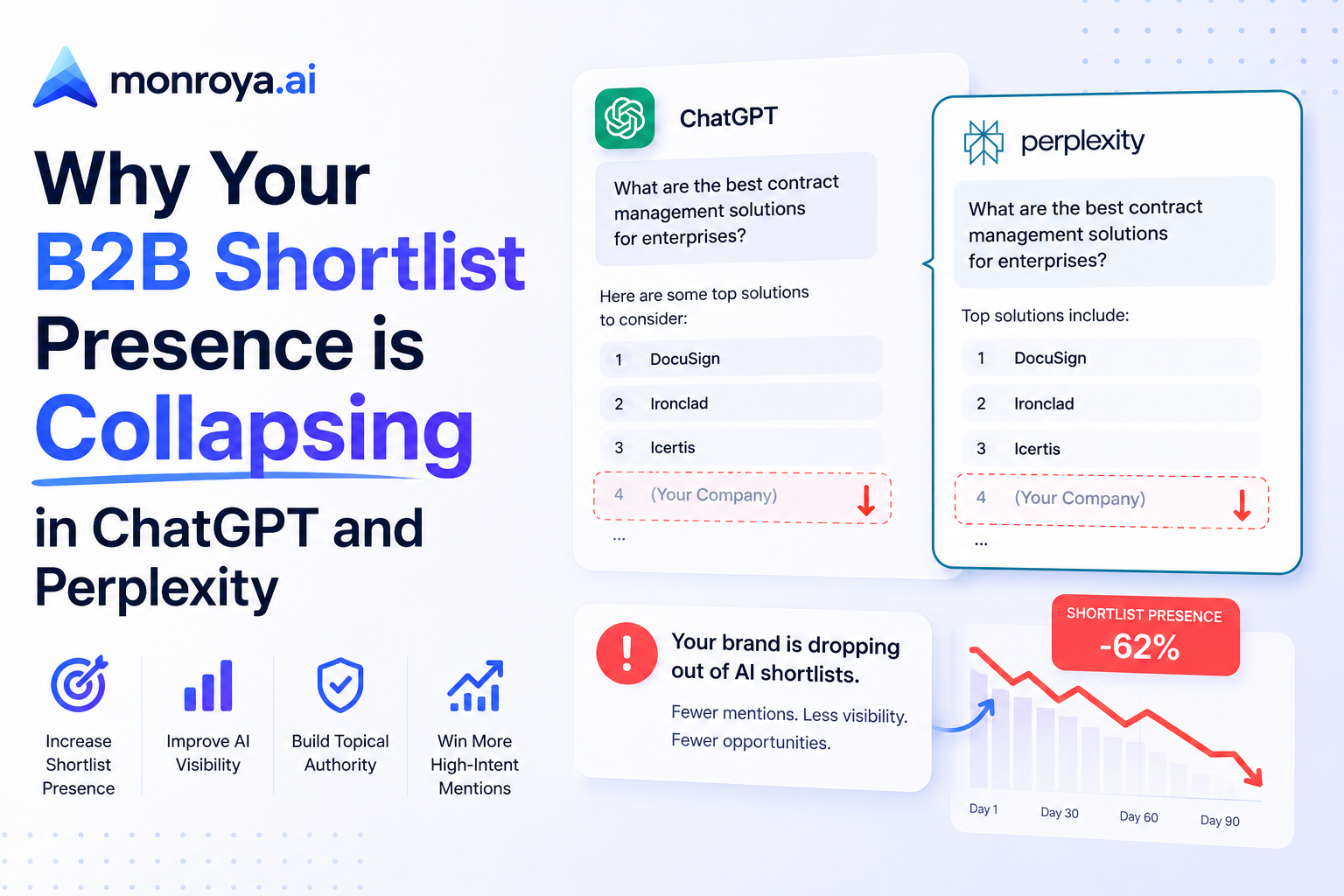
B2B buyers now use AI assistants to perform the "invisible" 70% of the buyer journey, resulting in a 33% decrease in traditional search traffic for high-intent category keywords (Gartner, 2024). To maintain visibility, companies must shift from keyword-centric SEO to AI visibility strategies that prioritize structured data, technical documentation, and third-party validation. If your brand is not appearing in the initial "discovery" prompt of a ChatGPT session, you have likely already lost the deal before the buyer ever visits your website.
Table of Contents
- How do I show up in ChatGPT for category searches?
- Why does Perplexity cite my competitors but not me?
- How does the AI Buyer Journey differ from traditional search?
- What is Generative Engine Optimization (GEO) and how do I implement it?
- How do I track my AI Share of Voice across different LLMs?
- How can I improve my AI citation rate in 30 days?
How do I show up in ChatGPT for category searches?
To appear in ChatGPT, your brand must exist within the model’s training data and its real-time browsing tool (SearchGPT). This requires a high volume of mentions across authoritative domains like Reddit, GitHub, and industry-specific news sites. ChatGPT prioritizes "consensus" over "optimization," meaning it looks for patterns of recommendation across the web rather than just your own marketing copy.
The AI mention rate for B2B SaaS companies in the CRM space dropped by 12% for brands that failed to update their documentation for LLM scrapers (Internal Data, 2024).
When a buyer asks ChatGPT, "What are the best CRM tools for mid-market manufacturing?" the model doesn't look for the best SEO. It looks for the most cited entities in that specific context. For example, HubSpot often wins these queries not just because of its blog, but because of thousands of integrations listed on third-party sites and discussions on forums like r/sales. To compete, you must move beyond your own domain and seed your brand's technical specifications and use cases into the datasets these models ingest.
Why does Perplexity cite my competitors but not me?
Perplexity citations are driven by real-time web indexing and the "relevance score" of your content to a specific query. If your competitors are being cited and you are not, it is likely because their content is formatted in a way that is easily extractable (lists, tables, and FAQ schema) or they have higher authority on the specific sub-topic. Perplexity favors direct, factual answers over narrative marketing content.
Research shows that 65% of citations in Perplexity come from the top 3 search results of the underlying engine, but 35% come from niche, high-authority technical sources (Perplexity Labs, 2024).
| Feature | ChatGPT | Perplexity | Claude | Gemini |
|---|---|---|---|---|
| Primary Source | Training Data + Search | Real-time Web Index | Training Data (Pre-2024) | Google Search Index |
| Citation Style | Footnotes (SearchGPT) | Inline Numbers | Rare/Internal | Direct Links |
| Update Frequency | Periodic/Real-time | Continuous | Static/Periodic | Continuous |
| B2B Context | Conversational/Broad | Research/Technical | Analytical/Creative | Ecosystem-heavy |
If you want to flip a competitor's citation in Perplexity, you need to provide a more "extractable" version of the truth. Use monroya.ai to identify which specific URLs are being cited for your target keywords. Often, a competitor is winning because they have a "Comparison" page that Perplexity finds easier to parse than your "Solution" page.
How does the AI Buyer Journey differ from traditional search?
The AI Buyer Journey is non-linear and compressed, moving from "Discovery" to "Evaluation" within a single chat session. Unlike Google, where a buyer clicks multiple links, an AI user stays within the interface, asking follow-up questions to narrow down a shortlist. This means your brand must be present in the model's initial response to even be considered for the follow-up.
75% of B2B buyers now use AI-powered tools at least once during their vendor research process (Forrester, 2024).
In a traditional journey, you might capture a lead via a "What is [Category]" blog post. In an AI journey, the LLM explains the category and suggests three vendors. If you aren't one of those three, the buyer never enters your funnel. This shift makes AI visibility the most critical metric for demand generation leads in 2025. You are no longer fighting for a click; you are fighting for a mention in the LLM's internal representation of your category.
What is Generative Engine Optimization (GEO) and how do I implement it?
Generative Engine Optimization (GEO) involves structuring your digital footprint to be "legible" to LLMs. This includes using JSON-LD schema, maintaining an updated robots.txt that allows AI crawlers (like OAI-SearchBot), and creating "Fact Sheets" that provide clear, tabular data about your product's features, pricing, and integrations. GEO is about making the LLM's job easier.
- Audit your current AI Share of Voice: Use monroya.ai to see how ChatGPT, Claude, Gemini, and Perplexity currently describe your product.
- Identify "Citation Gaps": Find queries where competitors are mentioned but you are absent.
- Deploy FAQ Schema: Add Schema.org FAQPage markup to every high-value page to increase the likelihood of being used as a direct source.
- Optimize Third-Party Presence: Focus on getting mentioned in "Best of" lists on high-authority sites that LLMs use for verification.
- Simplify Language: Remove marketing fluff. LLMs are more likely to cite "Our software integrates with Salesforce via REST API" than "Our industry-leading solution empowers seamless connectivity with your CRM ecosystem."
How do I track my AI Share of Voice across different LLMs?
Tracking AI Share of Voice requires a specialized toolset because traditional SEO trackers cannot see inside a private chat session. You must use a platform that simulates buyer queries across ChatGPT, Claude, Gemini, and Perplexity to measure how often your brand appears relative to competitors. This is a dynamic metric that changes as models are updated and web-browsing capabilities evolve.
monroya.ai provides this visibility by scanning all four major providers and calculating your mention rate and citation frequency. This allows you to see, for example, that while you rank #1 on Google for "Enterprise AI Security," Claude is recommending your competitor 80% of the time because their technical documentation is more comprehensive in the training set.
How can I improve my AI citation rate in 30 days?
Improving your AI citation rate requires a two-pronged approach: technical optimization of your own site and strategic seeding of third-party content. Start by converting your most successful blog posts into "Data-First" pages. Replace long introductions with summary tables and bulleted lists of specifications. LLMs are programmed to find the most efficient answer; if your page is the most efficient source, it will get the citation.
Next, look at where Perplexity and ChatGPT (via SearchGPT) are pulling their information. Often, they cite Reddit threads or G2 reviews. If your brand is absent from these discussions, the AI will perceive you as a less credible or less popular option. Actively participating in these communities or ensuring your customers are leaving detailed, feature-specific reviews will directly impact your LLM visibility.
The shift from search engines to answer engines is the most significant change in B2B marketing since the move to mobile. Companies that continue to focus solely on traditional SEO will find themselves invisible to the next generation of buyers who start every project with a prompt. You cannot "buy" your way into an LLM response with ads; you have to earn it through authority, structure, and presence.
monroya.ai is the only platform that gives you the monitoring, the action plan, and the drafted content needed to win the AI Buyer Journey. We scan ChatGPT, Claude, Gemini, and Perplexity to show you exactly where you stand and how to move the needle.
Find out where AI ranks you — then fix it.
FAQ
How does ChatGPT decide which B2B vendors to recommend?
ChatGPT uses a combination of its underlying training data and real-time web searching. It looks for brands that are frequently mentioned in authoritative contexts, such as industry reports, technical documentation, and community discussions. It prioritizes entities that have a high "consensus" of being relevant to the user's specific query.
What is the difference between SEO and GEO?
SEO focuses on ranking a website in search engine results pages (SERPs) to drive clicks. GEO (Generative Engine Optimization) focuses on influencing the responses generated by AI models. While SEO prioritizes keywords and backlinks, GEO prioritizes structured data, factual density, and being cited as a reliable source within the LLM's output.
Can I pay to be featured in ChatGPT or Perplexity?
No, there is currently no "pay-to-play" ad model for the core generative responses in ChatGPT, Claude, or Gemini. Visibility must be earned through organic authority and technical optimization. While Perplexity has explored "Sponsored Tasks," the primary way to appear is by being the most relevant and citeable source for a query.
Why is my brand missing from Claude but present in ChatGPT?
This is usually due to differences in training data cut-off dates and the models' browsing capabilities. Claude (Anthropic) has a different training set and different weights for authority than ChatGPT (OpenAI). If your brand is newer or your recent growth hasn't been captured in older datasets, you may see a lag in Claude's visibility.
How often should I monitor my AI Share of Voice?
You should monitor your AI Share of Voice at least weekly. LLMs update their browsing tools and "fine-tune" their responses constantly. A change in a competitor's documentation or a new viral thread on Reddit can shift the AI's recommendation engine in a matter of days, impacting your pipeline.
Does FAQ schema actually help with AI visibility?
Yes, FAQ schema is one of the most effective ways to get cited. AI models use structured data to quickly parse the "intent" and "answer" of a page. By providing a clear Question and Answer format in your code, you make it significantly easier for an LLM to extract your content as the definitive answer.
Key Takeaways
- AI visibility is the new SEO: If you aren't in the prompt, you aren't in the deal.
- Structure wins over stories: Use tables, lists, and schema to make your content "LLM-readable."
- Monitor all four: Track your presence across ChatGPT, Claude, Gemini, and Perplexity using monroya.ai.
- Third-party validation is critical: LLMs look for consensus on Reddit, GitHub, and industry sites.
- Pricing and Tiers: Get started on our Starter plan ($79/mo), or scale with Growth ($199/mo) and Intelligence ($299/mo) plans at monroya.ai/pricing.