What is Share of Model?
By Jeremy Unruh, Founder, Monroya · Published July 7, 2026 · Reviewed October 2026
Want this for your company? See how AI assistants answer about your site.
Run the free check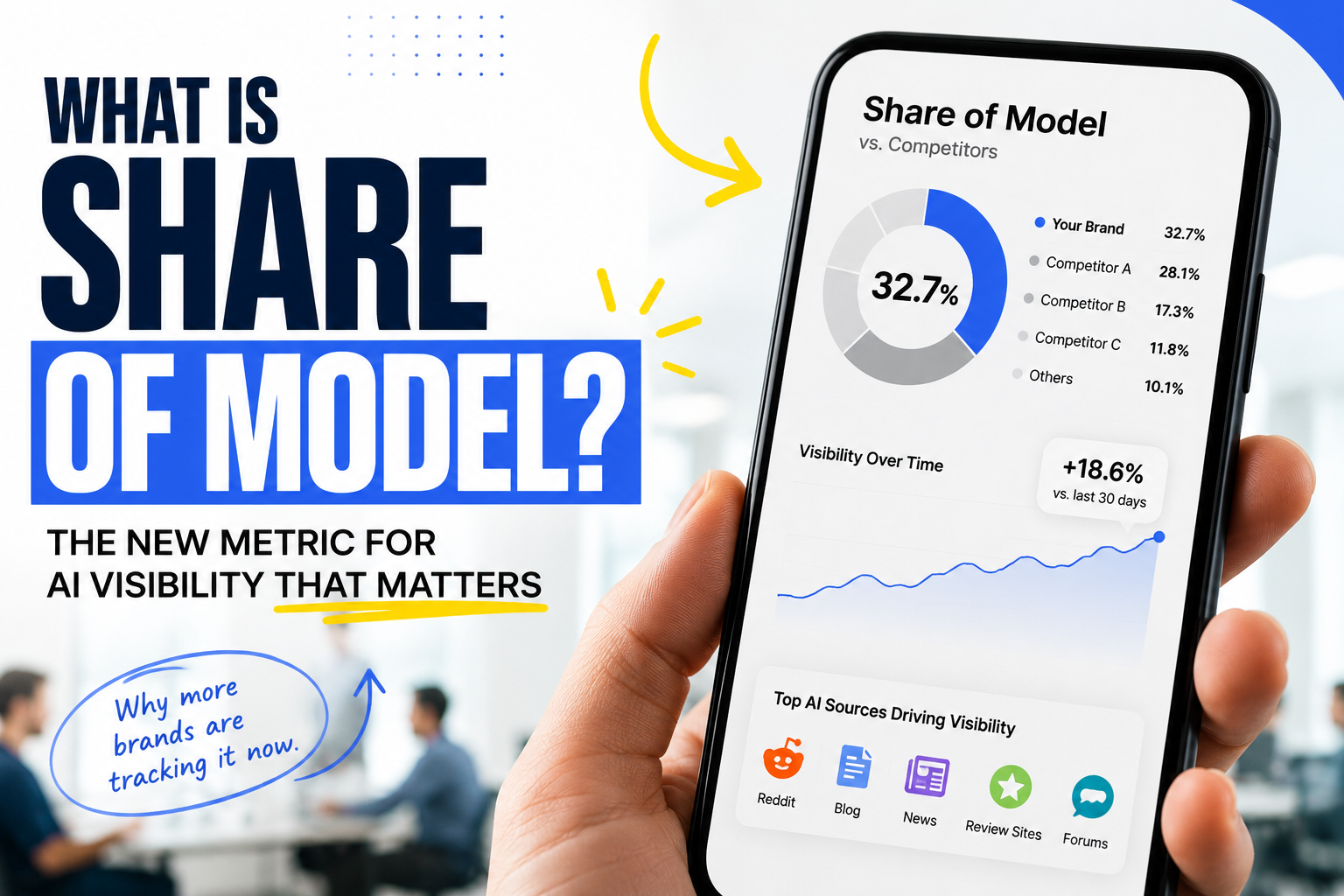
Share of Model is a metric that quantifies the frequency and sentiment with which a specific brand or product is mentioned by Large Language Models (LLMs) relative to its competitors within a defined category. Unlike traditional search metrics that track clicks or impressions, Share of Model measures the probability of an LLM recommending your solution when a user asks for a category-specific recommendation or comparison.
A closely related measure is AI share of voice: how often your brand is named compared with competitors across AI answers.
Table of Contents
- How do I calculate Share of Model?
- Why does Share of Model differ from Share of Voice?
- How do LLMs decide which brands to include in their training weights?
- Is Share of Model more important than organic search rankings?
- How can I increase my Share of Model in 30 days?
- FAQ
How do I calculate Share of Model?
To calculate Share of Model, you must aggregate the total number of brand mentions across a statistically significant sample of prompts (Discovery, Evaluation, and Decision) and divide your brand's mentions by the total mentions of all competitors in that set. This requires querying ChatGPT, Claude, Gemini, and Perplexity repeatedly to account for stochastic variance in their responses.
A growing number of B2B researchers use LLMs to narrow down their initial list of vendors before visiting a single corporate website.
Measuring this requires more than a single prompt. Because LLMs are probabilistic, not deterministic, a brand might appear in 4 out of 10 responses for the same query. Your Share of Model is the average presence across those iterations. If you are mentioned 40 times across 100 queries in a category with 200 total mentions, your Share of Model is 20%.
| Metric | Traditional SEO | Share of Model |
|---|---|---|
| Primary Goal | Rank for specific keywords | Increase probability of brand recommendation |
| Data Source | Search Engine Results Pages (SERP) | LLM latent space and training data |
| User Intent | Information retrieval (clicks) | Synthesis and decision support |
| Measurement | Position 1-10 | Percentage of total category mentions |
| Optimization | Backlinks and technical SEO | Semantic proximity and authoritative data sources |
Why does Share of Model differ from Share of Voice?
Share of Voice measures your brand's presence in the visible market—social media, paid ads, and PR—while Share of Model measures your brand's presence within the "black box" of an LLM's neural network. Share of Voice is about reach and frequency in the physical world; Share of Model is about the mathematical weight assigned to your brand during the model's pre-training and fine-tuning phases.
Companies with a high Share of Model often see higher conversion rates from lead to opportunity because the prospect has already been "pre-sold" by the LLM.
Traditional Share of Voice can be bought through high ad spend. Share of Model must be earned through high-density information environments. If your brand is discussed extensively on Reddit, GitHub, and in technical documentation, but you have zero ad spend, your Share of Model could still dwarf a competitor with a multi-million dollar marketing budget. monroya.ai tracks this divergence to show where your brand is winning the "mental model" of the AI.
How do LLMs decide which brands to include in their training weights?
LLMs prioritize brands that appear in "high-trust" clusters, such as peer review sites, technical forums, and authoritative industry publications, rather than corporate blogs. The model’s attention mechanism assigns higher weights to entities that are frequently associated with specific problem-solving contexts across diverse, non-promotional datasets.
A significant portion of the data used to train major LLMs comes from sources like Common Crawl, which prioritize educational and community-driven content over commercial landing pages.
For example, if a developer on Stack Overflow mentions using a specific API to solve a complex integration problem, that mention carries more weight for an LLM than a "Top 10" listicle on a marketing site. To influence this, you must shift focus from keyword density to entity association. Your brand needs to be semantically "close" to the problems your customers are trying to solve within the training data.
Is Share of Model more important than organic search rankings?
Share of Model is becoming a lead indicator for future revenue, as organic search traffic faces potential declines due to AI-integrated search. While organic rankings drive immediate traffic, Share of Model drives brand preference in the zero-click environment where the AI provides the answer directly to the user.
If a user asks, "Which CRM is best for mid-market manufacturing?" and the AI lists three competitors but omits you, your #1 Google ranking for "manufacturing CRM" is irrelevant. The user has already received a synthesized answer. monroya.ai helps teams identify these "omission gaps" where they rank in search but are invisible in the generative response.
How can I increase my Share of Model in 30 days?
To increase Share of Model, you must flood high-authority, third-party environments with structured and unstructured data that links your brand to specific use cases. This includes updating FAQ schema, engaging in high-traffic Reddit threads, and ensuring your documentation is crawlable and formatted for easy ingestion by LLM scrapers.
- Audit current standing: Use monroya.ai to run a baseline report across ChatGPT, Claude, Gemini, and Perplexity.
- Identify "Source Gaps": Look at which sites the LLMs are citing for your competitors and ensure your brand is represented there.
- Optimize Documentation: Convert "how-to" guides into clear, structured Markdown that LLMs can easily parse.
- Community Seeding: Increase brand mentions in non-commercial environments like Reddit and niche industry forums.
- Schema Implementation: Deploy advanced FAQ and Product schema to provide "explicit" facts to the model.
By focusing on these high-signal areas, you move the needle on how the model perceives your brand's relevance. Understanding your position is the first step toward dominance in the generative era. Check out the monroya.ai/pricing page to see which tier fits your team's needs for tracking these shifts in real-time.
The transition from traditional search to generative synthesis is not a trend; it is a fundamental shift in how information is brokered. If you are not measuring your Share of Model, you are effectively flying blind in the most important discovery channel of the decade.
Find out where AI ranks you — then fix it.
FAQ
What is the difference between Share of Model and GEO?
Share of Model is the metric used to measure your brand's presence within an LLM's output. Generative Engine Optimization (GEO) is the tactical process of improving that metric. Think of Share of Model as the scoreboard and GEO as the playbook you use to score points.
Can I buy a higher Share of Model?
No, you cannot directly pay OpenAI or Anthropic to increase your brand's prominence. Unlike Google Ads, Share of Model is earned through the quality and ubiquity of your data in the model's training set and its real-time search capabilities. It requires a long-term content and authority strategy.
How often does Share of Model change?
Share of Model fluctuates based on model updates (like a move from GPT-4 to GPT-5) and the integration of real-time search data. For tools like Perplexity and ChatGPT with Search, your Share of Model can change daily as new web content is indexed and synthesized into answers.
Why is my Share of Model lower than my SEO market share?
This usually happens because your content is optimized for search engines (keywords and backlinks) rather than for LLMs (semantic meaning and structured data). If your brand is mentioned frequently on your own site but rarely on third-party forums or in technical documentation, LLMs will perceive you as less authoritative.
Does Share of Model affect B2B sales cycles?
Yes, significantly. B2B buyers use LLMs to conduct "anonymous" research. A high Share of Model ensures your brand is included in the initial vendor shortlist generated by the AI. If you are excluded at this stage, you may never even know the prospect was in-market.
Which LLMs should I track for Share of Model?
You should track the four primary providers that dominate the market: ChatGPT, Claude, Gemini, and Perplexity. Each uses different training data and retrieval methods, meaning your Share of Model will likely vary across each platform, requiring a diversified optimization strategy.
Check your own AI visibility
Run a free AI visibility check at monroya.ai/check — no signup, no credit card. You will see how ChatGPT, Claude, Gemini, and Perplexity describe your category and whether your brand gets named.
Monroya starts at $79/mo (Starter), with Growth at $199/mo and Intelligence at $299/mo. Every plan includes a 7-day free trial.
Related reading
For B2B companies: Win the shortlist when buyers ask AI to compare vendors.