Why use AI search competitor analysis tools
By Jeremy Unruh, Founder, Monroya · Published June 29, 2026 · Reviewed September 2026
Want this for your company? See how AI assistants answer about your site.
Run the free check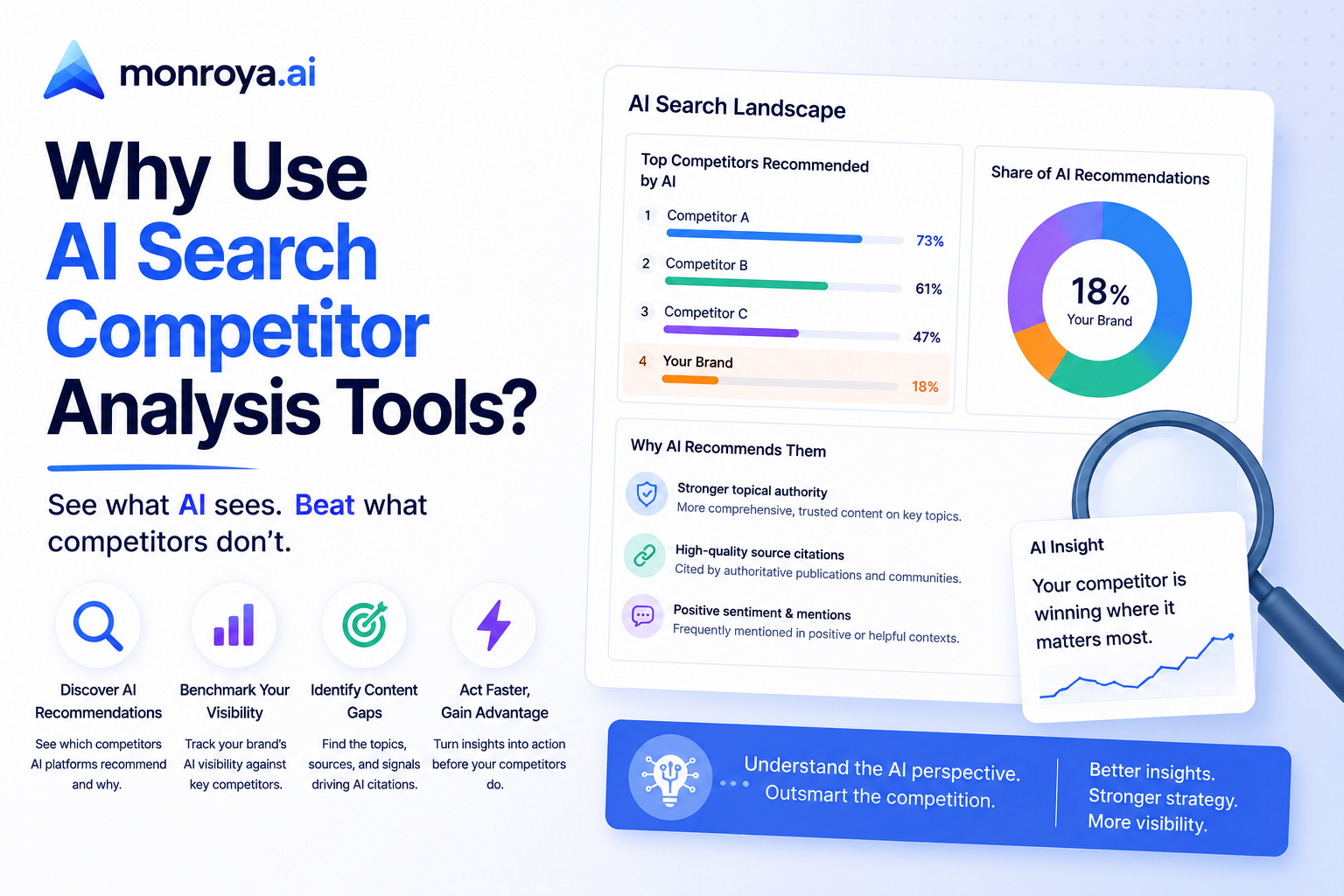
Buyers are asking AI assistants the questions they used to type into Google. "Best CRM for a 20-person sales team." "Alternatives to HubSpot for agencies." "Which AI visibility tool actually generates the fix." The answer that comes back — a four-name shortlist with reasoning — is the new search result. If your company is not in it, the buyer never types your URL.
This is the gap AI search competitor analysis tools exist to close. They tell you which prompts your buyers are running, who shows up in the answer, and what you can do about it. This guide explains what those tools actually do, when you need one, how they differ from legacy SEO and brand-monitoring software, and what to look for when you evaluate.
What an AI search competitor analysis tool does
Three jobs, in this order.
1. It runs the prompts your buyers are running. A real tool does not crawl Google. It queries ChatGPT, Claude, Gemini, and Perplexity directly through their APIs with the prompts your category gets asked — "best X for Y," "alternatives to Z," "who should I consider for ___." Each prompt runs across providers, multiple times, because LLM responses vary run to run. A single screenshot from one ChatGPT session is not data; a stable distribution across 50 to 500 prompts × 4 providers × repeated runs is.
2. It extracts who got cited. From the model's answer text, it pulls the named companies, products, and sources. That gives you three measurements per competitor: how often they appeared at all (mention rate), at which stage of the buyer journey they showed up (discovery vs evaluation vs decision), and which prompts surfaced them but not you (the gaps).
3. It tells you what to change. This is where most tools stop short. A dashboard that says "you are cited 12% of the time, your competitor is at 47%" is a leaderboard, not a tool. The useful version maps the gap to a specific fix — a page that needs rewriting, a comparison page that does not exist yet, a third-party listicle you should pitch — and ranks those fixes by impact, effort, and confidence. Some tools also draft the asset inline.
Why legacy SEO competitor tools are not enough
Ahrefs, Semrush, and SimilarWeb are excellent tools. They are also entirely about Google.
Google rankings and AI visibility correlate weakly. A page ranked #3 for "best CRM" might never appear in ChatGPT's answer to the same question — because ChatGPT is not reading the SERP, it is composing an answer from training data, retrieval, and tool calls. Conversely, a page that ranks #18 on Google can be the one ChatGPT cites, because the model latched onto a clear comparison table or a structured FAQ that the SERP buried.
If you want to know what AI assistants are saying about your category, the only signal that matters is what AI assistants are actually saying. That data does not live in Search Console, Semrush, or your analytics. It lives in the API responses of OpenAI, Anthropic, Google, and Perplexity, sampled at scale.
The category name for this discipline is GEO (Generative Engine Optimization) or AEO (Answer Engine Optimization). The tools that do it are a new category, not an SEO add-on. Treat them that way.
When you actually need one
Not every team needs an AI visibility tool yet. The honest answer:
You need one if your buyers are senior or technical. VP-level buyers, engineers, and operators are early adopters of ChatGPT and Perplexity for shortlist research. If your ICP is a 22-year-old buying sneakers, AI search is still a small fraction of intent. If your ICP is a Head of RevOps evaluating ten vendors, AI search is already a meaningful share of the consideration set.
You need one if your category is consultative. "Best X for Y" research happens in any category where the buyer can not just compare specs. CRMs, observability platforms, marketing tools, agencies, professional services, B2B SaaS — these are the categories where the AI's shortlist is the new shortlist.
You probably do not need one yet if you are a local services business without national reach, or if your buyers are walking into a store. Watch the space, do not invest yet.
You definitely need one if you are publishing content and not measuring AI lift. If your team is writing comparison pages, case studies, and category content, you are already paying for the input. Measuring whether any of it is changing AI citations turns a content cost center into a tracked initiative.
How AI search competitor analysis tools differ from each other
Five real axes of difference. Skip the marketing pages and ask each vendor these:
1. How many providers, and which ones. Most tools cover ChatGPT (OpenAI) and Perplexity. Some add Claude and Gemini. A few claim ten or more "Answer Engines" — be skeptical; the only ones with measurable buyer share in 2026 are ChatGPT, Claude, Gemini, and Perplexity. Coverage of niche engines is a marketing line, not a buying criterion.
2. How they handle variance. A single run of a single prompt against a single provider is noise. A real tool runs each prompt multiple times, across providers, on a schedule, and tracks the distribution. If a vendor cannot answer "how many runs per prompt, how often" with a number, it is a screenshot tool dressed up as analytics.
3. Per-page vs per-prompt vs per-stage view. The same scan data can be sliced three ways. Per-prompt is what most tools default to ("you appear in 12 of 50 prompts"). Per-page lets you see which of your URLs is doing the work. Per-stage — discovery, evaluation, decision — is the most useful for action, because it tells you whether you are losing the buyer at "who should I consider" or at "which one should I pick." Tools that only ship the per-prompt view leave you to do the synthesis.
4. Action vs dashboard. Once a gap is identified, what does the tool give you? A red bar, a recommendation paragraph, or a drafted asset? The cost of the tool is the same regardless. The cost of acting on it — your time turning a gap into a published page — is what determines whether the tool moves a number.
5. Self-serve vs sales-led. Enterprise platforms in this category gate access through demos and annual contracts. That is fine for global brands running coordinated AEO programs. It is wrong for an operator who wants to start measuring this quarter. If you can not sign up, run a scan, and see your first opportunity in under an hour, the tool is built for a different buyer than you.
The questions that actually separate vendors
Ask these in your evaluation call or trial:
- Can I see the raw API responses, or only your summary of them?
- How many runs per prompt per provider per week is included in my plan?
- What is the gap between "you found a problem" and "I shipped a fix"? Walk me through the workflow.
- Show me a screenshot of how a non-technical operator at my company would use this on a Tuesday morning.
- What happens when ChatGPT changes its citation behavior in three months? Does my historical data still mean something?
- Can I export everything? If we churn, do we walk away with the data?
Vendors that struggle with question 3 are leaderboard tools. Vendors that struggle with question 6 are trying to lock you in.
What this costs
The market has settled into a fairly clear range. Self-serve operator plans run $100 to $400 per month. Mid-market plans with more prompts, more providers, and a few seats run $500 to $2,000 per month. Enterprise plans with SSO, SOC 2, dedicated support, and unlimited everything are annual contracts in the $30k to $150k range. Most operators do not need the enterprise tier; most enterprises do not get good value from the operator tier.
The ROI math is easier than for legacy SEO. If a single comparison page closing a single high-volume gap delivers one or two deals you would not otherwise have closed, the tool has paid for two years. The challenge is rarely value; it is whether your team has the discipline to act on the recommendation.
How to evaluate in one week
You do not need a 60-day procurement cycle to pick one of these. Run this:
Day 1. Sign up for two tools, free trial or starter plan. Both should let you connect a domain and run a scan inside an hour. If they can not, drop them.
Day 2. Read the first findings. The questions to answer: do the prompts look like what your buyers would actually ask? Are the competitors named the ones you actually lose to?
Day 3. Pick one opportunity from each tool. Ship the fix. Note how much work the tool did for you vs. how much it left on your plate.
Day 4 to 7. Re-scan. Did the number move? Did either tool tell you why?
The tool that wins this test is the one you should buy. Not the one with the best demo.
How Monroya fits
Monroya is built for the operator side of this market. Self-serve with a 7-day trial, four providers covered deeply, a per-stage buyer-journey matrix as the home screen, and drafts generated inline with each opportunity. We do not claim more providers than we track well, and we do not require a sales call. If your shortlist includes any of the enterprise platforms above, we have a comparison hub that goes head-to-head on the questions that actually matter.
If you would rather just see what this looks like for your own domain, start a trial — your first scan finishes in about 15 minutes and the first opportunity is in front of you before the welcome email arrives.
Check your own AI visibility
Run a free AI visibility check at monroya.ai/check — no signup, no credit card. You will see how ChatGPT, Claude, Gemini, and Perplexity describe your category and whether your brand gets named.
Monroya starts at $79/mo (Starter), with Growth at $199/mo and Intelligence at $299/mo. Every plan includes a 7-day free trial.
FAQ
What do AI search competitor analysis tools do?
They show which prompts your buyers run, who gets named in the answers, and which sources those answers cite, so you can see where you are losing the shortlist.
When do I need one?
When buyers reach a shortlist before they visit your site, and your analytics cannot tell you who was named in the answers that produced it.
How should I evaluate one?
Check that prompts are run repeatedly per assistant, that cited sources are shown, that results are split by buying stage, and that you can re-check after a change.
Related reading
For B2B companies: Win the shortlist when buyers ask AI to compare vendors.