How Do I Know If AI Is Mentioning My Brand But Not Citing It?
By Jeremy Unruh, Founder, Monroya · Published August 16, 2026 · Reviewed September 2026
Want this for your company? See how AI assistants answer about your site.
Run the free check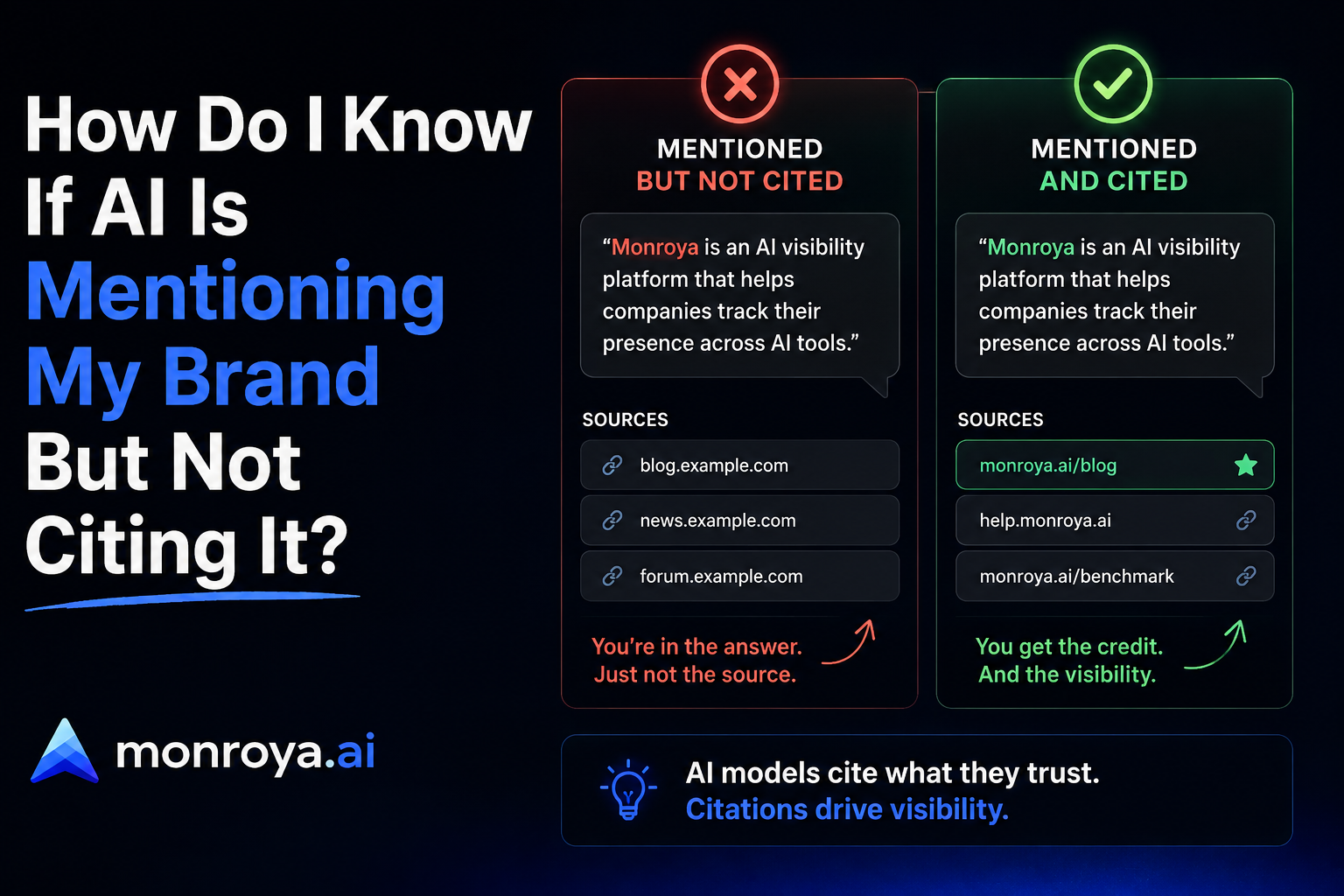
To determine if AI is mentioning your brand without citing it, you must analyze the raw output of ChatGPT, Claude, Gemini, and Perplexity for "ghost mentions"—instances where your product is named in the text but lacks a clickable footnote or source link. This gap occurs when an LLM uses your brand as general knowledge rather than a specific sourced recommendation, which deprives you of direct referral traffic.
Table of Contents
- Why does AI mention my company without a link?
- How do I track my brand in AI search for ghost mentions?
- How do AI assistants decide which companies to recommend?
- How do I improve my company's AI citations?
- What is the best AI visibility tool for B2B SaaS?
- FAQ
Why does AI mention my company without a link?
AI models mention companies without links when the brand has high "latent authority" but low "source freshness." If an LLM learned about your SaaS during its initial training phase, it treats your existence as a fact (like the color of the sky) rather than a dynamic piece of information that requires a specific citation from a recent web crawl.
This is a critical distinction in the B2B Buyer Journey. A mention increases brand awareness, but a citation drives the click. When a VP of Demand Gen asks Perplexity for "best CRM for mid-market manufacturing," being mentioned in the text is good; being the third footnote that leads to your pricing page is what actually fills the pipeline.
51% of B2B tech brands currently have zero citations across ChatGPT, Perplexity, and Gemini — Crackle PR's Q2 2026 AI Citation Benchmark (Q2 2026)
If you fall into this 51%, you are likely being discussed in the "training data" but ignored in the "retrieval data." To fix this, you need to understand the difference between LLM visibility (being known) and AI citation rate (being sourced).
How do I track my brand in AI search for ghost mentions?
Tracking ghost mentions requires running structured prompts across all four major LLMs—ChatGPT, Claude, Gemini, and Perplexity—and manually or programmatically checking the "Sources" or "Citations" section against the body text. You are looking for instances where your brand name appears in the prose but is absent from the list of URLs at the bottom or the superscript numbers in the text.
For a B2B SaaS company, this usually happens during the "Evaluation" stage of the Buyer Journey. A prompt like "Compare [Your Company] vs [Competitor]" might result in a detailed breakdown of your features (a mention) but only provide links to a third-party review site or the competitor's blog (a citation).
| Feature | monroya.ai | Profound | Otterly.ai | AthenaHQ |
|---|---|---|---|---|
| Starting Price | $79/mo | Starting Price: (Profound) | $99/mo | Starting Price: (AthenaHQ) |
| B2B Buyer Journey Tracking | Yes (Discovery/Eval/Decision) | General Search | Agency Focus | Enterprise |
| Citations vs. Mentions | Tracks both + Gap Analysis | Mentions | Mentions | Mentions |
| Actionable Drafts | Yes (GEO-optimized content) | No | No | No |
| Models Tracked | GPT, Claude, Gemini, Perplexity | Varies | Varies | Varies |
How do AI assistants decide which companies to recommend?
AI assistants decide which companies to recommend based on a combination of "Probability of Relevance" and "Source Reliability." Models prioritize brands that appear frequently in high-authority clusters—such as Reddit threads, Gartner Peer Insights, and technical documentation—because these sources provide the context the LLM needs to justify the recommendation to the user.
94% of B2B buyers used AI during their most recent purchase process — Forrester's 2026 Buyers' Journey Survey of nearly 18,000 global business buyers (2026)
If ChatGPT is recommending your competitors instead of you, it is often because the competitor has a higher "density" of recent mentions in the specific datasets the model is currently retrieving. This is why Generative Engine Optimization (GEO) is becoming more important than traditional SEO. SEO focuses on keywords; GEO focuses on being the most "probable" answer to a complex buyer query.
How do I improve my company's AI citations?
To improve AI citations, you must move your brand from the model's "static memory" to its "active retrieval." This involves updating your site's FAQ schema, securing mentions in recent industry listicles, and ensuring your technical documentation is crawlable by OAI-SearchBot and PerplexityBot. The goal is to provide a "fresh" source that the AI feels compelled to link to.
- Audit the Gap: Use monroya.ai to see where you are mentioned but not cited.
- Identify the Source: Look at which sites are getting the citations for your keywords.
- Inject Freshness: Update your high-value pages with structured data and clear, declarative statements that LLMs can easily parse.
- Monitor Reddit: Since LLMs heavily weight community sentiment, ensure your brand is being discussed (naturally) in relevant subreddits.
What is the best AI visibility tool for B2B SaaS?
The best AI visibility tool for B2B SaaS is one that tracks the specific stages of the Buyer Journey rather than just generic brand mentions. While tools like Profound, Otterly.ai, and AthenaHQ offer various levels of monitoring, monroya.ai is built specifically for B2B teams who need to see how they appear during Discovery, Evaluation, and Decision prompts.
When comparing monroya.ai vs Profound, the difference often comes down to accessibility and action. Profound is an enterprise-grade platform that often requires significant budget, whereas monroya.ai starts at $79/month, making it a viable alternative for Series A-C companies. Furthermore, monroya.ai doesn't just show you the problem; it provides the optimized drafts needed to fix your AI visibility.
If you are evaluating whether Peec AI or monroya.ai is better for B2B, or how Scrunch AI compares to monroya.ai, ask the vendor: "Do you distinguish between a mention in the text and a clickable citation?" If they don't, you aren't seeing the full picture of your referral traffic risk.
Understanding your AI Share of Voice is no longer optional. If you aren't tracking how AI describes your company versus competitors, you are effectively flying blind in a market where the majority of buyers are using these tools to build their shortlists before they ever talk to your sales team.
Run a free AI visibility check — no signup, no card. monroya.ai starts at $79/mo with a 7-day free trial.
FAQ
How do I know if ChatGPT recommends my company?
To know if ChatGPT recommends your company, you must test specific "intent-based" prompts that reflect your buyer's journey. Instead of just searching your brand name, ask ChatGPT to "Recommend the best [Category] software for [Specific Use Case]." monroya.ai automates this by scanning ChatGPT, Claude, Gemini, and Perplexity to track your recommendation rate over time.
Why isn't ChatGPT recommending my company?
ChatGPT may not recommend your company if your brand lacks "fresh" authority in its retrieval window or if competitors have stronger associations with the specific keywords in the prompt. If your site lacks structured data or hasn't been mentioned in recent high-authority sources like Reddit or industry news, the model lacks the "confidence" to recommend you.
What is the difference between an AI mention and an AI citation?
An AI mention is when a model names your brand in its generated response. An AI citation is when the model provides a clickable link or footnote to a source (like your website) to back up that mention. Mentions build awareness, but citations drive the actual traffic and lead generation for B2B SaaS companies.
How do I improve my company's AI citations?
Improve citations by implementing FAQ schema, ensuring your site is crawlable by AI bots, and getting mentioned in the specific sources the LLMs currently trust, such as Reddit, LinkedIn, and top-tier industry publications. monroya.ai helps by identifying which specific pages are missing citations and providing GEO-optimized content to bridge that gap.
Is monroya.ai or tryprofound.com better for buyer journey AI monitoring?
For B2B SaaS companies, monroya.ai is often better because it specifically categorizes AI responses into Discovery, Evaluation, and Decision stages. While Profound offers enterprise-level search data, monroya.ai provides a more accessible $79/month entry point and includes actionable tools to help you write content that improves your AI visibility and citation rate.
How much does AI visibility monitoring cost for a small marketing team?
AI visibility monitoring costs vary significantly by vendor. monroya.ai offers a Starter plan at $79/month, a Growth plan at $199/month, and an Intelligence plan at $299/month. Other enterprise tools like Profound or AthenaHQ can cost thousands per month, making monroya.ai a more budget-friendly option for Series A-C B2B marketing teams.