How Small Companies Beat Bigger Brands in AI Search
By Jeremy Unruh, Founder, Monroya · Published August 3, 2026 · Reviewed September 2026
Want this for your company? See how AI assistants answer about your site.
Run the free check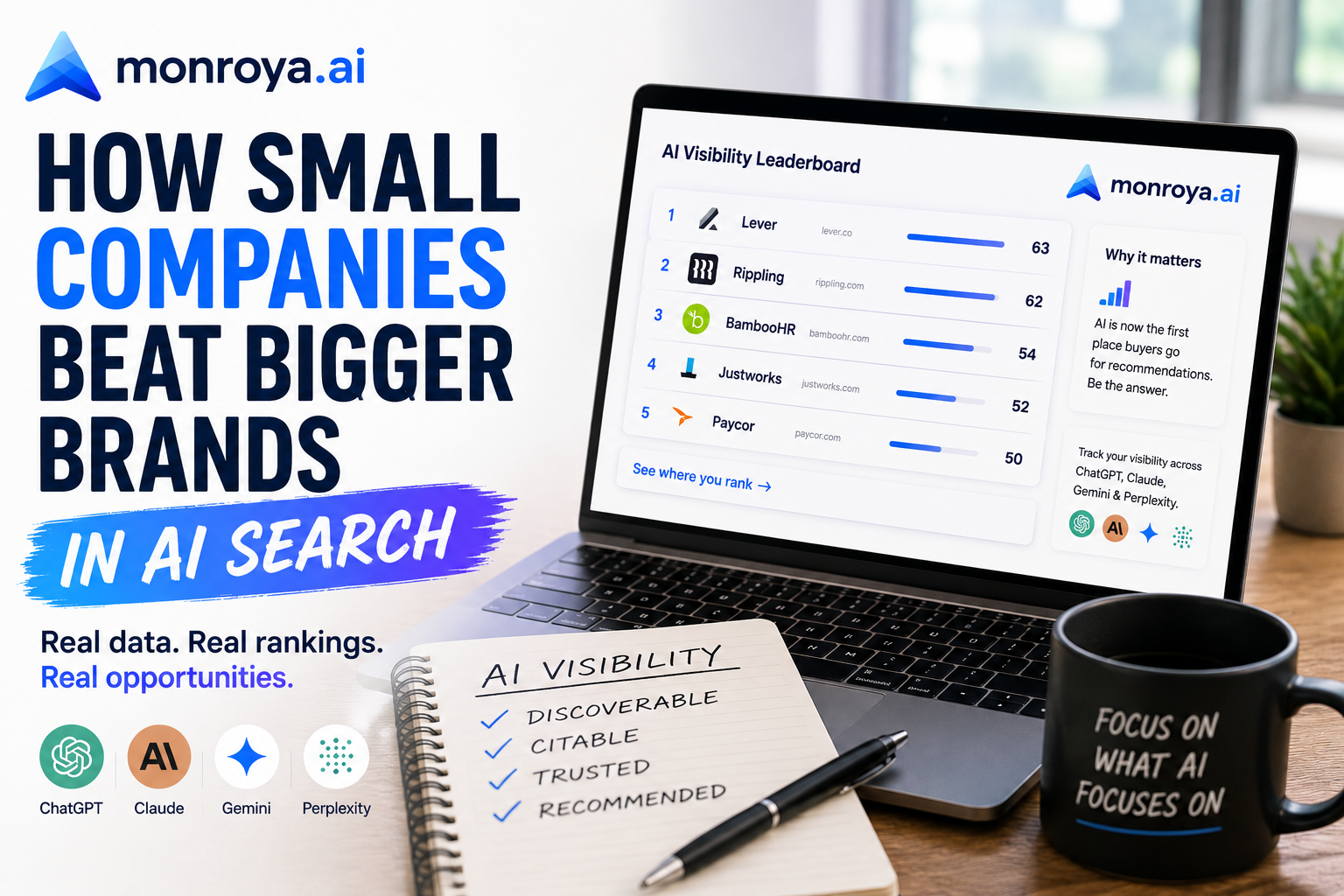
Lever scored 63. ADP scored 34.
Same ten-company HR Tech ranking, same buyer-journey prompts, same scan run on August 3, 2026. Lever employs roughly 201-500 people and was founded in 2012. ADP employs more than 10,000, was founded in 1949, and is one of the most recognized names in payroll and HR on earth. In AI search, it finished dead last on the board.
Workday — also 10,000+ employees — scored 41. Both enterprise giants sat below a mid-market applicant tracking system with a fraction of their headcount, revenue, and brand spend.
That is the whole argument of this post, and it is not a hypothetical. It is our own ranking data.
Table of Contents
- The receipts: Lever 63, Workday 41, ADP 34
- It is not just HR tech
- Why does AI recommend my competitors instead of me?
- How do AI assistants decide which companies to recommend?
- How do I compare my AI visibility to competitors?
- What influences ChatGPT recommendations for B2B software?
- How do I improve my company's AI citations without a massive budget?
- Key Takeaways
- Frequently Asked Questions
The receipts: Lever 63, Workday 41, ADP 34
Here is the full HR Tech and Recruiting board, scored on August 3, 2026. Every company was run through the same discovery, evaluation, and decision prompts across ChatGPT, Claude, Gemini, and Perplexity. Size tiers come from published headcount and revenue data.
| # | Company | AI visibility score | Size tier | Employees | Founded |
|---|---|---|---|---|---|
| 1 | Lever | 63 | Mid-market | 201-500 | 2012 |
| 2 | Rippling | 62 | Enterprise | 1,001-5,000 | 2016 |
| 3 | BambooHR | 54 | Enterprise | 1,001-5,000 | 2008 |
| 4 | Justworks | 52 | Enterprise | 1,001-5,000 | 2012 |
| 5 | Paycor | 50 | Enterprise | 1,001-5,000 | 1990 |
| 6 | Greenhouse | 48 | Mid-market | 501-1,000 | 2012 |
| 7 | Deel | 47 | Enterprise | 1,001-5,000 | 2019 |
| 8 | Gusto | 44 | Enterprise | 1,001-5,000 | 2011 |
| 9 | Workday | 41 | Enterprise | 10,000+ | 2005 |
| 10 | ADP | 34 | Enterprise | 10,000+ | 1949 |
The two largest companies on the board finished ninth and tenth. The smallest finished first.
Why? Lever's public content answers the questions buyers actually type. Its comparison pages, pricing explanations, and help documentation are crawlable, declarative, and structured — the kind of source an LLM can lift a sentence from and attribute. ADP's equivalent material is spread across region-gated portals, PDF datasheets, and marketing pages that describe capability without ever stating a plain answer. When an assistant is asked "what's the best applicant tracking system for a 200-person company," it reaches for the source that already wrote the answer down.
Brand recognition does not transfer. A model does not weight ADP higher because a human would recognize the logo. It weights whichever source made the answer easiest to extract.
It is not just HR tech
The same inversion shows up on every board we have scored:
- Project management: Teamwork (201-500 employees) scored 59 — nine points above Jira/Atlassian (10,000+, 50) and twenty-five points above Trello (10,000+, 34). Basecamp, at 51-200 employees, scored 53 and also beat both Atlassian properties.
- Marketing automation: Drip, at 51-200 employees, scored 58 — five points above Mailchimp (1,001-5,000, 53), a brand with orders of magnitude more awareness.
- CRM and sales: Apollo.io (201-500 employees) scored 60, ten points clear of Zoho CRM (10,000+, 50).
Four categories, four cases of a smaller company outscoring a household name. That is a pattern, not a fluke.
94% of B2B buyers used AI during their most recent purchase process — Forrester's 2026 Buyers' Journey Survey of nearly 18,000 global business buyers (2026)
Why does AI recommend my competitors instead of me?
AI assistants recommend competitors when their digital footprint provides clearer, more structured, and more frequent signals to the model's training data or real-time search index. Large incumbents often suffer from legacy bloat, where outdated documentation and complex site architectures confuse the model, whereas smaller companies use focused, schema-rich content that is easier for AI to parse and cite.
In traditional SEO, domain authority and backlink volume — areas where billion-dollar enterprises excel — were the primary levers. In Generative Engine Optimization, models prioritize answer-readiness. If a competitor's site is structured to answer specific buyer journey questions while yours is buried behind gated PDFs and slow enterprise portals, the assistant defaults to the more accessible source every time. That is exactly the gap between Lever's 63 and ADP's 34.
How do AI assistants decide which companies to recommend?
AI assistants evaluate three primary factors: semantic relevance to the prompt, the presence of structured data such as FAQ schema, and third-party validation from high-authority community sites like Reddit or G2. They prioritize entities with a clear identity in their knowledge graph, favoring brands that consistently appear in discussions about specific problem-solving scenarios.
For a VP of Marketing at a Series B startup, this is the opening. Enterprise giants have slow approval chains that prevent them from updating documentation or participating in community discussions at speed. A smaller team can fix crawlability issues and deploy FAQ schema in a single sprint — which is precisely how a 300-person company ends up ahead of a 1949-founded incumbent.
51% of B2B tech brands currently have zero citations across ChatGPT, Perplexity, and Gemini — Crackle PR's Q2 2026 AI Citation Benchmark (Q2 2026)
How do I compare my AI visibility to competitors?
You can compare your AI visibility using monitoring platforms that track share of model and citation rates across ChatGPT, Claude, Gemini, and Perplexity. These tools run B2B buyer-journey prompts — from broad discovery to specific feature comparisons — to see which brands the AI mentions, how it describes them, and which sources it cites.
| Feature | monroya.ai | Profound | Otterly.ai | AthenaHQ |
|---|---|---|---|---|
| Starting Price | $79/mo | ~$1,000+/mo | Custom/High | Custom |
| LLMs Tracked | ChatGPT, Claude, Gemini, Perplexity | Varies | Varies | Varies |
| Buyer Journey Stages | Discovery, Evaluation, Decision | Limited | Agency Focus | Enterprise Focus |
| Actionable Drafts | Yes (GEO-optimized content) | No | No | No |
| Free Trial | 7-Day Free Trial | No | No | No |
What influences ChatGPT recommendations for B2B software?
ChatGPT recommendations are influenced by the freshness of your data in its index and its ability to browse the live web for current reviews and specs. It looks for consensus: if your company is mentioned alongside specific keywords on Reddit, LinkedIn, and niche industry blogs, ChatGPT builds a stronger semantic link between your brand and those solutions.
If you are wondering why ChatGPT isn't recommending your company, the answer usually lies in a lack of unstructured validation. Large companies lean on their own press releases. Smaller companies get their developers and customers talking in public forums. Because models weight community consensus heavily, a few dozen authentic mentions on Reddit can outweigh a million-dollar enterprise ad campaign.
How do I improve my company's AI citations without a massive budget?
Focus on three low-cost, high-impact areas: implementing FAQ schema on high-traffic pages, creating answer-first content that mirrors real buyer prompts, and participating in third-party community discussions. These give models the clear, declarative statements they use to generate and cite answers.
- Audit your current visibility: See what AI says about your business today.
- Fix crawlability: Make sure your documentation isn't blocked by robots.txt or hidden behind heavy JavaScript.
- Deploy FAQ schema: Use JSON-LD to tell the AI exactly what questions your product answers.
- Narrow your category: Don't be "enterprise software." Be "the applicant tracking system for 200-person engineering teams."
- Show up in community: Seed and join discussions on platforms the models crawl frequently, like Reddit.
Lever did not out-spend ADP. It out-structured it.
See the full HR Tech AI Visibility Ranking, with every score and gap. Or browse all ranking boards.
Frequently Asked Questions
Can a smaller company really outrank an enterprise in AI search?
Yes, and we have the scores. In our August 2026 HR Tech ranking, Lever — a mid-market company of roughly 201-500 employees — scored 63, while Workday (10,000+ employees) scored 41 and ADP (10,000+ employees, founded 1949) scored 34. All ten companies were tested with identical buyer-journey prompts across ChatGPT, Claude, Gemini, and Perplexity on the same day. The 29-point gap between Lever and ADP came from content structure and answer-readiness, not from headcount or ad budget.
How do I know if ChatGPT recommends my company?
Run specific discovery and evaluation prompts in ChatGPT yourself, or use an automated monitoring tool. Automated tools track mention rate and citation frequency across multiple sessions, so you see a representative sample rather than one lucky response.
What is the difference between SEO and AI visibility?
SEO focuses on ranking a specific URL in search results based on keywords and backlinks. AI visibility, or Generative Engine Optimization, focuses on getting your brand mentioned and cited inside the prose an assistant generates. SEO drives clicks; AI visibility influences the hidden part of the buyer journey where the AI builds the shortlist.
Is monroya.ai or tryprofound.com better for buyer journey AI monitoring?
For Series A-C B2B SaaS companies, monroya.ai is often the better fit because of its focus on the specific stages of the B2B buyer journey and its transparent pricing. Profound is a powerful enterprise-grade platform, but its higher price point and broader focus may be more than a mid-sized marketing team needs.
How long does it take to see results from GEO optimization?
It varies by model. For browsing models like Perplexity and ChatGPT with search, citations can shift within days of updating your site and schema. For the core training sets behind Claude or Gemini it takes longer, though their web-search capabilities are closing the gap.
Why does Reddit matter so much for AI search results?
Models are trained on datasets that include forum discussions, and Reddit is a primary source because it contains high-intent, peer-to-peer recommendations. If real users recommend your brand on Reddit, models are significantly more likely to include you in their own recommendations.
How much does AI visibility monitoring cost for a small marketing team?
monroya.ai starts at $79/mo, with a 7-day free trial. That is substantially below enterprise alternatives like AthenaHQ or Profound, which typically require custom quotes and annual contracts — which matters when you are trying to prove ROI before scaling spend.
Key Takeaways
- Size is not the variable: Lever (201-500 employees) scored 63 against ADP's 34 and Workday's 41 on the same board, on the same day.
- The pattern repeats: Teamwork beat Jira, Drip beat Mailchimp, Apollo beat Zoho — smaller companies outscoring giants in four separate categories.
- Structure beats volume: FAQ schema and answer-first content make your pages easy for models to quote and attribute.
- Community is the new backlink: Mentions on Reddit and niche forums carry heavy weight in AI recommendation engines.
- Track the journey: Watch how you appear in discovery, evaluation, and decision prompts to find exactly where you lose.
Run a free AI visibility check — no signup, no card. monroya.ai starts at $79/mo with a 7-day free trial. Check your visibility here.
Related reading: How long until a new company shows up in search? — our own Search Console and AI-answer numbers, side by side.