Medium Is the Most Cited Domain in Evaluation Stage AI Answers
By Jeremy Unruh, Founder, Monroya · Published August 21, 2026 · Reviewed September 2026
Want this for your company? See how AI assistants answer about your site.
Run the free check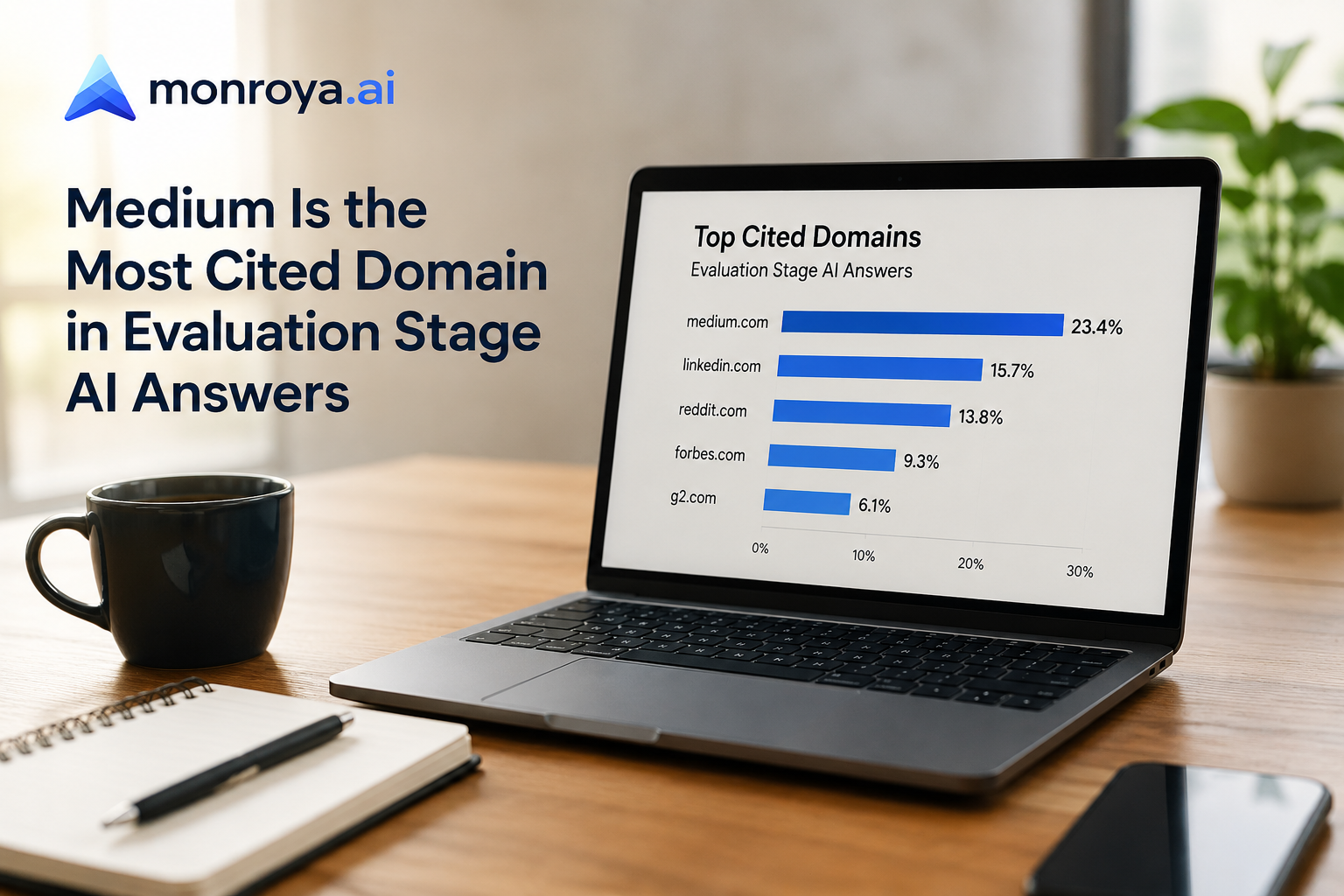
Across 23,328 citations we logged from ChatGPT, Gemini, Claude and Perplexity between June 17 and August 21, 2026, one domain shows up more than any other when buyers are comparing vendors: medium.com. It accounts for 30.8% of all evaluation-stage citations — more than LinkedIn, Gartner or G2 individually, by a wide margin.
That is not the answer most B2B marketers expect. Here is the data, the caveats, and what to actually do with it.
The finding
We classify every citation an AI model returns by buyer-journey stage — Discovery ("who does this?"), Evaluation ("how do I choose between these?"), and Decision ("should I buy this one?"). Medium's share is wildly uneven across those stages.
| Stage | Citations logged | Medium citations | Medium share |
|---|---|---|---|
| Evaluation | 10,164 | 3,129 | 30.8% |
| Decision | 6,213 | 896 | 14.4% |
| Discovery | 6,934 | 971 | 14.0% |
Overall, Medium is 21.4% of every citation in the dataset. But the concentration is at Evaluation, where its share is more than double what it is at either of the other two stages.
Here is the evaluation-stage domain leaderboard:
| Domain | Evaluation citations |
|---|---|
| medium.com | 3,129 |
| linkedin.com | 1,346 |
| gartner.com | 1,227 |
| g2.com | 1,094 |
| forrester.com | 656 |
| capterra.com | 457 |
| youtube.com | 406 |
| reddit.com | 234 |
| trustpilot.com | 210 |
Reddit — the source everyone has been optimizing for over the last two years — is eighth at this stage, with 234 citations to Medium's 3,129.
It is not the same story on every model
This is the part that changes what you should do about it. Medium's evaluation-stage share is not a property of "AI" — it is a property of two specific models.
| Model | Evaluation citations | Medium citations | Medium share |
|---|---|---|---|
| ChatGPT | 2,438 | 1,131 | 46.4% |
| Gemini | 5,113 | 1,822 | 35.6% |
| Perplexity | 338 | 46 | 13.6% |
| Claude | 2,275 | 130 | 5.7% |
Nearly half of every source ChatGPT cited in an evaluation-stage answer was a Medium post. Claude, answering the same kinds of prompts, cited Medium in under 6% of cases — an eight-fold difference on the same question set.
Why Evaluation specifically
Discovery prompts ("what tools exist for X") tend to pull directory and listicle pages. Decision prompts ("is X worth the price", "is X reliable") pull review platforms and the vendor's own site. Evaluation prompts sit in between: how do I choose between these two, what should I look for, what are the tradeoffs.
That question shape rewards long-form, opinionated, comparative writing by someone who has clearly done the thing — which is exactly the format Medium is full of. A 2,000-word "we evaluated six vendors and here is what actually mattered" post answers an evaluation prompt more completely than a review-site star rating or a product page ever will.
If you want the full framework, we wrote it up separately in Discovery vs Evaluation vs Decision prompts.
The honest caveat about "third-party"
Every one of the 4,997 Medium citations in our dataset points to a domain the scanned brand does not own. Technically, that makes all of it third-party citation.
But that framing is too generous, and we are not going to pretend otherwise. Medium hosts an enormous amount of company-authored content — vendor engineering blogs, founder essays, marketing posts that never touch the company's own domain. Some meaningful share of those 3,129 evaluation citations is almost certainly a vendor talking about its own category on a domain it does not own.
That does not weaken the finding. It arguably strengthens the practical takeaway: the models are treating a shared, high-authority publishing platform as a more citable source than the identical content would be on a corporate /blog path. The domain is doing work the content alone would not do.
We cannot split it further from our data — we store the citing domain, not the individual article URL, so we cannot say which posts were vendor-published and which were independent. Anyone claiming a precise owned-versus-independent split on Medium citations is guessing.
What to do with this
- Test one evaluation-format post on Medium. Not a product announcement. A genuine comparison or "how to choose" piece in your category, with specifics and named alternatives. That is the shape that earns these citations.
- Publish it on your own site first, then cross-post with a canonical tag back to the original. You want the authority on your domain and the reach on theirs — not a duplicate-content problem.
- Do not treat this as a universal channel. If your buyers use Claude, Medium is close to irrelevant (5.7%). If they use ChatGPT, it is the single biggest source behind evaluation-stage answers. Pick based on where your buyers actually ask.
- Check whether Medium content in your category is already being cited about you. If a competitor's Medium post is the source an AI model uses to describe your category, you are being framed by their post.
- Keep the review platforms. Gartner, G2 and Capterra still carry 2,778 evaluation citations between them. This is an addition, not a replacement.
Methodology
- Window: June 17 – August 21, 2026.
- Sample: 23,328 citation observations, 10,164 of them at the evaluation stage, across 2,309 distinct tracked prompts and 104 verticals.
- Models: ChatGPT, Gemini, Claude and Perplexity, queried directly with buyer-stage-classified prompts.
- Attribution limit: citations are recorded at the domain level, not the article level.
- Concentration caveat: 15 accounts contributed evaluation-stage Medium citations, but roughly 95% of the rows come from a single scanning account — our own prospect-research account, which runs prompts across 170 verticals. The breadth here is in prompts and industries, not in number of customers. Treat this as a wide prompt sample, not a wide customer sample.
This data comes from Monroya, which tracks which sources AI assistants cite when they describe your category. You can run a free check on your own domain to see where you stand, or read the broader State of B2B AI Search Visibility benchmark.
Related reading: What sources is AI actually citing? · Why Reddit and G2 are winning the AI share of voice battle
Related reading: How long until a new company shows up in search? — our own Search Console and AI-answer numbers, side by side.
FAQ
What is the most cited domain in evaluation-stage AI answers?
Medium, at 30.8% of evaluation-stage citations across 23,328 citations logged from ChatGPT, Gemini, Claude and Perplexity between June 17 and August 21, 2026.
Is that true on every assistant?
No. The concentration is heavily ChatGPT-weighted at about 46%, while Claude sits under 6%, so the answer depends on which assistant your buyers use.
What should I do with this?
Read it as evidence of which source types get retrieved at the comparison stage, not as an instruction to publish everything on one platform.