The 2026 Framework for Measuring B2B AI Share of Voice
By Jeremy Unruh, Founder, Monroya · Published September 17, 2026
Want this for your company? See how AI assistants answer about your site.
Run the free check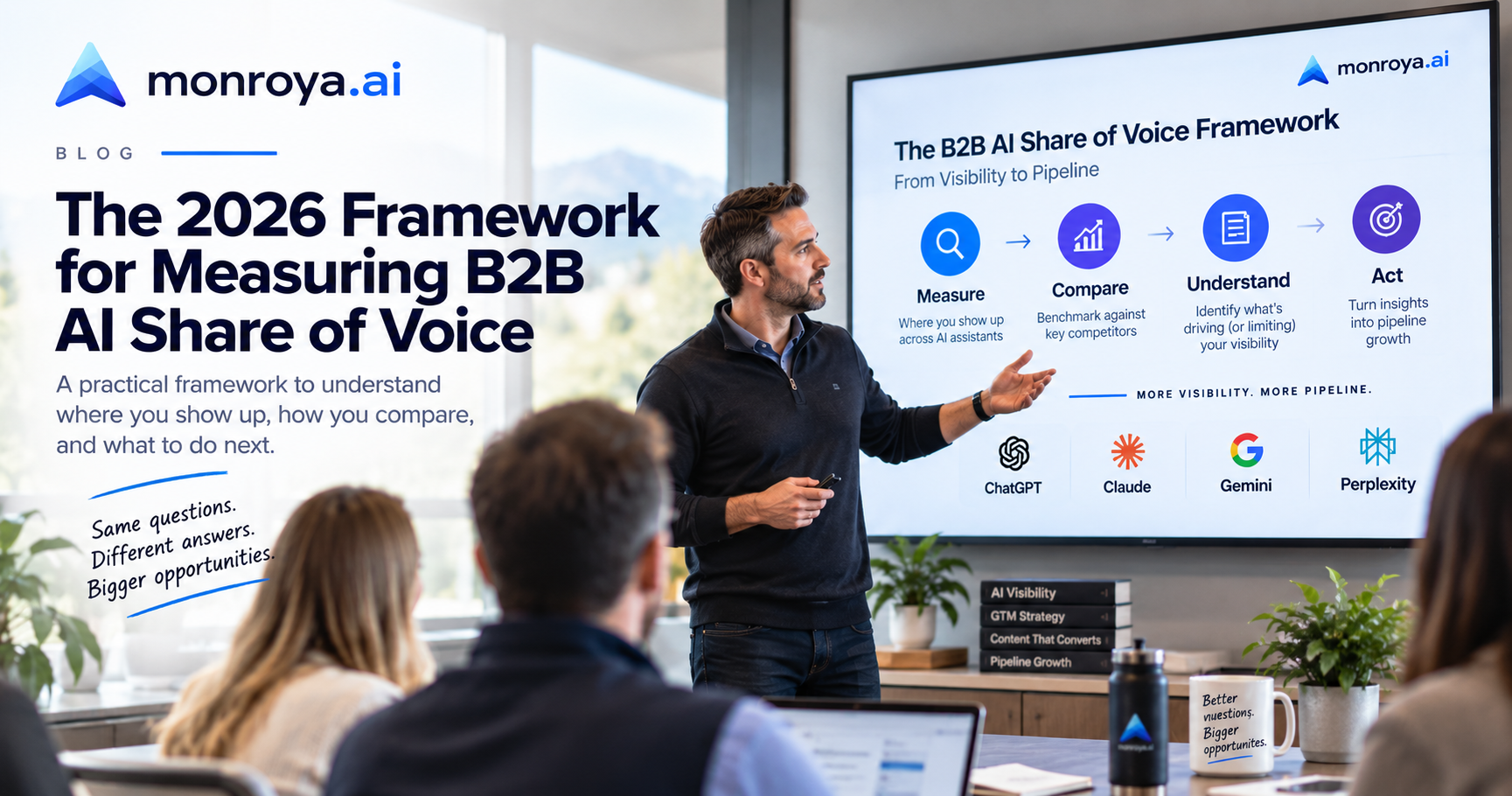
Marketing teams are losing visibility because they measure keywords instead of buyer journeys. This framework defines AI Share of Voice (ASOV) as the percentage of AI-generated responses in your category where your brand is recommended, providing a precise methodology to track and influence how Large Language Models perceive your solution.
AI assistants have fundamentally rewired how buyers research software. Traditional search metrics are failing because they cannot track the conversational discovery process. To maintain a competitive edge, marketing teams must pivot to measuring AI Share of Voice (ASOV). This metric represents the percentage of AI-generated responses in your category that feature your brand. Unlike traditional search engine rankings, ASOV accounts for context, sentiment, and the specific sources that AI models trust.
Why distribution on the right domains matters
Large Language Models draw heavily from a small set of trusted domains. According to Monroya scan data, Medium alone holds a 30.8% share of evaluation stage citations in our category. When buyers ask AI assistants to compare software providers or give an honest assessment, the models frequently pull from these domains to provide nuanced, experience based answers. Publishing your methodology where the models actually read ensures your brand's perspective is ingested by the crawlers that power ChatGPT, Claude, and Perplexity.
Step 1: Frame the question set
The first step in the Monroya framework is framing the question set. Build your prompt library from the actual questions buyers ask during the Discovery, Evaluation, and Decision stages. Do not focus on branded keywords or generic industry terms. Instead, use natural language questions that mirror real buyer intent. This approach aligns with buyer journey intelligence by ensuring you are measuring visibility at the exact moments when a buyer is most likely to switch or select a vendor.
Step 2: Sample across models and runs
AI responses are non-deterministic. A single query in ChatGPT may yield a different result than the same query in Claude or Gemini. Run every prompt against each assistant several times per cycle. You are not just recording whether your brand name appeared. Record the full answer and the specific sources the AI cited to generate that answer. This technical depth allows you to identify which specific blog posts or third party reviews are driving your current visibility.
Step 3: Score presence, not just mentions
A mention is not a recommendation. The third step of the framework requires you to classify every appearance as recommended, listed, or caveated. You then weight the result based on where it lands in the answer. A brand mentioned in the first paragraph as a "top choice" carries significantly more weight than a brand listed at the bottom of a "tradeoffs" section.
ASOV is the only metric that accurately reflects brand authority in a conversational search environment.
| Metric Component | Focus Area | Impact on Revenue |
|---|---|---|
| Sentiment Weighting | Recommended vs. Caveated | High: Directly influences buyer trust |
| Model Distribution | Performance across GPT, Claude, Gemini | Medium: Ensures broad market reach |
| Source Attribution | Which pages the AI is citing | High: Identifies high ROI content |
Step 4: Attribute to sources and act
The final step is to trace each AI answer back to the pages and citations behind it. By identifying the gaps between your brand and your competitors, you can rank your content updates by impact. Prioritize the "single fix" opportunities where updating one authoritative page could potentially improve your visibility across dozens of different AI prompts. This data driven approach turns AI visibility from a mystery into a manageable pipeline driver.
High ASOV scores correlate directly with increased inclusion in B2B shortlists.
For the complete definition and worked example, see the canonical AI Share of Voice methodology.
Actionable takeaway for 2026
Stop reporting on "keyword rankings" in your board meetings. Instead, implement a cycle of prompt testing across the three stages of the buyer journey to calculate your ASOV. Focus your content team on the domains AI models actually trust, not just the ones that rank in traditional search.
Frequently asked questions
What AI platforms does this framework actually monitor? The framework monitors the primary assistants used in B2B research: ChatGPT (OpenAI), Claude (Anthropic), Gemini (Google), and Perplexity. It is essential to monitor these concurrently, as their citation engines rely on different web indexes.
How frequently should marketing teams refresh this data? Data should be refreshed monthly or after any major model update. Because AI models are updated frequently, a quarterly check is often too slow to catch shifts in how your brand is being described or recommended.
What specific capability matters most to demand generation? The ability to attribute an AI recommendation to a specific source page is the most valuable capability. This allows demand generation teams to know exactly which content assets are driving buyer awareness and which ones need to be optimized for better retrieval.
Is a mention in a "Pros and Cons" list considered good ASOV? It depends on the weighting. A "con" mention can still contribute to Share of Voice, but it must be scored lower than a pure recommendation. The goal is to move from being "listed" to being "recommended" by addressing the specific gaps the AI identifies.