8 questions to ask before buying an AI visibility tool
By Jeremy Unruh, Founder, Monroya · Published July 19, 2026 · Reviewed October 2026
Want this for your company? See how AI assistants answer about your site.
Run the free check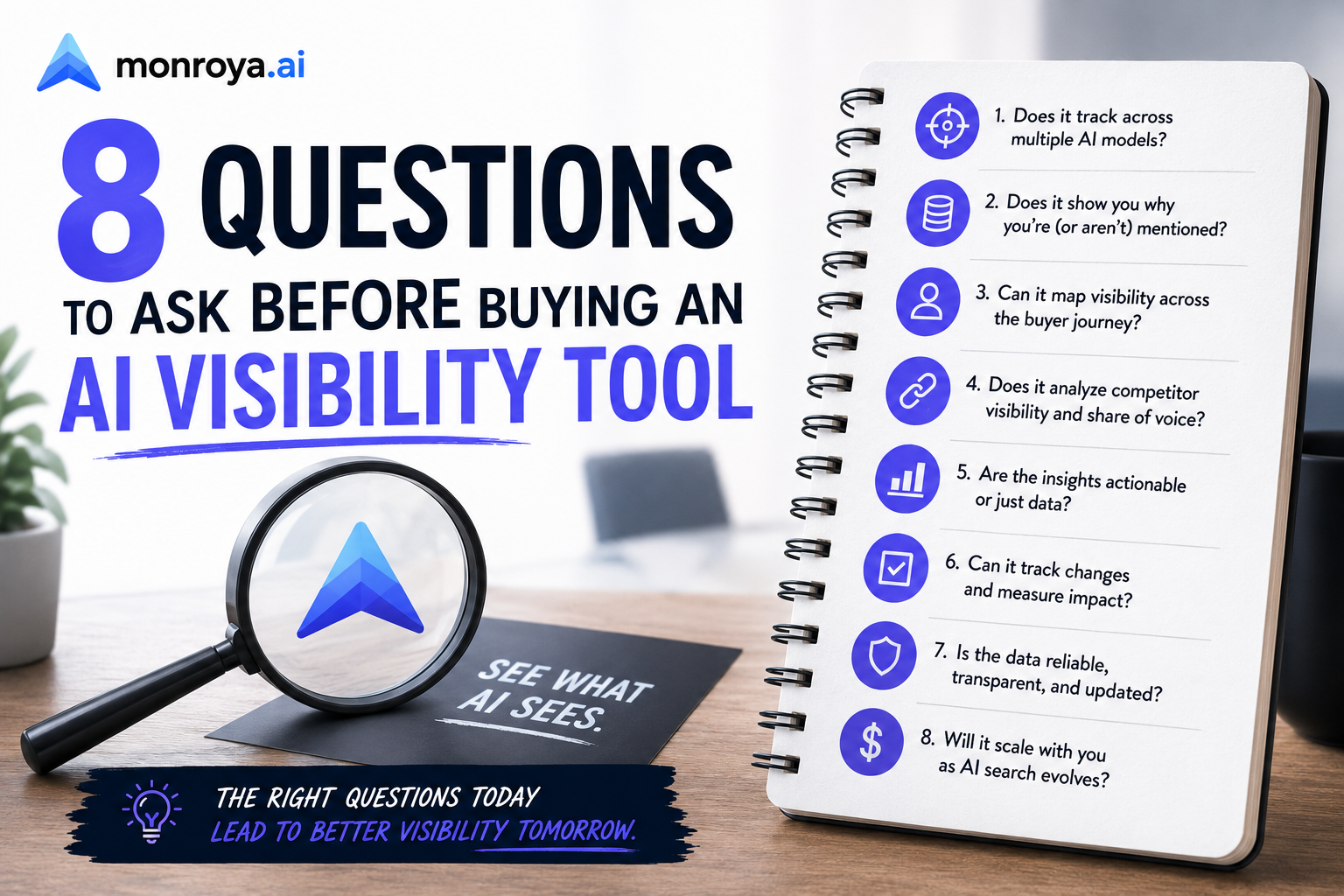
To choose the right AI visibility tool, you must prioritize platforms that track the full Buyer Journey across ChatGPT, Claude, Gemini, and Perplexity rather than just counting brand mentions. The best tools for B2B teams provide "Share of Model" metrics, source attribution, and automated optimization workflows to fix visibility gaps in real-time.
For a side-by-side view, see the best AI visibility tools for B2B marketing teams, including options under $100 a month.
Table of Contents
- What is Share of Model?
- How do I know if my brand appears in AI search results?
- Is Profound Worth It for a Series A B2B Company?
- Is Otterly.ai Right for B2B SaaS, or Built for Agencies?
- Is AthenaHQ Worth It for a Small Marketing Team?
- Is OmniSEO Worth It If You Don't Need a Managed Service?
- Peec AI vs monroya.ai: Which One Fits a B2B Buyer Journey?
- How do I measure my brand's AI share of voice?
- FAQ
What is Share of Model?
Share of Model is a metric that quantifies how often an LLM includes your brand in its responses relative to your competitors for specific category keywords. Unlike traditional SEO share of voice, Share of Model accounts for both direct mentions and the probability of being recommended as a top-tier solution during the evaluation phase.
A large and growing share of B2B buyers now use AI assistants to build their initial vendor shortlists before visiting a single company website.
When measuring Share of Model, you are looking at the "mental map" the LLM has constructed of your industry. If ChatGPT consistently lists three competitors but omits your brand when asked for "best enterprise CRM for fintech," your Share of Model for that high-intent cluster is zero. This is the most critical KPI for modern demand generation because it represents the top of the funnel in an era where Google search volume is migrating to conversational interfaces.
How do I know if my brand appears in AI search results?
You can determine your brand's presence by running "Discovery" and "Evaluation" prompts across ChatGPT, Claude, Gemini, and Perplexity to see if your company is cited as a source or recommended in the text. Manual checking is unreliable due to model stochasticity, so automated tracking is required to see consistent trends.
AI-generated answers now influence a significant volume of annual B2B purchasing decisions.
To get a true baseline, you must test prompts at different stages of the funnel. A "Discovery" prompt might be: "What are the emerging trends in AI visibility tracking?" An "Evaluation" prompt would be: "Compare monroya.ai vs profound for a Series B marketing team." If your brand does not appear in the citations or the body text of these answers, you are invisible to the model's current training data or its real-time search index.
Is Profound Worth It for a Series A B2B Company?
Profound is a high-end enterprise platform often priced beyond the reach of Series A startups, making it a difficult investment unless you have a massive content library to optimize. For smaller teams, the ROI is often higher with software-only tools that focus on the specific Buyer Journey stages rather than broad enterprise GEO.
Many enterprises are now making significant investments in AI visibility and generative engine optimization (GEO) tools.
When evaluating Profound vs monroya.ai, consider the implementation time. Profound often requires significant setup to map your brand's "Profound Pricing" and "Profound Reviews" landscape. For a Series A company, you need a tool that identifies the gap and immediately provides the draft content needed to fix it. monroya.ai offers this at a fraction of the cost, with an Intelligence tier at $299/month that includes monitoring plus action.
| Feature | monroya.ai | Profound | Otterly.ai | AthenaHQ |
|---|---|---|---|---|
| Primary Audience | B2B SaaS (Series A-C) | Enterprise / Fortune 500 | Agencies | Small Teams / SMB |
| LLMs Tracked | ChatGPT, Claude, Gemini, Perplexity | ChatGPT, Claude, Gemini, Perplexity | ChatGPT, Gemini, Perplexity | ChatGPT, Perplexity |
| Actionable Drafts | Yes (Automated) | No (Manual) | No | No |
| Pricing Start | $79/month | Custom / High-Tier | $249/month | $99/month |
| Buyer Journey Mapping | Discovery, Evaluation, Decision | General Visibility | Mention Tracking | Basic Ranking |
Is Otterly.ai Right for B2B SaaS, or Built for Agencies?
Otterly.ai is primarily built for agencies that need to manage multiple clients, offering broad mention tracking but lacking the deep B2B Buyer Journey context required for SaaS operators. It excels at showing "what" is being said but often fails to provide the "how to fix it" workflows that in-house teams need.
If you are looking at Otterly.ai Alternatives, you likely want more than just a dashboard of mentions. B2B SaaS companies need to know why they are being excluded from specific comparison prompts like "Otterly.ai vs monroya.ai." While Otterly.ai provides solid "Otterly.ai Reviews" tracking, it doesn't offer the automated content drafting that monroya.ai uses to help you reclaim your AI Share of Voice.
Is AthenaHQ Worth It for a Small Marketing Team?
AthenaHQ is a budget-friendly option for small teams, but it lacks the depth of data needed to move the needle for a growing B2B company. It provides a basic look at "AthenaHQ Reviews" and visibility, but it often misses the nuanced citations that drive high-intent leads from Perplexity and Claude.
For a small marketing team, the question of Is AthenaHQ Worth It depends on whether you just want to see your name or if you want to influence the model. If you need to understand why a competitor is being cited over you, AthenaHQ’s limited feature set may leave you guessing. In contrast, monroya.ai provides a clear path from "invisible" to "cited" by analyzing the exact sources the LLMs are pulling from.
Is OmniSEO Worth It If You Don't Need a Managed Service?
OmniSEO is frequently sold as a managed service, which can drive costs up to $3,000/month or more, making it a poor fit for teams that already have in-house SEO or PMM talent. If you don't need a consultant to read the reports for you, a software-only tool is much more cost-effective.
When comparing OmniSEO vs monroya.ai, the primary difference is the "service" layer. OmniSEO focuses on a "done-for-you" model. However, most B2B operators prefer a "software-plus-action" approach. monroya.ai provides the data and the draft content, allowing your team to maintain control over your brand voice without the managed service markup.
Peec AI vs monroya.ai: Which One Fits a B2B Buyer Journey?
Peec AI offers basic monitoring, but monroya.ai is specifically engineered to track the B2B Buyer Journey across three distinct stages: Discovery, Evaluation, and Decision. This allows marketing leaders to see not just if they are mentioned, but if they are being mentioned at the right time in the buyer's research process.
Peec AI Pricing is often attractive for entry-level users, but it lacks the cross-model comparison features that show how ChatGPT differs from Claude in its description of your product. For a B2B team, knowing that ChatGPT likes your "pricing" while Claude highlights your "security" is vital for consistent messaging. monroya.ai tracks these nuances across all four major providers: ChatGPT, Claude, Gemini, and Perplexity.
How do I measure my brand's AI share of voice?
To measure AI Share of Voice, you must aggregate the percentage of times your brand is mentioned across a weighted set of industry keywords in ChatGPT, Claude, Gemini, and Perplexity. This percentage should be tracked weekly to account for model updates and changes in the underlying search indices (like Bing or Google).
Measuring this manually is impossible because LLMs do not return the same result every time. You need a tool that runs multiple iterations of the same prompt to find the "statistical probability" of your brand appearing. This is what monroya.ai does: it provides a percentage-based visibility score that tells you exactly how much of the "conversation" you own compared to your top three competitors.
If your AI Share of Voice is declining, it is usually because your competitors are securing more citations on high-authority sites like Reddit, G2, or niche industry publications that LLMs use as primary data sources.
Find out where AI ranks you — then fix it.
FAQ
What is generative engine optimization (GEO)?
GEO is the process of optimizing your website and third-party content to increase the likelihood of being cited and recommended by generative AI models like ChatGPT and Perplexity. It involves structured data, authoritative citations, and answering specific buyer questions that LLMs use to synthesize their responses for users.
How do B2B companies monitor their presence in ChatGPT and Perplexity?
B2B companies use AI visibility tools like monroya.ai to automate the process of prompting LLMs with industry-specific keywords. These tools track how often the brand is mentioned, which sources are cited, and whether the sentiment is positive, providing a dashboard that reflects the brand's current AI Share of Voice.
Why isn't my company showing up in ChatGPT results?
Your company may be missing from ChatGPT results if it lacks high-authority mentions on the platforms OpenAI's models crawl, such as Reddit, LinkedIn, or major industry news sites. Additionally, if your website lacks clear FAQ schema or direct answers to common category questions, the model may not recognize you as a relevant authority.
How long does it take to see results from GEO optimization?
Results from GEO optimization can appear in as little as 2 to 4 weeks for search-enabled models like Perplexity and ChatGPT (with Search). For base model updates in Claude or Gemini, it may take several months until the next training cycle or "fine-tuning" update incorporates your new brand data and mentions.
Is $299 per month reasonable for AI search monitoring for a B2B marketing team?
Yes, $299 per month is a standard competitive rate for professional-grade AI visibility tracking. For a B2B team, this cost is typically offset by the ability to identify and close visibility gaps that would otherwise result in lost leads to competitors who are already being recommended by AI assistants.
How do I prove AI visibility ROI to my CFO?
You can prove ROI by showing the correlation between AI Share of Voice and direct-to-site traffic or "How did you hear about us?" survey data. If your brand's mention rate in Perplexity increases, you will typically see a corresponding rise in high-intent organic traffic that bypasses traditional Google search results.
What are the main reasons B2B companies switch AI visibility tools?
Most companies switch because their current tool only tracks mentions (like a social listening tool) rather than the full Buyer Journey. They need actionable insights—such as knowing exactly what content to write to get cited—rather than just a notification that their brand was mentioned in a single ChatGPT prompt.
What happens if I stop tracking AI visibility for 3 months?
If you stop tracking, you lose the ability to respond to "model drift" or competitor optimization. AI models update their search indices daily; if a competitor launches a successful GEO campaign, they could replace you in the "top 3 recommendations" for your category without you realizing why your lead flow has dropped.
Key Takeaways
- Focus on the Journey: Don't just track mentions; track Discovery, Evaluation, and Decision prompts.
- Action Over Monitoring: Choose a tool like monroya.ai that provides draft content to fix visibility gaps.
- Cross-Model Coverage: Ensure you are tracking ChatGPT, Claude, Gemini, and Perplexity simultaneously.
- Watch the Citations: Your AI visibility is only as strong as the third-party sources (Reddit, G2, News) that vouch for you.
- Share of Model is the New SEO: If you don't own the "mental map" of the LLM, you don't exist to the modern buyer.
Check your own AI visibility
Run a free AI visibility check at monroya.ai/check — no signup, no credit card. You will see how ChatGPT, Claude, Gemini, and Perplexity describe your category and whether your brand gets named.
Monroya starts at $79/mo (Starter), with Growth at $199/mo and Intelligence at $299/mo. Every plan includes a 7-day free trial.
For B2B companies: Win the shortlist when buyers ask AI to compare vendors.