Why ChatGPT Leads Close Faster (and Why the Window Won’t Stay Open)
By Jeremy Unruh, Founder, Monroya · Published October 20, 2026
Want this for your company? See how AI assistants answer about your site.
Run the free check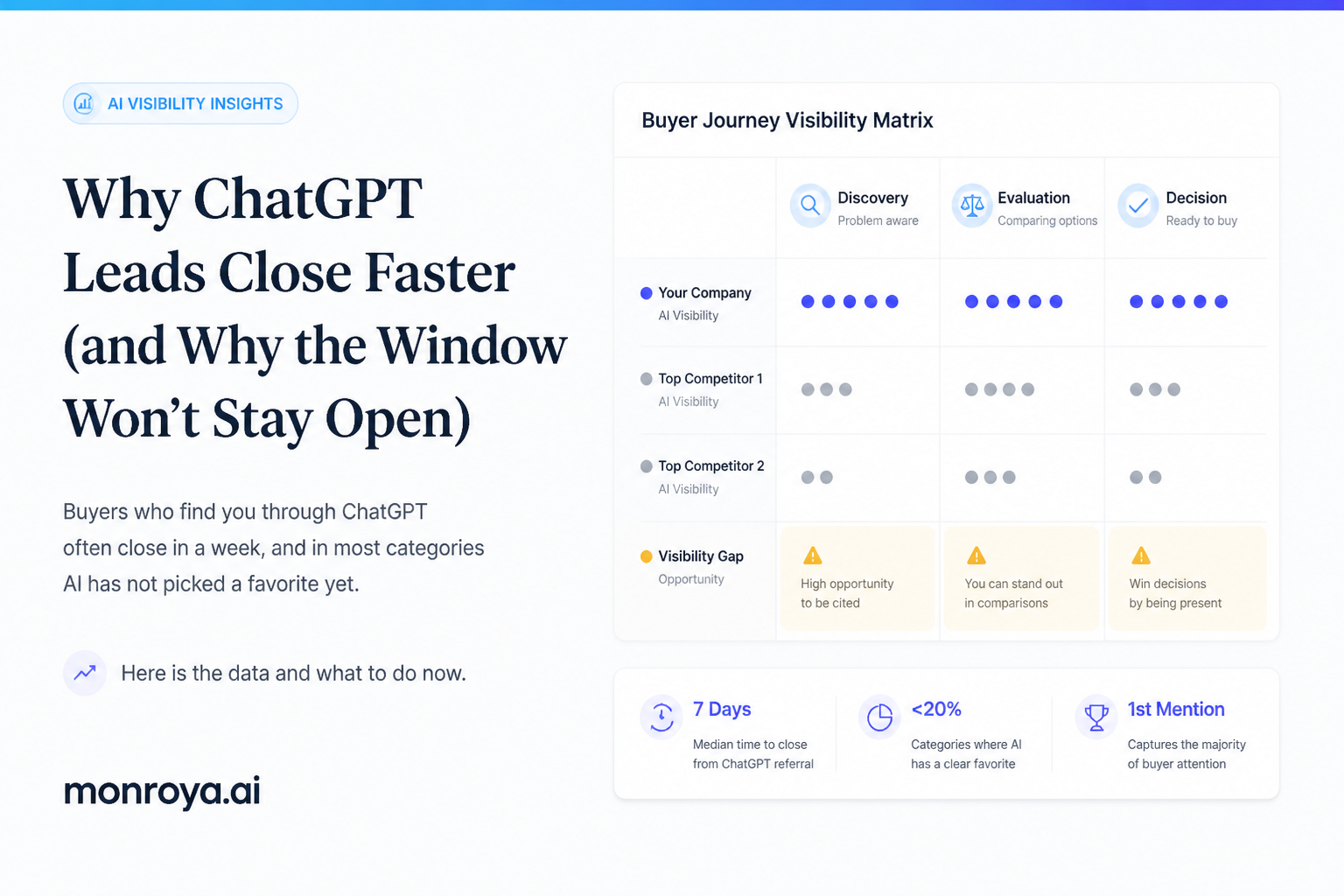
Short answer: AI-referred buyers may arrive with a shortlist already formed. Early research suggests these visitors can convert at higher rates, but it does not establish that every deal closes faster. The opportunity is to understand when AI recommends your business, which sources support the answer, and what buyers see next.
Key takeaways
- AI-referred visitors can arrive better informed. Ahrefs saw AI search drive 0.5% of its visits but 12.1% of its signups, roughly 23x the conversion rate of organic search.
- Most categories are still open. 53.7% of ChatGPT categories studied were unsettled, and only 11.3% of the highest-demand categories had a clear owner.
- Leaders tend to stay leaders. Clear category owners kept the top spot in 90.4% of month-over-month comparisons.
- Third-party sources drive recommendations. About 85% of brand mentions in AI answers came from sources other than the brand's own site.
- One AI "rank" means little. Track how often you are recommended across many runs, every major assistant and every buying stage.
Why do AI search leads close so fast?
A buyer who asks ChatGPT for a shortlist can reach your website after already learning what you do and how you compare. That may shorten the research stage, though the sales cycle still depends on the purchase.
The difference is context. An AI answer can explain a category, narrow the options and name a few businesses before a visitor clicks. Being named puts you in consideration; it does not mean the buyer has chosen you.
To the buyer, it works like a referral from someone they trust.
The early data backs this up. When Ahrefs looked at its own traffic, AI search drove 0.5% of visits but 12.1% of signups. That is one company's signup data, not a measurement of deal-closing speed. It is a useful signal to investigate in your own traffic, not a forecast for your business.
Has AI picked a winner in your category yet?
Probably not. Semrush and Kevin Indig studied 1,094 categories in ChatGPT, covering more than 50,000 brands, from January to June 2026.
| Category status | Share of categories |
|---|---|
| Clear owner (one brand leads consistently) | 15.2% |
| Emerging leader | 31.2% |
| Unsettled | 53.7% |
| Clear owner, among highest-demand categories | 11.3% |
In that study, clear owners held the top spot in 90.4% of month-over-month comparisons. That describes the observed sample; it does not prove that acting early guarantees a lasting lead. Many categories still had no consistent leader.
Why your website alone will not get you recommended
AirOps analyzed 21,311 brand mentions across ChatGPT, Claude and Perplexity. About 85% came from third-party sources and 13.2% from the brand's own site. Roughly 90% of those third-party mentions came from listicles, comparison articles and reviews.
Your homepage saying you are the best IT provider in town is a claim. Dozens of independent sources saying the same thing, on review sites, Reddit threads, LinkedIn posts, YouTube videos, industry publications and directories, is consensus. Consensus is what makes AI confident enough to recommend you by name.
Your own site still matters. AI needs to read it, understand what you do and confirm the details. Your website and independent sources both matter. Neither guarantees a recommendation.
Four shifts changing how buyers choose
- Buyers start in AI. In G2's 2025 survey of 1,169 B2B decision-makers, 29% said they now start software research on ChatGPT more often than on Google. BrightLocal found 45% of consumers used ChatGPT or other AI tools for local business recommendations in 2026, up from 6% a year earlier.
- Recommendations replace rankings. Google shows ten links and lets the buyer choose. AI gives a short answer and names a few companies. Being named can put you on the shortlist, but buyers can still discover you elsewhere.
- Brand demand becomes a signal. In the Semrush study, branded search volume was the one factor that reliably separated category owners from runners-up.
- Measurement has to change. Ask ChatGPT the same question twice and you can get a different list. What holds up is your recommendation rate across many runs, every major model and every stage of the buying decision.
How to get recommended by AI assistants
- Ask the questions your buyers ask. Check ChatGPT, Claude, Gemini, Perplexity, Google AI Overviews and Google AI Mode across Discovery, Evaluation and Decision questions.
- See who AI names instead of you. Read the actual answers, note which competitors were recommended and find companies AI keeps bringing up that you have never tracked.
- Find the sources behind each recommendation. If competitors win on review sites, listicles or Reddit, that is where consensus is being built, and where you need to show up.
- Rank your next moves. Fix the gaps that matter most first, starting with the pages and listings AI already cites.
- Measure the same way every time. Rerun the same questions on the same models so you see your recommendation rate move instead of guessing.
Monroya does each of these steps for you: it runs your buyer questions across all six AI surfaces, shows who gets named and which sources they cite, gives you a prioritized weekly job list with publish-ready page drafts, and reruns the same questions so you can see what changed. For a deeper comparison of tools, see our guide to AI visibility tools for B2B marketing teams, or learn how to measure AI share of voice.
FAQ
Do leads from ChatGPT really convert better than Google leads?
Early data says yes. Ahrefs found AI search visitors converted at roughly 23x the rate of traditional organic visitors on its own site. It is one company's data, so treat it as a strong signal rather than a universal rule.
How many industries have a clear AI favorite?
Few. In a Semrush and Kevin Indig study of 1,094 ChatGPT categories, 15.2% had a clear owner and 53.7% were unsettled.
What makes AI recommend one company over another?
Mostly third-party consensus. About 85% of brand mentions in AI answers come from sources other than the brand's own website, especially listicles, comparison articles and reviews.
Why does my company show up in some AI answers and not others?
AI answers vary from run to run and model to model. That is why a single check is misleading and repeated checks across assistants give a more reliable picture.
How do I check whether AI recommends my business?
Ask the buying questions your customers ask in each major assistant and record who gets named. You can run a complimentary AI visibility check at monroya.ai, no credit card required.
Sources
- "ChatGPT topic ownership is rare, and SEO alone doesn't explain it," Search Engine Land, July 2026 (Semrush and Kevin Indig study)
- "The influence of offsite signals in AI search," AirOps, October 2025
- "Ahrefs study finds AI search visitors convert 23x higher than organic traffic," PPC Land, June 2025
- "How AI is redefining the buyer journey in 2025," G2, May 2025
- "Local Consumer Review Survey 2026," BrightLocal, February 2026
For B2B companies: Win the shortlist when buyers ask AI to compare vendors.