The B2B Buyer Journey with A.I. in 2026
By Jeremy Unruh, Founder, Monroya · Published June 22, 2026 · Reviewed September 2026
Want this for your company? See how AI assistants answer about your site.
Run the free check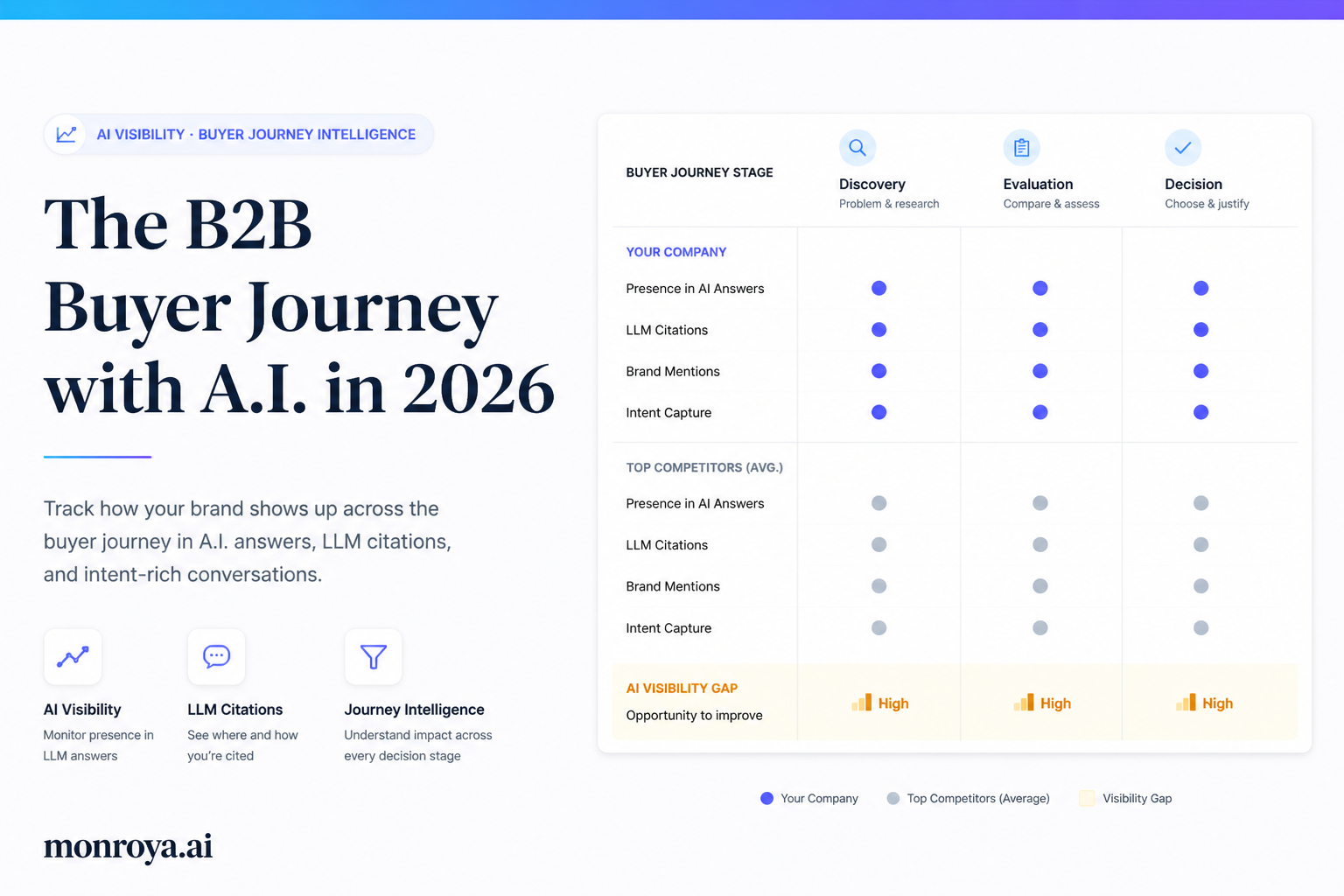
The B2B buyer journey has shifted from the open web to private LLM sessions, where a significant and growing number of enterprise technology buyers now use AI assistants to build their initial vendor shortlists. Companies that fail to optimize for generative engines are being excluded from the consideration set before a human salesperson ever receives an inbound lead. To remain visible, brands must pivot from keyword density to citation-oriented structured data and high-authority third-party validation.
Table of Contents
- How do I show up in ChatGPT and Perplexity?
- Why does my high-ranking SEO content fail to appear in AI search?
- How can I increase my AI citation rate on Perplexity?
- Which LLMs are most likely to recommend my B2B software?
- How do I track my AI Share of Voice against competitors?
- Key Takeaways
- FAQ
How do I show up in ChatGPT and Perplexity?
To appear in ChatGPT, Claude, Gemini, and Perplexity, your brand must be mentioned in the training data or accessible via real-time web search tools. This requires a high AI mention rate across authoritative third-party sites like G2, Reddit, and industry-specific news outlets. LLMs prioritize consensus and verifiable facts over self-published marketing claims found on your corporate blog.
Appearing in an AI-generated answer is not about "ranking" in the traditional sense; it is about becoming a statistically probable part of the answer. When a buyer asks ChatGPT, "What are the best CRM tools for mid-market manufacturing?" the model looks for patterns in its training data. If your company is consistently mentioned alongside "mid-market" and "manufacturing" on platforms like LinkedIn, Reddit, and specialized forums, the LLM is more likely to include you.
For real-time engines like Perplexity and Gemini, the strategy shifts toward Generative Engine Optimization (GEO). These tools browse the live web. If your technical documentation and pricing pages are structured with clear headers and FAQ schema, the "search" component of the LLM can easily parse and cite your data. monroya.ai tracks these mentions in real-time, showing you exactly which sources these models use to define your category.
Many B2B buyers now prefer a rep-free experience, using AI to conduct a significant portion of their research.
Why does my high-ranking SEO content fail to appear in AI search?
Traditional SEO focuses on click-through rates and keyword placement, whereas AI search optimization focuses on information density and factual corroboration. LLMs often ignore "fluff" content—long intros, metaphorical language, and gated assets—favoring direct, declarative statements found in documentation, community discussions, and unbiased reviews. If your content is hidden behind a lead magnet, it is invisible to AI.
Consider the "Information Gain" factor. Google’s search algorithms have historically rewarded long-form content that keeps users on the page. In contrast, an LLM's goal is to extract the answer and move on. If your blog post takes 1,000 words to explain a concept that could be summarized in a table, ChatGPT will likely skip your site in favor of a competitor’s documentation or a Reddit thread that provides a direct answer.
| Feature | Traditional SEO | Generative Engine Optimization (GEO) |
|---|---|---|
| Primary Goal | Rank #1 for a specific keyword | Become the cited source in a generated answer |
| Content Style | Educational, long-form, keyword-rich | Declarative, factual, structured data |
| Success Metric | Organic Traffic / CTR | AI Share of Voice / AI Citation Rate |
| Key Platforms | Google, Bing | ChatGPT, Claude, Gemini, Perplexity |
| Authority Source | Backlinks and Domain Rating | Mentions in training data and Reddit/G2 |
How can I increase my AI citation rate on Perplexity?
Increasing your AI citation rate requires a two-pronged approach: optimizing your site's technical structure for crawlers and seeding your brand in high-authority "seed sites" that Perplexity favors. Use FAQ schema, clean HTML tables, and direct answers at the top of your pages. Simultaneously, ensure your brand is active in niche communities where Perplexity’s "Pro" search frequently sources its information.
Perplexity is a "search-first" LLM. When it answers a query, it performs a series of web searches and synthesizes the results. If you want to be the source for a query like "How does [Your Company] compare to [Competitor]?", you need a dedicated comparison page that is crawlable and uses objective data. Avoid marketing adjectives; use specific metrics.
B2B companies with high AI visibility tend to see more "brand-aware" inbound leads who have already vetted the product via LLMs.
A specific example of this behavior can be seen with the company Snowflake. When users ask Perplexity about data warehousing, the engine frequently cites Snowflake’s own documentation because it is structured in a highly logical, hierarchical format that is easy for an LLM to parse and summarize. By contrast, competitors with "marketing-heavy" sites are often passed over for third-party review sites.
Which LLMs are most likely to recommend my B2B software?
Different LLMs have different "personalities" based on their training sets and retrieval methods. ChatGPT and Claude tend to rely more on their internal training data (historical mentions), making them harder to influence in the short term. Gemini and Perplexity are more reactive to recent web content, meaning a well-executed PR campaign or a surge in Reddit discussions can influence their outputs within days.
- ChatGPT: Relies on massive historical data. To show up here, you need long-term brand presence and mentions in major publications.
- Claude: Highly analytical and cautious. It favors technical accuracy and often cites documentation or academic-style whitepapers.
- Gemini: Deeply integrated with Google’s search index. If you rank well in Google Search, you have a high probability of Gemini visibility.
- Perplexity: The most "cite-heavy" engine. It prioritizes recent news, Reddit threads, and structured comparison data.
Using monroya.ai, you can see a side-by-side comparison of how these four models describe your brand. This allows you to identify if you have a "visibility gap" in a specific model. For instance, you might have a high AI Share of Voice in ChatGPT but be completely absent from Gemini because your site's technical SEO is lagging.
How do I track my AI Share of Voice against competitors?
Tracking AI Share of Voice requires moving beyond traditional rank tracking to "mention tracking" within LLM responses. You must prompt ChatGPT, Claude, Gemini, and Perplexity with the same set of Buyer Journey questions your customers use—ranging from "What is the best [Category] software?" to "Is [Company] better than [Competitor]?"—and calculate the percentage of time your brand is recommended or cited.
Manual tracking is impossible due to the probabilistic nature of LLMs; the same prompt can yield different results. monroya.ai automates this by running thousands of simulated buyer queries across all four major providers. This provides a statistically significant AI mention rate.
Companies that monitor their AI visibility are better positioned to identify and correct negative brand hallucinations before they impact sales.
To start, map your Buyer Journey to specific prompts.
- Discovery: "What are the top-rated tools for [Problem]?"
- Evaluation: "Compare [Your Company] vs [Competitor A] vs [Competitor B]."
- Decision: "What are the pros and cons of [Your Company]?"
Once you have this data, you can use monroya.ai to generate optimized content drafts designed to fill the gaps in the LLM's knowledge. If the AI thinks your product lacks a specific feature, you can use monroya.ai to identify which source it's getting that wrong information from and take action to correct it.
The shift to AI-driven discovery is not a future trend; it is the current reality for B2B SaaS. If you are not actively managing how these models perceive your brand, you are ceding your market share to competitors who are. You can check your current standing and start optimizing today by visiting monroya.ai/pricing to choose a plan that fits your growth stage.
Key Takeaways
- AI visibility is the new SEO: Buyers are using LLMs to shortlist vendors before visiting websites.
- Consensus is king: LLMs prioritize what the "internet says" about you over what you say about yourself.
- Structure matters: Use FAQ schema and clear tables to help real-time engines like Perplexity and Gemini cite your site.
- Monitor all four: ChatGPT, Claude, Gemini, and Perplexity all have different data sources and biases.
- Actionable data: Use monroya.ai to track your AI Share of Voice and generate content that fixes brand hallucinations.
FAQ
How do I show up in ChatGPT?
To appear in ChatGPT, your brand must be prominently mentioned in the training data or accessible via its web-browsing feature. Focus on gaining mentions in high-authority third-party sites like Reddit, G2, and major industry publications. monroya.ai helps you identify which specific sources ChatGPT is using to describe your category and your competitors.
What is Generative Engine Optimization (GEO)?
Generative Engine Optimization (GEO) is the process of optimizing content to be easily parsed, understood, and cited by AI models like Perplexity and Gemini. Unlike traditional SEO, GEO focuses on factual density, structured data (like FAQ schema), and objective language that LLMs can easily synthesize into a direct answer for a user.
Why is my AI citation rate low?
A low AI citation rate usually stems from a lack of structured data or a lack of third-party validation. If your content is buried in PDFs or behind lead-gen forms, LLMs cannot access it. Furthermore, if your brand isn't being discussed on community forums or review sites, the LLM lacks the "consensus" needed to cite you confidently.
How does Perplexity choose which sites to cite?
Perplexity uses a retrieval-augmented generation (RAG) process that prioritizes recent, relevant, and authoritative web content. It favors sites with clear headings, structured tables, and direct answers. It also heavily weights community-driven content from Reddit and specialized forums to provide "real-world" perspectives to the user's query.
Can I fix a hallucination in ChatGPT about my company?
Yes, you can influence ChatGPT's output by updating the sources it crawls and by increasing the "correct" information across the web. While you cannot edit the training data directly, providing clear, factual documentation and structured data helps the model's web-search tool find the right information, which monroya.ai can help you draft and deploy.
What is AI Share of Voice?
AI Share of Voice is a metric that measures how often your brand is mentioned or recommended by LLMs compared to your competitors for specific buyer queries. It is the primary metric for understanding your visibility in the new AI-driven buyer journey and is a core feature of the monroya.ai platform.
See where AI ranks your company against competitors in each stage of a buyer's journey at monroya.ai.
Check your own AI visibility
Run a free AI visibility check at monroya.ai/check — no signup, no credit card. You will see how ChatGPT, Claude, Gemini, and Perplexity describe your category and whether your brand gets named.
Monroya starts at $79/mo (Starter), with Growth at $199/mo and Intelligence at $299/mo. Every plan includes a 7-day free trial.
Related reading
For B2B companies: Win the shortlist when buyers ask AI to compare vendors.