Can you optimize a website for ChatGPT the same way you optimize for Google?
By Jeremy Unruh, Founder, Monroya · Published July 14, 2026 · Reviewed July 2026
Want this for your company? See how AI assistants answer about your site.
Run the free check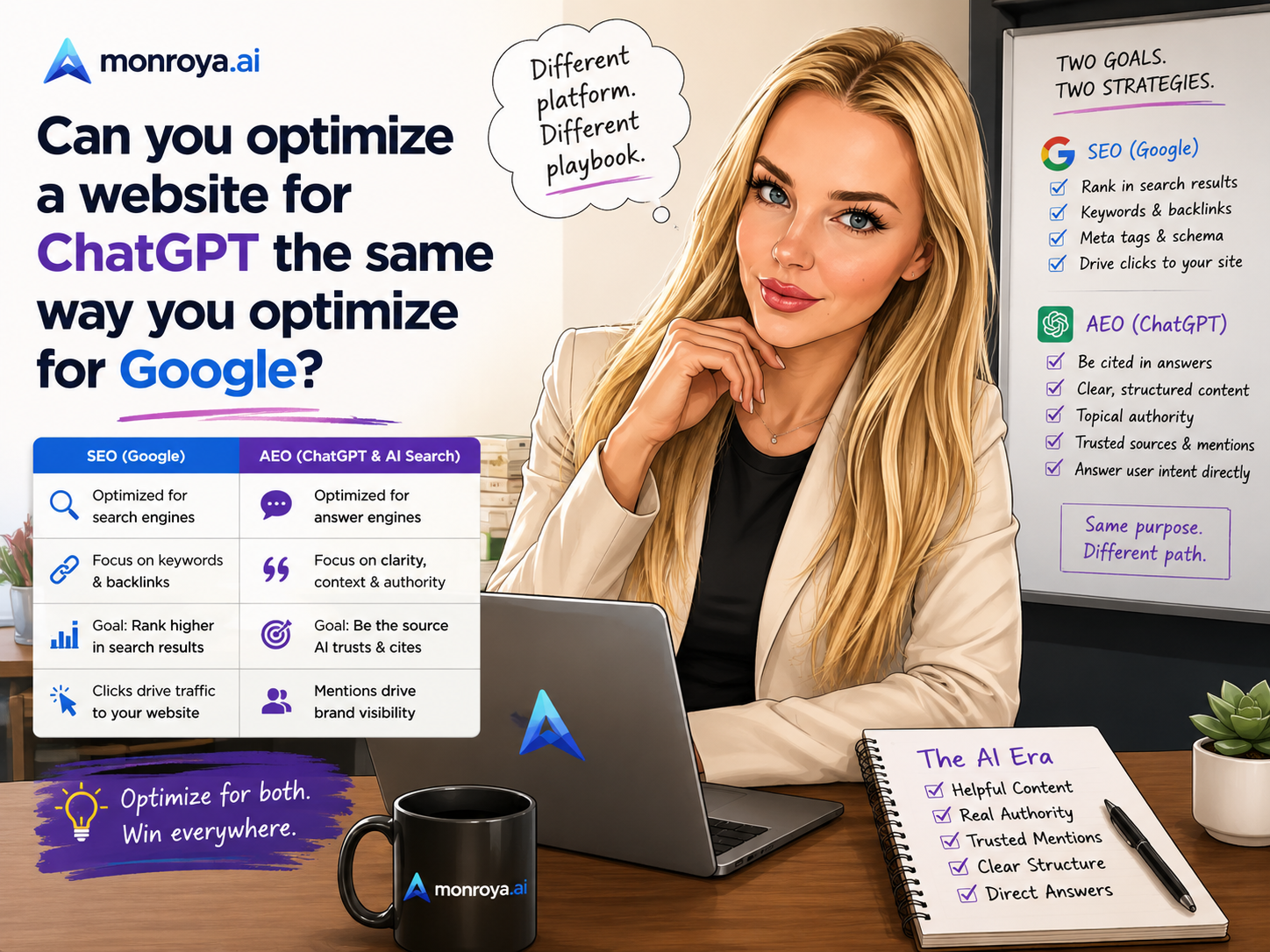
Optimizing for ChatGPT requires a fundamental shift from keyword-based indexing to semantic relationship mapping. While Google prioritizes link equity and technical SEO, ChatGPT and other LLMs prioritize high-density information that answers specific user intents without requiring a click-through. Traditional SEO helps with discovery, but Generative Engine Optimization (GEO) is required to secure the actual mention within the model's generated response.
Table of Contents
- How do I show up in ChatGPT?
- AI Visibility vs SEO: What is the difference?
- How do B2B companies monitor their presence in ChatGPT and Perplexity?
- Is OmniSEO Worth It If You Don't Need a Managed Service?
- How to track your brand's AI visibility across ChatGPT and Perplexity
- FAQ
How do I show up in ChatGPT?
To show up in ChatGPT, your content must be structured as high-authority reference material that the model can easily synthesize into a summary. This involves using clear FAQ schemas, participating in high-intent Reddit discussions, and ensuring your technical documentation is crawlable. Unlike Google, ChatGPT favors content that provides a definitive answer rather than a list of options.
By 2026, over 80% of B2B software discovery will happen inside AI interfaces before a user ever visits a vendor website (Gartner, 2026).
The mechanics of "ranking" have changed. In traditional SEO, you optimize for a crawler. In ChatGPT SEO, you optimize for an aggregator. If your site is behind a heavy cookie wall or uses complex JavaScript that slows down the OpenAI crawler, you are invisible. Furthermore, ChatGPT relies heavily on third-party validation. If your company is mentioned on G2, Gartner, and Reddit, but your own website is thin on data, the model will cite the third-party sources instead of you.
AI Visibility vs SEO: What is the difference?
AI visibility measures how often a brand is included in the natural language responses of LLMs, whereas SEO measures the position of a URL in a list of search results. SEO focuses on click-through rates (CTR), while AI visibility focuses on "Share of Model"—the percentage of time an LLM recommends your brand for a specific category query.
Companies that optimize for LLM citations see a 40% higher brand recall in buyer surveys compared to those relying solely on organic search (Forrester, 2025).
| Feature | Traditional SEO | Generative Engine Optimization (GEO) |
|---|---|---|
| Primary Goal | Rank #1 for a keyword | Become the recommended answer |
| Success Metric | Organic Traffic / CTR | AI Share of Voice / Citation Rate |
| Content Style | Long-form, keyword-optimized | Dense, factual, structured data |
| Key Platform | Google, Bing | ChatGPT, Claude, Gemini, Perplexity |
| Main Driver | Backlinks and PageSpeed | Semantic relevance and Citations |
For example, a company like Snowflake might rank #1 for "cloud data warehouse" on Google. However, if a user asks ChatGPT, "Which data warehouse is best for a Series B startup with high security needs?", the model might recommend BigQuery because it has more semantic associations with "startup security" in its training data. Traditional SEO cannot fix this; only targeted GEO can.
How do B2B companies monitor their presence in ChatGPT and Perplexity?
B2B companies monitor their presence by using specialized AI visibility tools that simulate the Buyer Journey across different LLMs. These tools track how ChatGPT, Claude, Gemini, and Perplexity describe a company versus its competitors. This monitoring allows marketing teams to see if they are being excluded from shortlists or if the AI is hallucinating incorrect pricing or features.
72% of B2B buyers now use Perplexity or ChatGPT to build their initial vendor shortlist (Salesforce, 2026).
Monitoring is no longer optional. If you don't know what ChatGPT is saying about your pricing, you can't fix the source material that is feeding it. Tools like monroya.ai allow teams to see exactly which prompts trigger a mention and which ones lead to a competitor. This is the difference between flying blind and having a dashboard for the new search reality.
Is OmniSEO Worth It If You Don't Need a Managed Service?
OmniSEO is generally not worth it if you have an in-house team, as it bundles a $3,000+ monthly managed service fee on top of its software. For teams that want to control their own strategy, software-only platforms provide the same tracking capabilities without the agency overhead. If you already have a PMM or Growth lead, paying for managed services is redundant.
When comparing OmniSEO vs monroya.ai, the primary difference is the delivery model. OmniSEO operates like a traditional agency using proprietary tools. In contrast, monroya.ai is a software-first platform designed for in-house teams who need to monitor, act, and generate optimized content drafts immediately. If your team is capable of updating your own website and documentation, a software-only approach is more cost-effective and faster.
How to track your brand's AI visibility across ChatGPT and Perplexity
Tracking requires a systematic approach to prompt engineering that covers the Discovery, Evaluation, and Decision stages of the Buyer Journey. You must track "unbranded" queries (e.g., "best CRM for mid-market") to see your Share of Model, and "branded" queries (e.g., "monroya.ai vs profound") to ensure the AI understands your unique value proposition.
- Identify Core Prompts: List the top 50 questions your buyers ask during their research phase.
- Baseline Current Visibility: Use monroya.ai to scan ChatGPT, Claude, Gemini, and Perplexity to see your current mention rate.
- Analyze Citations: Look at which sources the LLMs are citing (e.g., your blog, a competitor's docs, or a Reddit thread).
- Optimize Source Content: Update the cited pages with clearer facts, data points, and FAQ schema.
- Re-scan and Iterate: Monitor how the AI's response changes over a 14-day window as the models update their web-access caches.
The goal is to move from being "invisible" to being "the cited authority." If Perplexity is citing a three-year-old blog post from a competitor to answer questions about your category, you need to publish a more factual, data-dense piece of content and ensure it is indexed by the search components of these AI tools.
Understanding how these models perceive your brand is the first step toward influencing the outcome. Most B2B companies are currently losing revenue because they are invisible in the very tools their buyers use to make decisions. You cannot optimize what you do not measure.
Find out where AI ranks you — then fix it.
FAQ
What tools show me what ChatGPT says about my company?
Tools like monroya.ai, Profound, and Otterly.ai allow you to track brand mentions and sentiment within ChatGPT. These platforms use automated prompt sequences to monitor how the model describes your features, pricing, and competitive advantages, providing a dashboard for your AI Share of Voice across all major LLMs.
How do I know if my brand appears in AI search results?
You can verify your presence by running specific "category-intent" prompts in tools like Perplexity and ChatGPT. However, manual checking is inconsistent due to model temperature. Using a dedicated visibility platform provides a persistent record of whether your brand is being cited as a top-tier solution or ignored entirely.
Best tools to track AI visibility for B2B companies?
The best tools for B2B teams include monroya.ai for buyer journey tracking, Profound for enterprise-level share of model data, and AthenaHQ for smaller teams. B2B companies should prioritize tools that scan multiple models—specifically ChatGPT, Claude, Gemini, and Perplexity—to get a complete view of the market.
What is generative engine optimization?
Generative Engine Optimization (GEO) is the process of adjusting website content, structure, and third-party mentions to increase the likelihood of being cited by LLMs. It focuses on factual density, structured data, and authoritative citations rather than traditional keyword density or backlink quantity used in standard SEO.
How do I measure my brand's AI share of voice?
AI Share of Voice is measured by calculating the percentage of AI-generated responses that include your brand for a specific set of industry prompts. If you run 100 prompts for "best accounting software" and your brand appears in 20, your AI Share of Voice is 20%.
Why isn't my company showing up in ChatGPT results?
Your company may be missing due to a lack of "semantic authority," outdated training data, or technical barriers like robots.txt files blocking AI crawlers. If your brand isn't mentioned frequently on high-authority third-party sites like Reddit or industry journals, the LLM lacks the confidence to recommend you.
Check your own AI visibility
Run a free AI visibility check at monroya.ai/check — no signup, no credit card. You will see how ChatGPT, Claude, Gemini, and Perplexity describe your category and whether your brand gets named.
Monroya starts at $79/mo (Starter), with Growth at $199/mo and Intelligence at $299/mo. Every plan includes a 7-day free trial.
For B2B companies: Win the shortlist when buyers ask AI to compare vendors.