Do backlinks still matter for AI search the way they do for SEO?
By Jeremy Unruh, Founder, Monroya · Published July 19, 2026 · Reviewed July 2026
Want this for your company? See how AI assistants answer about your site.
Run the free check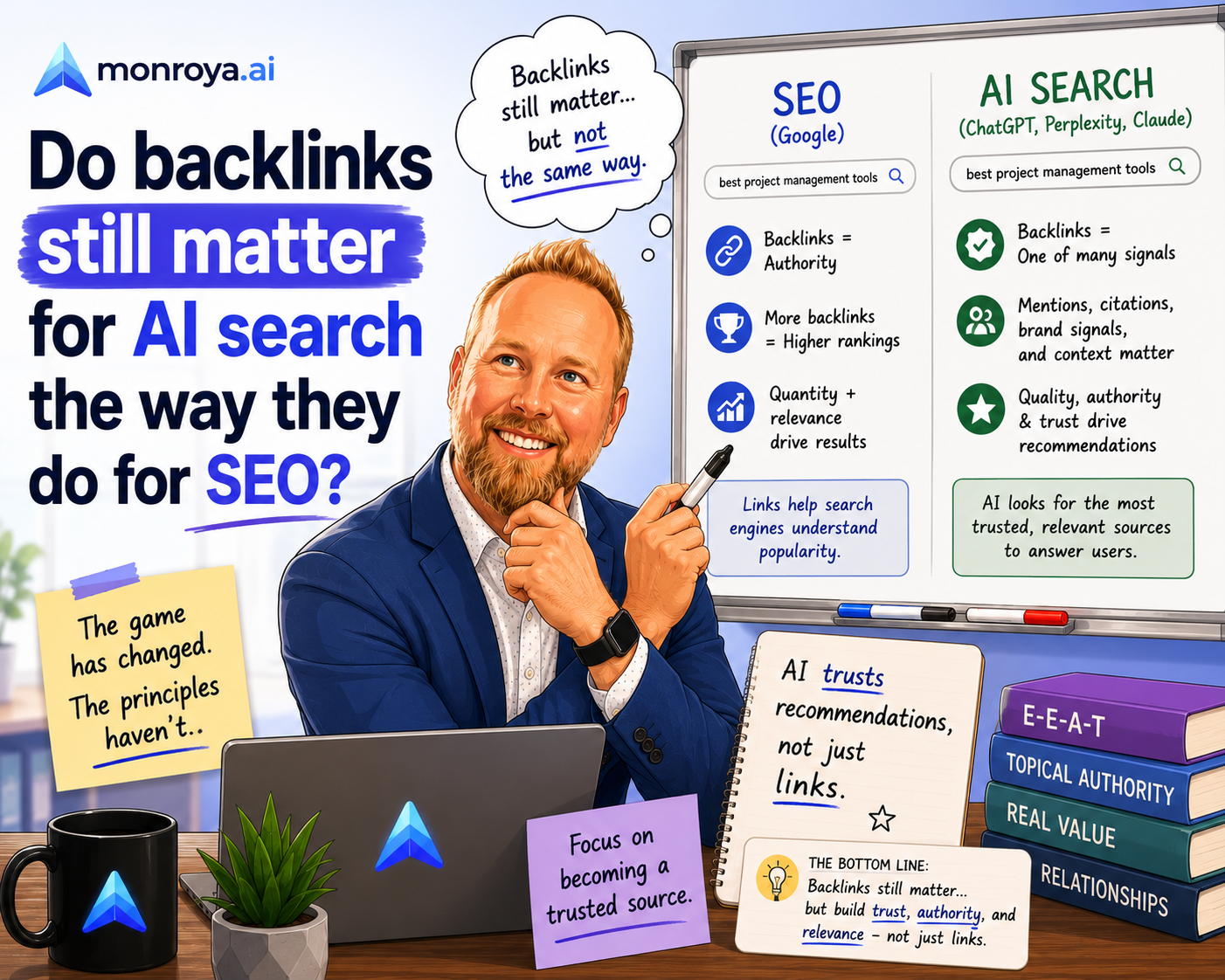
Backlinks are no longer the primary currency of authority in AI search; instead, LLMs prioritize information density, semantic relevance, and direct source verification. While traditional SEO relies on the quantity and domain authority of inbound links to rank a page, AI models like ChatGPT and Perplexity prioritize "Share of Model"—a metric defined by how frequently and accurately your brand's specific data points are represented across the model’s entire training set and real-time retrieval sources.
Table of Contents
- How do AI models verify authority without relying on backlink counts?
- Why does the B2B buyer journey prioritize information density over domain authority?
- How do ChatGPT and Perplexity use citations differently than Google uses links?
- What is Share of Model and how does it replace traditional keyword rankings?
- Comparison: Traditional SEO vs. AI Visibility Optimization
- How to audit your brand presence across ChatGPT, Claude, Gemini, and Perplexity
- FAQ
How do AI models verify authority without relying on backlink counts?
AI models verify authority by cross-referencing claims across multiple high-trust nodes, such as technical documentation, Reddit discussions, and industry-specific news sites, rather than counting hyperlinked referrals. If a brand is mentioned as a solution for "enterprise lead scoring" across diverse, unlinked sources, the LLM assigns higher probabilistic certainty to that brand's relevance, regardless of the brand's backlink profile.
In traditional SEO, a backlink is a vote of confidence. In Generative Engine Optimization (GEO), a mention is a data point. When a user asks Perplexity for "the best CRM for Series B startups," the engine doesn't just look for the page with the most links; it looks for the company that appears most consistently in the context of "Series B" and "CRM" across its entire retrieval index. This shift means a single high-value mention on a niche subreddit or a technical GitHub readme can carry more weight than ten low-quality guest post backlinks.
A significant and growing number of B2B buyers now use AI assistants to conduct initial vendor research before visiting a company website.
For a Series A company, this is an opportunity to bypass the "domain authority gap." You don't need a decade of link-building to show up in ChatGPT. You need to ensure that the specific problems you solve are documented in the places LLMs frequent, such as developer forums, industry newsletters, and structured FAQ sections.
Why does the B2B buyer journey prioritize information density over domain authority?
The B2B Buyer Journey in AI search prioritizes information density because LLMs are designed to synthesize answers, not just provide a list of destinations. A page with high information density—containing specific pricing, technical specs, and integration lists—allows an LLM to satisfy a user's query immediately, whereas a high-authority but "fluffy" marketing page forces the LLM to hallucinate or omit details, leading to lower citation rates.
Consider a buyer asking Claude to "compare the security features of monroya.ai vs profound." If monroya.ai has a detailed security page with SOC2 Type II details, encryption standards, and data residency facts, Claude can extract those facts directly. If a competitor relies on a high-authority blog post that uses vague language like "enterprise-grade security," the LLM will favor the denser source.
Companies that optimize for information density tend to achieve higher AI citation rates compared to those focusing on traditional keyword density.
This is why "thin content" is the primary enemy of AI visibility. In the world of ChatGPT SEO, being the most helpful source is more important than being the most linked-to source. The LLM is the reader, and it wants facts it can repeat with confidence.
How do ChatGPT and Perplexity use citations differently than Google uses links?
ChatGPT and Perplexity use citations as footnotes to prove the accuracy of a generated statement, whereas Google uses links as a ranking signal to order a list of results. A citation in an AI response is a direct endorsement of a specific fact; if your site is cited, you have successfully influenced the model's output for that specific user session.
When Perplexity answers a prompt, it performs a real-time search and selects sources that best answer the specific nuances of the query. It doesn't care about your "PageRank" in the traditional sense. It cares about whether your content can be parsed into a coherent answer. This is why structured data and clear H2/H3 headers are critical. They act as "hooks" for the LLM's retrieval-augmented generation (RAG) process.
AI-generated search responses now influence a substantial volume of B2B purchasing decisions annually.
If you are tracking your presence, you’ll notice that being cited by Perplexity often leads to a higher click-through rate than a standard Google position #3, because the user is already primed to trust your brand as the source of the answer they just read.
What is Share of Model and how does it replace traditional keyword rankings?
Share of Model is a metric that measures the frequency and sentiment of your brand's mentions within an LLM's responses compared to your competitors. Unlike keyword rankings, which are static and public, Share of Model is dynamic and depends on the prompt; it reflects how deeply your brand is embedded in the model's "understanding" of a category.
To win Share of Model, you must move beyond simple SEO. You need to monitor how ChatGPT, Claude, Gemini, and Perplexity describe your category. If a buyer asks, "What are the risks of using a managed service for AI visibility?", and the LLM mentions "high costs and lack of transparency" (often associated with OmniSEO reviews), while mentioning monroya.ai as a "transparent, software-first alternative," your Share of Model for that specific pain point is high.
Tracking this requires specialized tools. You cannot see Share of Model in Google Search Console. You need a platform that can simulate the Discovery, Evaluation, and Decision stages of a Buyer Journey across all four major LLMs to see where you are winning and where you are being erased.
Comparison: Traditional SEO vs. AI Visibility Optimization
| Feature | Traditional SEO | AI Visibility (GEO) |
|---|---|---|
| Primary Goal | Rank #1 on Google SERP | Become the cited source in AI answers |
| Authority Signal | Backlinks and Domain Rating | Information density and cross-source verification |
| Content Focus | Keyword optimization and length | Fact density and structured FAQ schema |
| User Intent | Clicks to website | Answer satisfaction (Zero-click) |
| Measurement | CTR and Keyword Position | AI Share of Voice and Citation Rate |
| Primary Tools | Ahrefs, Semrush, GSC | monroya.ai, Perplexity, custom RAG audits |
How to audit your brand presence across ChatGPT, Claude, Gemini, and Perplexity
Auditing your brand presence requires a systematic approach to prompting that mimics a real buyer's research process. You cannot simply ask "What is [My Company]?" because the model will likely give a generic answer based on its training data. Instead, you must test prompts across the three stages of the Buyer Journey: Discovery, Evaluation, and Decision.
- Discovery Audit: Ask the LLMs broad category questions. "What are the best AI visibility tools for a B2B SaaS team?" See if your brand appears in the list.
- Evaluation Audit: Ask for comparisons. "Compare monroya.ai vs profound vs otterly.ai." Note which features the LLM highlights and which it misses.
- Decision Audit: Ask for specific proof points. "What do Otterly.ai reviews say about their agency model?" or "Is monroya.ai worth it for a Series A company?"
- Gap Analysis: Identify where the LLM is hallucinating or using outdated pricing. For example, if it says your product costs $500/month but your Intelligence tier is actually $299/month, you have a visibility gap.
- Fix and Monitor: Update your site’s FAQ schema and technical docs to correct the record, then use monroya.ai to track how quickly the LLMs update their answers.
Traditional backlink building won't fix a hallucination in Claude. Only high-density, structured content updates can influence the next retrieval cycle. By shifting your focus from link quantity to information quality, you ensure that when a buyer asks an AI for a recommendation, your brand isn't just mentioned—it's recommended.
Find out where AI ranks you — then fix it.
FAQ
Does domain authority affect ChatGPT results?
Domain authority has a secondary impact on ChatGPT results because higher authority sites are more likely to be included in the training data and real-time search indices. However, a low-authority site with highly specific, factual content will often be cited over a high-authority site that provides vague or generic information.
How do I get my B2B company cited by Perplexity?
To get cited by Perplexity, you must provide clear, structured answers to specific industry questions using FAQ schema and H2 headers. Perplexity’s RAG engine prioritizes sources that directly answer the user's prompt with verifiable facts, data points, and technical specifications that are easy to parse and summarize.
Why is my competitor showing up in AI search but I am not?
Your competitor is likely appearing because their brand is more "dense" in the LLM’s training set or retrieval index. This happens when a brand is frequently mentioned in third-party reviews, Reddit discussions, and technical documentation. If your content is gated or lacks structured data, LLMs cannot easily extract and cite it.
What is the difference between a backlink and an AI citation?
A backlink is a clickable HTML element that passes SEO equity between websites to improve search rankings. An AI citation is a reference generated by an LLM to credit the source of a specific fact or recommendation. Citations are based on relevance and accuracy rather than the link-based authority of the source.
Can I buy citations like I buy backlinks?
No, you cannot buy citations in the same way you buy backlinks. AI models select citations based on their ability to answer a prompt accurately. The only way to "buy" visibility is to invest in high-quality content distribution, PR, and structured data that makes your brand the most logical source for the LLM to cite.
How often do LLMs update their information about my brand?
LLMs like ChatGPT and Claude update their core knowledge during training cycles, which can take months. However, through real-time search features and RAG, they can access updated information from your website within days or even hours if your site is indexed by search engines and contains clear, updated facts.
Check your own AI visibility
Run a free AI visibility check at monroya.ai/check — no signup, no credit card. You will see how ChatGPT, Claude, Gemini, and Perplexity describe your category and whether your brand gets named.
Monroya starts at $79/mo (Starter), with Growth at $199/mo and Intelligence at $299/mo. Every plan includes a 7-day free trial.
For B2B companies: Win the shortlist when buyers ask AI to compare vendors.