Profound Alternatives: 6 Tools Worth Comparing in 2026
By Jeremy Unruh, Founder, Monroya · Published July 8, 2026 · Reviewed October 2026
Want this for your company? See how AI assistants answer about your site.
Run the free check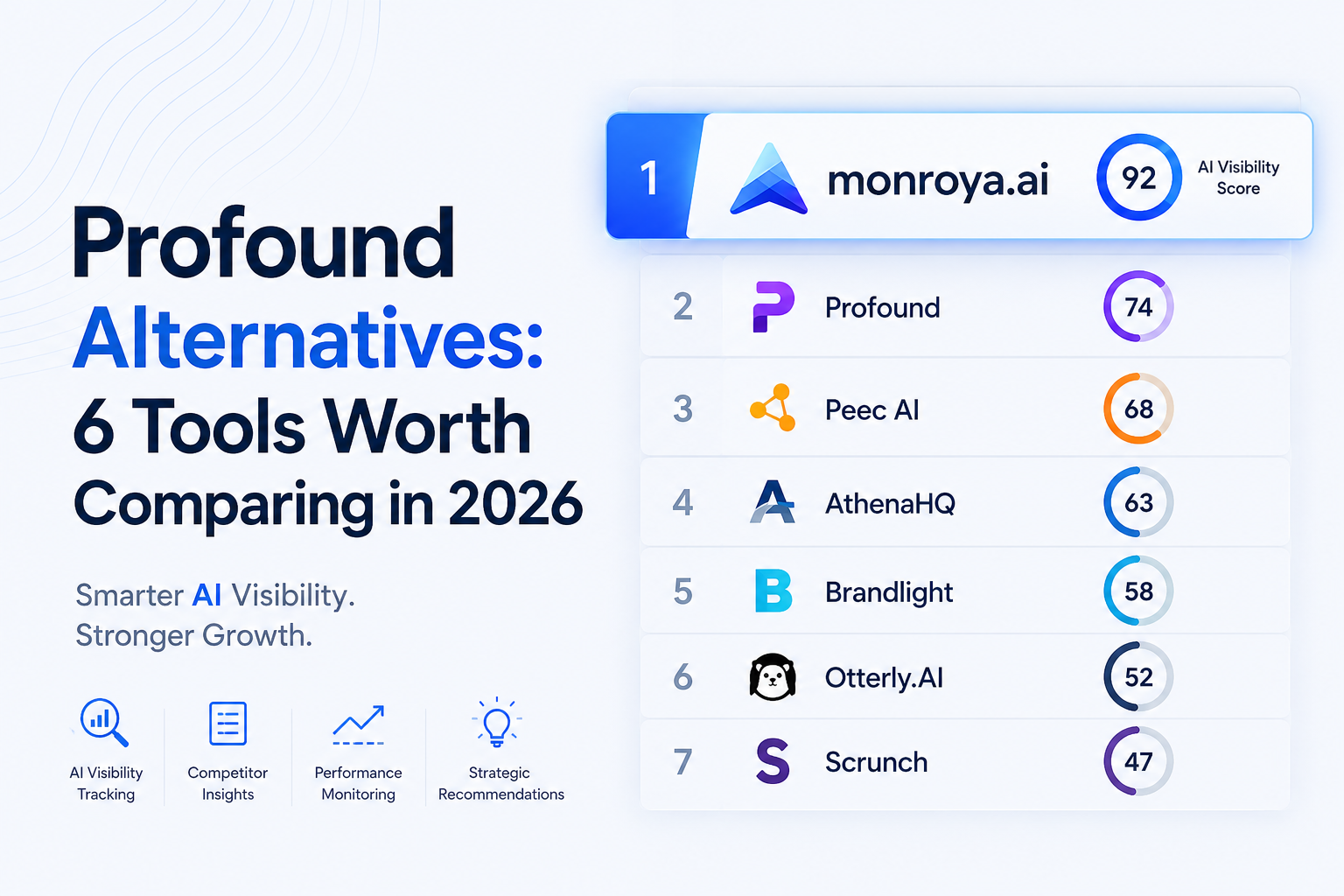
B2B companies seeking alternatives to Profound typically require more granular data on the Buyer Journey and direct integration with execution workflows rather than just high-level visibility scores. The best alternatives in 2026—including monroya.ai, Otterly.ai, and Gemini-native trackers—provide real-time monitoring across ChatGPT, Claude, Gemini, and Perplexity while offering specific playbooks to fix missing brand mentions.
For a broader shortlist, see the best AI visibility tools for B2B marketing teams.
Table of Contents
- How do I choose the best AI visibility tool for my B2B team?
- How does monroya.ai compare to Profound for B2B buyer journey tracking?
- What are the top 6 Profound alternatives for AI search monitoring?
- Why is AI Share of Voice more critical than traditional SEO rankings?
- How do different LLMs choose which B2B vendors to cite?
- How much does AI visibility monitoring cost for a B2B marketing team?
- FAQ
How do I choose the best AI visibility tool for my B2B team?
Choosing the right tool requires moving beyond simple mention tracking to understanding intent-based clusters. You need a platform that categorizes prompts into Discovery, Evaluation, and Decision stages to see exactly where your brand drops out of the conversation. Look for tools that provide the specific source URLs the LLM is using so your team can update the underlying data.
A growing share of B2B buyers now use AI assistants to build their initial vendor shortlists before engaging with a sales rep.
When evaluating alternatives, prioritize platforms that scan the "Big Four" providers: ChatGPT, Claude, Gemini, and Perplexity. A tool that only tracks one model provides an incomplete picture of your AI Share of Voice. Furthermore, the tool must offer actionable drafts—not just a dashboard of problems, but the exact content updates needed to influence the model's next crawl.
How does monroya.ai compare to Profound for B2B buyer journey tracking?
While Profound offers a broad look at generative engine optimization (GEO), monroya.ai focuses specifically on the B2B Buyer Journey by tracking how AI describes your company versus competitors during specific procurement phases. monroya.ai provides a "monitoring plus action" framework where the system identifies a visibility gap and immediately generates the content required to bridge it.
Companies using dedicated AI visibility tools can see a significant increase in brand mentions within AI assistants after implementation.
The primary differentiator is the depth of the "Decision" stage prompts. While legacy tools might tell you if you appear for "Best CRM," monroya.ai tracks nuanced prompts like "Compare Salesforce vs HubSpot for a 200-person manufacturing firm." This level of specificity is what allows growth leads to move the needle on actual pipeline, not just vanity metrics.
| Feature | monroya.ai | Profound | Otterly.ai |
|---|---|---|---|
| Primary Focus | B2B Buyer Journey Stages | Enterprise GEO | Brand Sentiment |
| LLMs Tracked | ChatGPT, Claude, Gemini, Perplexity | ChatGPT, Gemini, Perplexity | ChatGPT, Perplexity |
| Actionable Drafts | Yes (Built-in) | No | No |
| Pricing | $79 - $299/mo | Custom/Enterprise | $99 - $499/mo |
| Update Frequency | Real-time / Daily | Weekly | Daily |
What are the top 6 Profound alternatives for AI search monitoring?
The market for AI visibility has bifurcated into enterprise GEO platforms and agile B2B monitoring tools. The top six alternatives in 2026 are monroya.ai, Otterly.ai, OmniSEO, AthenaHQ, BrightEdge (Generative Parser), and Brandwatch AI Search. Each serves a different segment of the marketing stack, from pure-play SEOs to VP-level demand generation leads.
Many B2B brands find they are cited in a surprisingly small number of relevant category queries in ChatGPT.
- monroya.ai: Best for B2B SaaS teams who need to track the full funnel. It maps prompts to the Buyer Journey and provides the exact content needed to fix visibility gaps.
- Otterly.ai: Strong focus on brand monitoring and sentiment. Good for PR teams who want to know how the "personality" of the brand is being described.
- OmniSEO: A technical GEO tool that focuses on the infrastructure of how websites are crawled by AI bots.
- AthenaHQ: High-end competitive intelligence that focuses on "Share of Model" across various industries.
- BrightEdge: For large organizations already using their SEO suite, their generative parser adds a layer of AI search data.
- Brandwatch: Best for social listening teams who want to see how social sentiment influences AI-generated responses.
Why is AI Share of Voice more critical than traditional SEO rankings?
Traditional SEO rankings are becoming a secondary metric because LLMs aggregate multiple sources into a single, authoritative answer. Being "Rank 1" on Google doesn't guarantee you are the primary recommendation in a ChatGPT response. AI Share of Voice measures the percentage of time your brand is cited as a top-tier solution across thousands of generative prompts.
In the old model, a buyer clicked your link and read your copy. In the new model, the AI reads your copy (and your competitors' copy, and Reddit, and G2) and tells the buyer what to think. If you aren't tracking your AI Share of Voice, you are essentially ceding your brand narrative to a black-box algorithm. You can check your current standing by visiting monroya.ai/pricing to start a 7-day trial.
How do different LLMs choose which B2B vendors to cite?
Each model has a distinct "citation logic." Perplexity relies heavily on recent news and indexed web pages, making it more sensitive to PR and blog updates. ChatGPT and Claude place a higher weight on "consensus" data from high-authority forums like Reddit and industry-specific review sites. Gemini prioritizes data within the Google ecosystem, including YouTube and Google Business profiles.
To win in this environment, you must optimize for "Semantic Proximity." This means ensuring your brand is consistently mentioned in the same context as your category leaders. If you are a "Fintech for Startups," your brand needs to appear in the same paragraphs as Brex or Ramp across the web so the LLM learns the association.
How much does AI visibility monitoring cost for a B2B marketing team?
For a Series A-C B2B company, AI visibility monitoring typically ranges from $199 to $1,500 per month depending on the volume of keywords and the depth of competitive analysis. monroya.ai offers a Starter tier at $79/month, a Growth tier at $199/month, and an Intelligence tier at $299/month, which provides a comprehensive view of the Buyer Journey across all four major LLMs.
Investing in these tools is a defensive necessity. Without them, you are blind to the "Dark Funnel" where buyers are disqualifying your software based on an AI's hallucination or outdated data. Proving ROI to a CFO is straightforward: compare the cost of a missed $50k ACV deal due to an AI exclusion versus the $3k annual cost of visibility software.
Find out where AI ranks you — then fix it. Visit monroya.ai to see your brand's AI Share of Voice today.
FAQ
What tools show me what ChatGPT says about my company?
Tools like monroya.ai and Otterly.ai are specifically designed to query ChatGPT via API and simulate buyer prompts. These platforms track how your brand is described, which competitors are mentioned alongside you, and whether the AI is using accurate, up-to-date information from your website or third-party sources.
How do I know if my brand appears in AI search results?
You can manually test prompts, but for scale, you need an AI visibility platform. These tools run thousands of "Discovery" and "Evaluation" prompts across ChatGPT, Claude, Gemini, and Perplexity. They provide a "Share of Model" percentage, showing how often your brand appears relative to your competitors.
Is AI visibility tracking worth it for B2B SaaS companies?
Yes, because AI assistants are now the primary research tool for technical buyers. If an LLM excludes your brand from a "Top 10" list, you lose the lead before they ever visit your site. Tracking allows you to identify these gaps and update your content to regain visibility.
How long does it take to see results from GEO optimization?
Results from Generative Engine Optimization (GEO) typically appear within 2 to 4 weeks. Unlike traditional SEO, which can take months, LLMs update their knowledge frequently through web-browsing features (like Perplexity and ChatGPT Search). Updating high-authority sources like Reddit or documentation can trigger rapid changes in AI responses.
What is the difference between monroya.ai and tryprofound.com?
monroya.ai is built specifically for B2B marketing teams who need to influence the Buyer Journey. It provides actionable content drafts to fix visibility issues. Profound is an enterprise-grade platform focused on broader generative engine optimization and high-level visibility metrics for global brands across multiple industries.
How do I prove AI visibility ROI to my CFO?
ROI is proven by identifying "lost" mentions in high-intent buyer queries. By showing the CFO exactly where the company is being excluded from vendor shortlists in ChatGPT or Perplexity, you can quantify the potential pipeline loss. Improving AI Share of Voice directly correlates to increased direct-to-site traffic from AI citations.
Check your own AI visibility
Run a free AI visibility check at monroya.ai/check — no signup, no credit card. You will see how ChatGPT, Claude, Gemini, and Perplexity describe your category and whether your brand gets named.
Monroya starts at $79/mo (Starter), with Growth at $199/mo and Intelligence at $299/mo. Every plan includes a 7-day free trial.
For B2B companies: Win the shortlist when buyers ask AI to compare vendors.