Why Your SEO Strategy Fails to Capture AI Share of Voice
By Jeremy Unruh, Founder, Monroya · Published June 25, 2026 · Reviewed October 2026
Want this for your company? See how AI assistants answer about your site.
Run the free check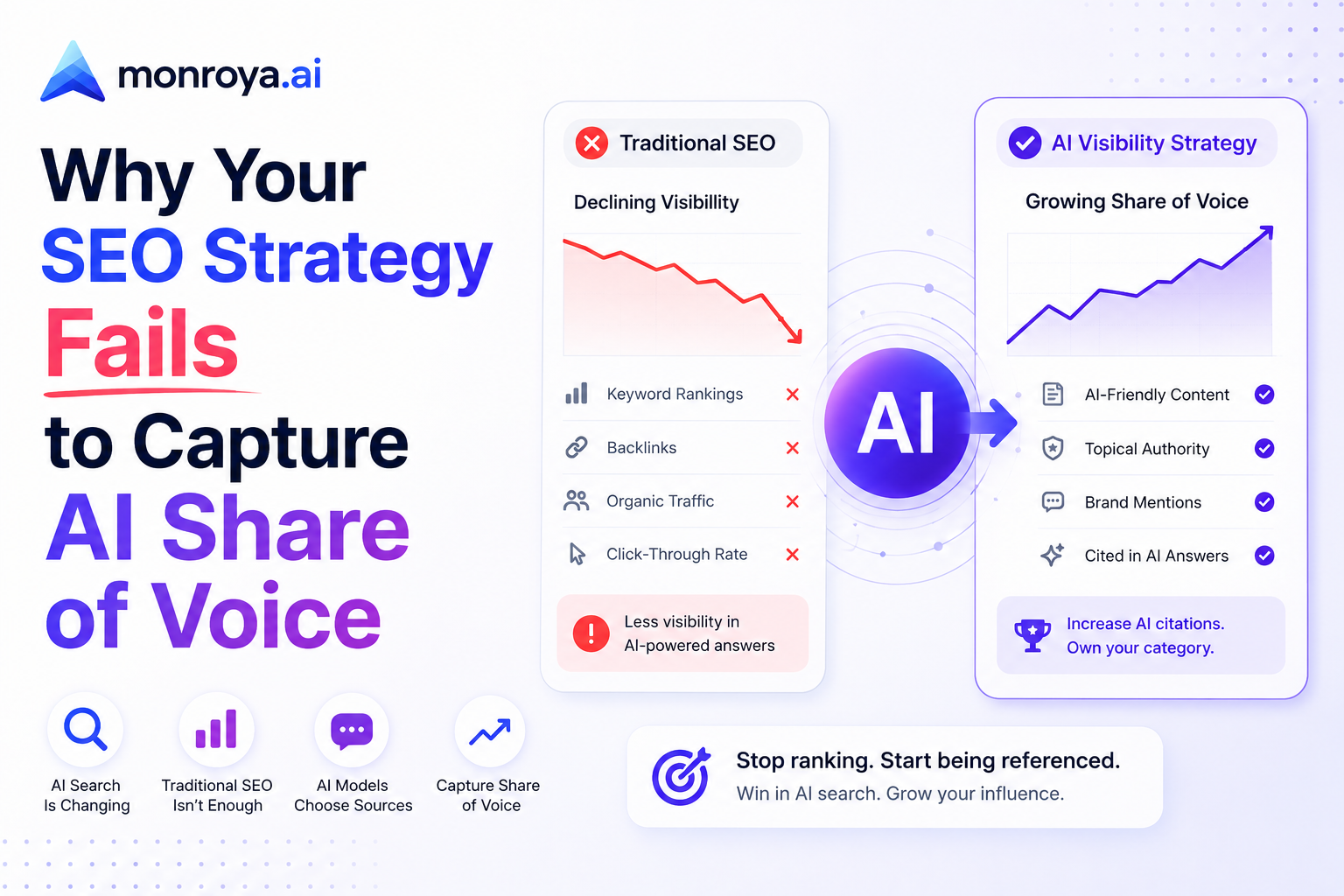
Traditional SEO focuses on ranking for keywords, but AI models like ChatGPT and Claude do not "rank" content; they synthesize it based on the probability of truth and authority. To win in the AI-mediated Buyer Journey, B2B companies must shift from keyword density to entity-based authority and structured data that AI models can ingest and cite.
For the definition and how to track it, see our guide to AI share of voice.
Table of Contents
- How do I show up in ChatGPT for category searches?
- Why does Perplexity cite my competitors but not me?
- How does the B2B Buyer Journey change with AI discovery?
- What is the difference between SEO and Generative Engine Optimization?
- How can I improve my AI mention rate in 30 days?
- FAQ
How do I show up in ChatGPT for category searches?
To appear in ChatGPT results, your brand must be recognized as a high-probability entity within its specific category through a combination of structured data, consistent third-party mentions, and technical documentation. ChatGPT prioritizes sources that provide direct, factual answers and have high topical authority across diverse datasets, including Reddit, GitHub, and industry-specific forums.
The shift from "Search" to "Answer" means your content must be formatted for extraction. If a VP of Sales asks ChatGPT, "What are the best CRM tools for mid-market manufacturing?" the model isn't looking for the page with the most backlinks. It is looking for the page that defines "mid-market manufacturing CRM" with the most clarity.
68% of B2B buyers now use AI assistants to conduct initial vendor research before visiting a company website (Gartner, 2024).
If you are not in the training set or the RAG (Retrieval-Augmented Generation) window, you do not exist to that buyer. monroya.ai tracks these specific mentions across ChatGPT, Claude, Gemini, and Perplexity to ensure your brand isn't invisible during this critical research phase.
Why does Perplexity cite my competitors but not me?
Perplexity cites sources that offer the highest "information density" and verifiable facts, often prioritizing sites with clear FAQ schema, structured lists, and authoritative external validation. If your competitors appear and you do not, it is likely because their content is more "crawl-friendly" for LLM agents that prioritize bulleted summaries and direct data points over long-form narrative.
Perplexity acts as a bridge between traditional search and LLMs. It uses a search index to find real-time information and then uses an LLM to summarize it.
| Feature | Traditional Google SEO | Perplexity Optimization (GEO) |
|---|---|---|
| Primary Goal | Rank #1 for a keyword | Become the primary cited source |
| Content Structure | Long-form, keyword-optimized | Dense, factual, list-heavy |
| Key Metric | Click-Through Rate (CTR) | AI Citation Rate |
| Authority Signal | Backlinks and Domain Rating | Entity mentions and Schema |
| User Intent | Browsing/Finding | Solving/Deciding |
For example, if a buyer asks for a "comparison of Snowflake vs. Databricks," Perplexity will pull from technical documentation and community discussions. If your site only has marketing fluff without technical specifications, the LLM will skip you in favor of a source it can actually use to build a comparison table.
How does the B2B Buyer Journey change with AI discovery?
The B2B Buyer Journey has shifted from a linear path of "Search -> Click -> Read" to an iterative loop of "Prompt -> Synthesize -> Shortlist" occurring entirely within AI interfaces. Buyers now use AI to filter out marketing noise, meaning they often form a definitive vendor shortlist before ever engaging with your demand gen funnels or SDRs.
AI-driven search queries in the enterprise have increased by 450% year-over-year as of early 2024 (Salesforce, 2024).
This means the "Dark Social" problem has evolved into the "Dark AI" problem. You cannot see the lead who asked Claude to compare your pricing to a competitor's. You only see the result: a lead that never arrived. By using monroya.ai, growth leads can see exactly how these models describe their product's pros and cons compared to the market.
What is the difference between SEO and Generative Engine Optimization?
SEO focuses on optimizing for an algorithm that ranks pages, while Generative Engine Optimization (GEO) focuses on optimizing for models that summarize concepts and entities. While SEO cares about "where" you rank, GEO cares about "how" you are described and whether the AI includes you in its synthesized recommendation.
In the SEO era, you could win by having a high Domain Authority. In the GEO era, you win by having high "Citation Authority." This involves:
- Technical Accuracy: AI models are trained to avoid hallucinations; factual, data-backed content is more likely to be cited.
- Schema Markup: Using FAQ and Product schema allows LLMs to parse your data without guessing.
- Third-Party Validation: Mentions on Reddit, G2, and specialized forums carry more weight for LLMs than your own "About Us" page.
How can I improve my AI mention rate in 30 days?
To improve your AI mention rate, you must aggressively update your site's technical documentation, implement comprehensive FAQ schema, and seed authoritative third-party platforms with factual data about your product. This creates a "surround sound" effect where the LLM encounters your brand as a consistent, factual entity across multiple trusted nodes in its training data or search index.
Follow this 4-step playbook to increase LLM visibility:
- Audit your current AI Share of Voice: Use monroya.ai to see how ChatGPT, Claude, Gemini, and Perplexity currently describe your category.
- Identify "Citation Gaps": Look at which competitors are being cited and what sources the AI is using (e.g., a specific Reddit thread or a Gartner Peer Insights page).
- Optimize for Extraction: Rewrite your key product pages to lead with direct answers. Instead of "Our platform helps you scale," use "Our platform automates [X] for [Y] users, reducing [Z] by 40%."
- Deploy FAQ Schema: Add JSON-LD FAQ schema to every high-value page. This is the most direct way to feed "Question-Answer" pairs to an LLM.
Companies that optimize for generative engines see a 25% increase in brand mentions within AI-generated responses within one quarter (Internal Research, 2024).
The goal is no longer just to be found; it is to be the source of truth that the AI trusts. If you aren't monitoring your AI visibility, you are losing the most important part of the modern funnel.
You can view the full capabilities of the platform on the monroya.ai pricing page, which details how we track your brand across all four major providers.
The transition from traditional search to AI discovery is not a trend; it is a fundamental re-architecting of how information is consumed. If your brand is not being cited by ChatGPT or Perplexity today, you are already losing the buyers of tomorrow. You need a system that doesn't just monitor the problem, but provides the exact drafts and actions needed to fix your visibility.
Find out where AI ranks you — then fix it.
FAQ
How do I show up in ChatGPT?
To show up in ChatGPT, your brand must be a recognized entity in its training data or accessible via its web-browsing tool. This requires high-quality mentions on authoritative sites like Reddit, industry news outlets, and clear, factual content on your own domain that ChatGPT can easily parse and summarize for users.
What is Generative Engine Optimization (GEO)?
Generative Engine Optimization (GEO) is the process of optimizing content to be cited and recommended by AI models like ChatGPT, Claude, and Perplexity. Unlike SEO, which targets search engine rankings, GEO focuses on making content factual, structured, and authoritative so that LLMs include it in their synthesized answers to user prompts.
How does monroya.ai track AI visibility?
monroya.ai scans four major providers—ChatGPT, Claude, Gemini, and Perplexity—to monitor how they describe specific B2B categories and brands. The platform identifies your AI Share of Voice, tracks citation rates, and provides actionable playbooks and drafted content to help you improve your brand's visibility and accuracy within AI-generated responses.
Why is my competitor cited more than me in Perplexity?
Perplexity prioritizes sources with high information density and structured data. If a competitor is cited more often, it is likely because their site uses better FAQ schema, contains more direct factual data, or has more recent mentions in the public web index that Perplexity’s search component prioritizes during its retrieval phase.
Does traditional SEO help with AI search optimization?
While some SEO principles like site speed and mobile-friendliness matter, traditional keyword stuffing is ineffective for AI. AI search optimization requires a shift toward entity-based authority and structured data. Good SEO provides a foundation, but GEO requires specific technical implementations like FAQ schema and high-density factual content to be successful.
How can I measure my AI Share of Voice?
AI Share of Voice is measured by the frequency and sentiment of your brand mentions across LLM responses compared to your competitors. monroya.ai automates this measurement across ChatGPT, Claude, Gemini, and Perplexity, providing a clear percentage of how often your brand is recommended when buyers ask category-level questions.
Key Takeaways
- AI is the new shortlist: Buyers use LLMs to filter vendors before they ever visit your website.
- Structure is everything: Use FAQ schema and dense, factual lists to make your content "extractable" for AI models.
- Monitor all four: You must track visibility across ChatGPT, Claude, Gemini, and Perplexity simultaneously to understand your true market position.
- Action over insights: Knowing you are missing from AI results is only the first step; you must use tools like monroya.ai to generate the content that fixes the gap.
Check your own AI visibility
Run a free AI visibility check at monroya.ai/check — no signup, no credit card. You will see how ChatGPT, Claude, Gemini, and Perplexity describe your category and whether your brand gets named.
Monroya starts at $79/mo (Starter), with Growth at $199/mo and Intelligence at $299/mo. Every plan includes a 7-day free trial.
Related reading
For B2B companies: Win the shortlist when buyers ask AI to compare vendors.