The AI Visibility Impact Matrix: What Content Actually Moves the Needle
By Jeremy Unruh, Founder, Monroya · Published July 10, 2026 · Reviewed September 2026
Want this for your company? See how AI assistants answer about your site.
Run the free check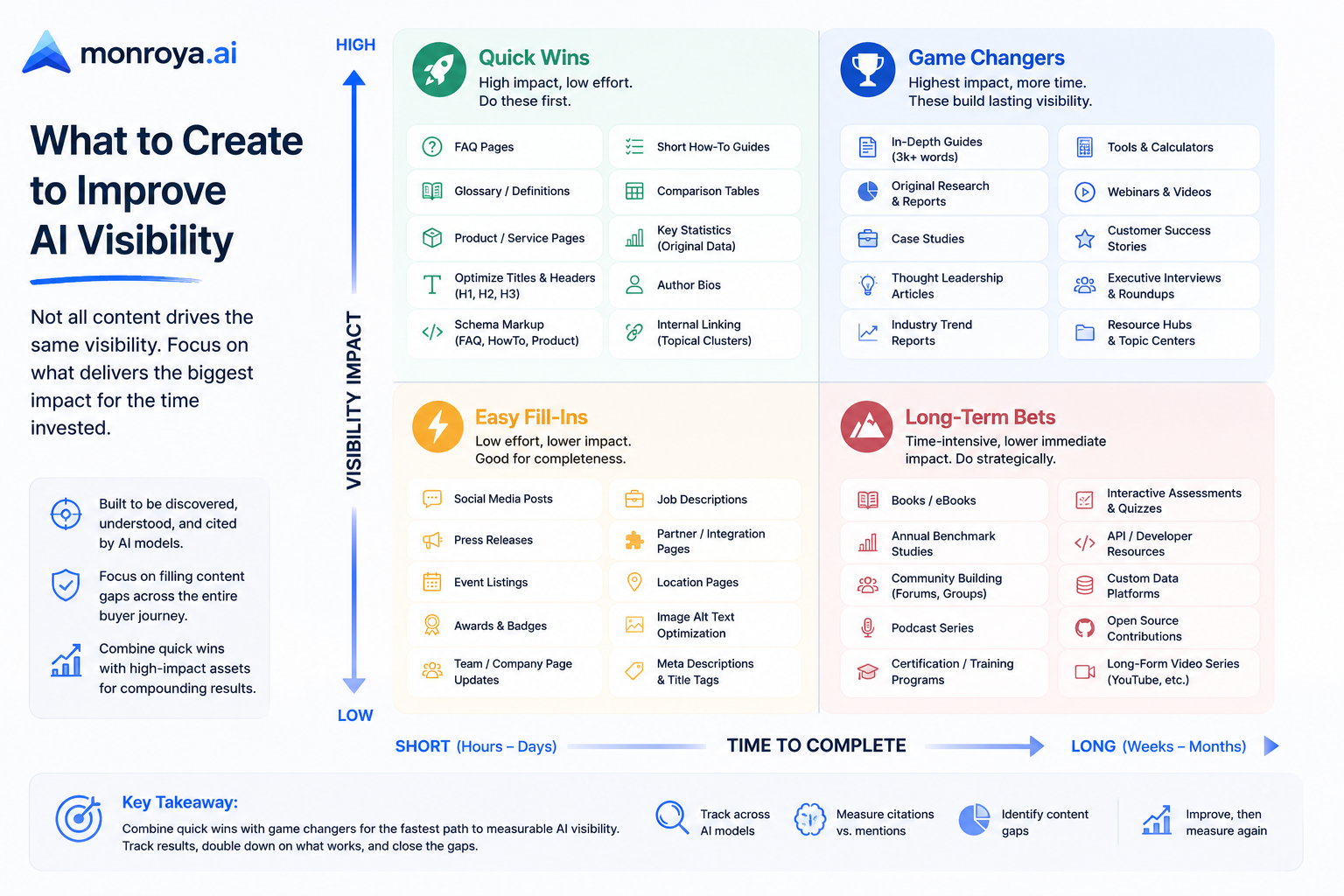
Every AI visibility guide gives you the same list: FAQ pages, comparison tables, schema markup, thought leadership, case studies, glossaries, original research, and about twenty more. The lists are correct. They are also useless without prioritization — because most teams have time to ship three of those this quarter, not thirty.
The matrix below sorts every common asset by the two variables that actually decide whether you'll do it: visibility impact (how much it moves ChatGPT, Claude, Gemini, and Perplexity coverage) and time to complete (hours vs. months).
Table of Contents
- Quick Wins: high impact, low effort
- Game Changers: highest impact, more time
- Easy Fill-Ins: low effort, lower impact
- Long-Term Bets: time-intensive, lower immediate impact
- How to sequence the four quadrants
- Why "impact" is stage-specific
Quick Wins: high impact, low effort
These are the assets to ship in the first two weeks. They punch above their weight because LLMs preferentially cite structured, question-shaped, definition-shaped content — and most sites don't have any of it.
- FAQ pages. Answer the ten questions your buyers actually ask (not the ones marketing wishes they asked). Each answer should be self-contained in 40–80 words so a model can lift it as a citation without needing the surrounding page.
- Short how-to guides. 400–800 words, one procedure, numbered steps, no throat-clearing intro.
- Glossary / definitions. One term per page, canonical definition in the first sentence, then context. This is how you win "what is X" prompts across all four providers.
- Comparison tables. The single most-cited format in evaluation-stage prompts. Even a 6-row table beats 2,000 words of prose.
- Product / service pages with clear, extractable claims — pricing, features, integrations, limits.
- Optimized H1/H2/H3 that match real search phrases, not clever internal names.
- Key statistics with original data. One data point you own, sourced and dated, gets cited disproportionately.
- Author bios. Models increasingly weight source authority. A named human with credentials on the byline changes retrieval.
- Schema markup — FAQ, HowTo, Product. This is a one-time engineering task that keeps compounding.
- Internal linking (topical clusters). Group related pages under a hub. Coverage of a topic beats a single strong page.
Ship five of these in the first sprint and you will see movement in your next scan.
Game Changers: highest impact, more time
These take weeks, not days — but they are what actually makes an LLM describe you as the answer in a category rather than an option.
- In-depth guides (3,000+ words). The definitive resource on a specific problem. When ChatGPT summarizes "how to do X," it's summarizing whatever the deepest, most-linked-to guide says.
- Original research and reports. A survey, a benchmark, a proprietary dataset. Original data becomes the source everyone else cites, which becomes the source LLMs cite.
- Case studies. Named customer, specific numbers, before-and-after. Generic "trusted by leading brands" content gets ignored.
- Thought leadership articles — a real point of view, defended with evidence. Models can distinguish this from lightly-edited AI slop; they cite the former.
- Industry trend reports. Recurring, dated, category-defining. This is how you become a reference source.
- Tools and calculators. The most linkable asset on the internet. A single well-built calculator can outperform a hundred blog posts.
- Webinars and videos. Transcripts get indexed. Video presence increasingly feeds multimodal models.
- Customer success stories at scale — a library, not a page.
- Executive interviews and roundups. These pull authority from other named experts and route it back to your domain.
- Resource hubs and topic centers. The clearest signal to a model that you own a category.
Easy Fill-Ins: low effort, lower impact
Ship these when a writer or marketer has a spare afternoon. Don't build your quarter around them.
Social media posts, press releases, event listings, awards and badges, job descriptions, partner/integration pages, location pages, image alt text, team pages, meta descriptions and title tags. Each one is worth doing. None of them, alone, will change how ChatGPT describes your category. Their value is completeness — the twentieth signal that tells a model you are a real company covering a real topic.
Long-Term Bets: time-intensive, lower immediate impact
These are the assets that don't pay back for six to twelve months, but the payback is durable when it lands.
Books and eBooks, annual benchmark studies, community building (forums, Slack groups, subreddits), podcast series, certification and training programs, interactive assessments and quizzes, API and developer resources, custom data platforms, open source contributions, long-form video series.
The pattern: these all generate their own gravity. A book gets cited by other writers. A community produces user-generated content indexed under your domain. An open source project earns backlinks from engineers, not marketers. Start one long-term bet per quarter; do not start four.
How to sequence the four quadrants
The mistake we see most often: teams start with Long-Term Bets ("we're planning our annual report") or Easy Fill-Ins ("we're refreshing meta descriptions") because those feel like real projects. Meanwhile they have no FAQ pages and no comparison tables.
The correct sequence, from a standing start:
- Weeks 1–2: Ship five Quick Wins. Rescan.
- Weeks 3–8: Begin one Game Changer while you continue publishing Quick Wins weekly.
- Ongoing: Fold in Easy Fill-Ins as background work. Start one Long-Term Bet per quarter.
- After every publish: Track the delta. If your Discovery-stage citations moved but Evaluation didn't, you probably shipped a definition and now need a comparison.
Why "impact" is stage-specific
The matrix above is a starting rank. The real ranking depends on which buyer journey stage you're weakest in.
- Discovery-stage weakness (buyers don't yet know brand names) is fixed by FAQ pages, glossaries, and how-to guides — the informational formats.
- Evaluation-stage weakness (buyers are comparing options) is fixed by comparison tables, case studies, and in-depth guides — the commercial formats.
- Decision-stage weakness (buyers are ready to buy) is fixed by product pages, pricing pages, integrations, and reviews — the transactional formats.
A general "we don't show up in AI" complaint almost always resolves to one of these three specific gaps. Fix the right one and the visibility movement is disproportionate; fix the wrong one and you added great content that didn't move your number.
That's the whole point of tracking by stage: quadrant tells you what to build; stage tells you why.
If you want to see which stage is dragging your visibility, run a free scan — one week, no card, full matrix across ChatGPT, Claude, Gemini, and Perplexity.
Check your own AI visibility
Run a free AI visibility check at monroya.ai/check — no signup, no credit card. You will see how ChatGPT, Claude, Gemini, and Perplexity describe your category and whether your brand gets named.
Monroya starts at $79/mo (Starter), with Growth at $199/mo and Intelligence at $299/mo. Every plan includes a 7-day free trial.
FAQ
Which content types move AI visibility most?
The matrix sorts common assets by visibility impact and effort, so you can pick the few that shift assistant coverage rather than working through a list of thirty.
Why prioritise at all?
Most teams can ship about three content assets a quarter, so a complete list of recommended asset types is not useful without an order to do them in.
How do I know a change worked?
Re-run the same buyer questions after the change and compare who gets named, rather than judging from a single answer.
Related reading
For B2B companies: Win the shortlist when buyers ask AI to compare vendors.