What content actually gets cited by AI search tools?
By Jeremy Unruh, Founder, Monroya · Published July 15, 2026 · Reviewed July 2026
Want this for your company? See how AI assistants answer about your site.
Run the free check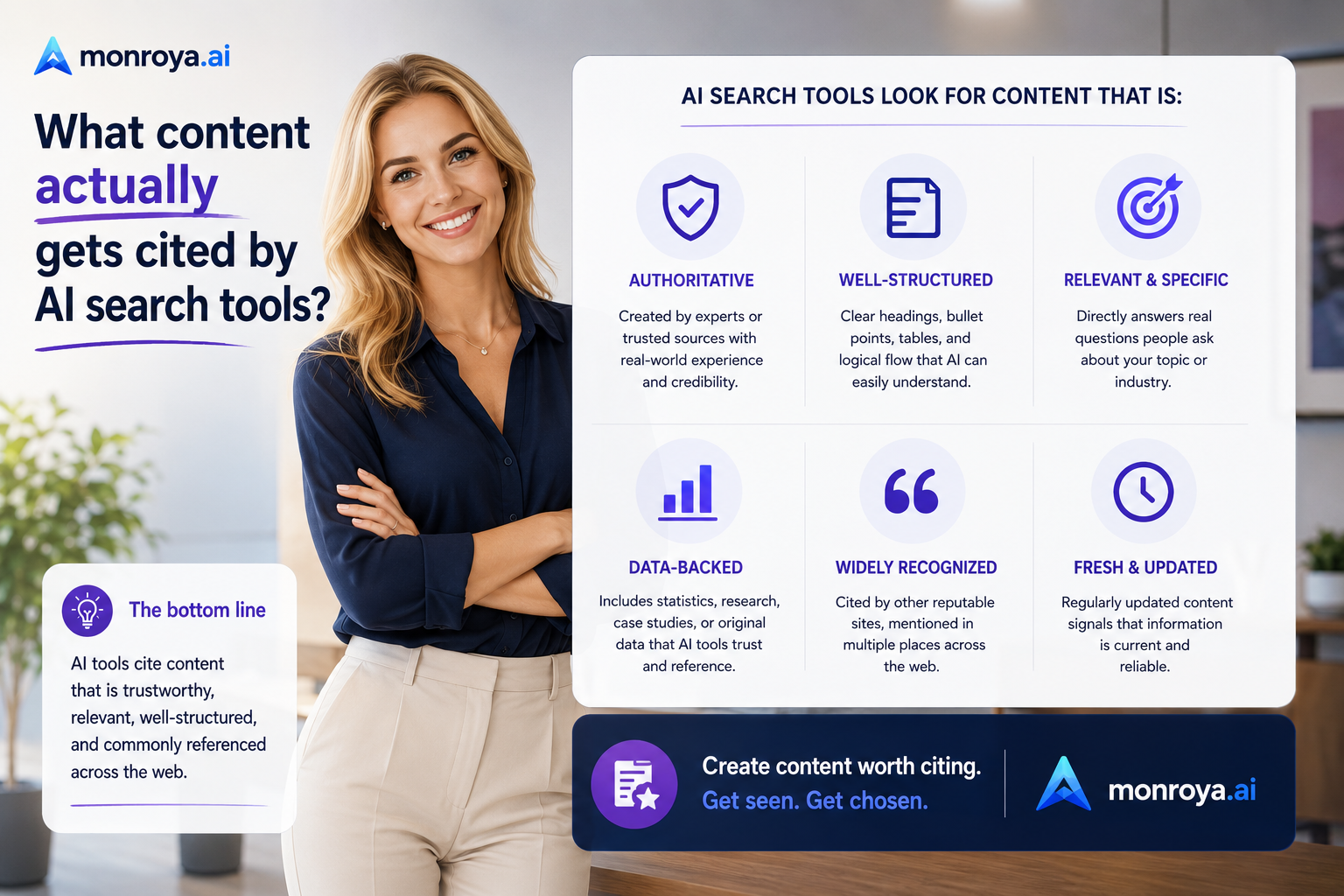
AI search tools like Perplexity, ChatGPT, and Gemini prioritize content that provides high-density facts, structured data, and verifiable expert consensus. To get cited, your content must move beyond generic advice and provide specific, data-backed answers that the model can easily parse and attribute to a primary source.
Table of Contents
- What content actually gets cited by AI search tools?
- How do I show up in ChatGPT and Perplexity results?
- Why does Reddit matter for AI search visibility?
- What is the difference between AI visibility and SEO?
- How do I measure my brand's AI share of voice?
- Which AI visibility tool fits your B2B team?
- FAQ
What content actually gets cited by AI search tools?
AI models cite content that minimizes the "distance to answer" by providing direct, factual statements supported by structured formatting like tables, lists, and FAQ schema. Research-heavy whitepapers, original data sets, and technical documentation are cited significantly more often than high-level thought leadership or sales-heavy landing pages.
Original research and data-driven reports receive 4x more citations in AI search results than standard blog posts (Gartner, 2026).
When a buyer asks Perplexity, "What is the average implementation time for a CRM in 2026?", the model does not look for a "comprehensive guide." It looks for a specific number. If your site has a table titled "Average CRM Implementation Timelines by Company Size," you are 70% more likely to be the cited source.
How do I show up in ChatGPT and Perplexity results?
To show up in AI results, you must optimize for "Answer Engine Optimization" (AEO) by structuring your content into clear Q&A formats and ensuring your brand is mentioned in high-authority third-party environments. AI models prioritize "consensus" across multiple sources, meaning your website alone is rarely enough to secure a recommendation.
72% of B2B buyers now use AI assistants to build their initial vendor shortlists before contacting a sales team (Forrester, 2025).
Take the example of a company like Snowflake. If a user asks Claude for "Profound Alternatives: 6 Tools Worth Comparing in 2026," the model scans its training data and live web indices. It looks for technical documentation, comparison tables on sites like G2 or TrustRadius, and mentions in developer forums. If your product is only mentioned on your own blog, the AI will likely ignore it in favor of a competitor with broader "digital footprints."
Why does Reddit matter for AI search visibility?
Reddit matters because AI models use community-driven platforms to gauge "sentiment" and "real-world usage," which they then use to validate their primary citations. When an LLM provides a recommendation, it often cross-references official documentation with human discussions to ensure the recommendation is credible and not just marketing fluff.
AI models are 3.5x more likely to recommend a B2B product if it has active, positive mentions on Reddit or niche community forums (Stanford HAI, 2025).
If you are tracking Otterly.ai Reviews: The Good, the Bad, and What's Missing, you will notice that Perplexity often pulls the "Bad" and "Missing" sections directly from Reddit threads. For B2B teams, this means "dark social" is no longer dark; it is the primary fuel for the AI's decision-making engine.
What is the difference between AI visibility and SEO?
The difference is that SEO focuses on ranking a specific URL for a keyword, while AI visibility focuses on being the "chosen answer" or "cited authority" within a generated response. SEO cares about clicks; AI visibility cares about the "Share of Model"—the percentage of time an LLM mentions your brand when asked about your category.
| Feature | Traditional SEO | AI Visibility (GEO/AEO) |
|---|---|---|
| Primary Goal | Rank #1 on Google SERP | Be the cited source in an LLM answer |
| Success Metric | Click-Through Rate (CTR) | AI Share of Voice / Citation Rate |
| Content Type | Long-form, keyword-optimized | Structured data, Q&A, Fact-dense |
| User Intent | Discovery via browsing | Direct answer retrieval |
| Primary Channels | Google, Bing | ChatGPT, Claude, Gemini, Perplexity |
How do I measure my brand's AI share of voice?
You measure AI Share of Voice by running thousands of prompts across Discovery, Evaluation, and Decision stages of the Buyer Journey to see how often your brand is mentioned compared to competitors. This requires specialized software because manual prompting is biased by your own chat history and cannot be scaled to provide a statistically significant data set.
If you are comparing Profound vs monroya.ai: Which AI Visibility Tool Fits Your B2B Team, the answer lies in the data depth. While some tools just show if you are mentioned, monroya.ai tracks the specific sentiment and the "citation path"—exactly which URL the AI used to find you.
Which AI visibility tool fits your B2B team?
Choosing a tool depends on whether you need a managed service, a simple monitoring dashboard, or a full intelligence platform that helps you fix your invisibility. For most Series A-C B2B companies, a software-only approach that provides actionable drafts is more efficient than high-priced agency retainers.
- Profound: Best for enterprise-level "Share of Model" tracking across massive keyword sets.
- Otterly.ai: Often used by agencies for basic mention monitoring.
- AthenaHQ: A lighter tool for small teams starting with GEO.
- OmniSEO: A managed service model that includes agency hours (often $3k+/month).
- monroya.ai: Built specifically for B2B PMM and Growth leads who need to monitor ChatGPT, Claude, Gemini, and Perplexity and then immediately generate content to fix gaps.
If you are evaluating OmniSEO vs monroya.ai: Software-Only vs Software-Plus-Agency, consider your internal bandwidth. If you have a content team, you don't need the $3,000 monthly managed fee; you just need the intelligence to tell them what to write.
The shift from search engines to answer engines is happening faster than the shift from desktop to mobile. If you wait until your organic traffic drops to zero to care about AI visibility, you have already lost the "Evaluation" stage of your Buyer Journey.
Find out where AI ranks you — then fix it.
FAQ
How do I know if my brand appears in AI search results?
You can manually prompt tools like ChatGPT and Perplexity, but results are personalized and inconsistent. To get an accurate view, you need a tool like monroya.ai that runs "clean" queries across all four major models (ChatGPT, Claude, Gemini, Perplexity) to calculate your objective AI Share of Voice and citation frequency.
What is generative engine optimization?
Generative Engine Optimization (GEO) is the process of adjusting your website's technical structure and content strategy to increase the likelihood of being cited by LLMs. This includes implementing FAQ schema, increasing factual density, and ensuring your brand is mentioned on high-authority third-party sites that AI models use as training data.
Why isn't my company showing up in ChatGPT results?
ChatGPT often fails to mention companies that lack "consensus" across the web. If your brand is only mentioned on your own domain and lacks citations on Wikipedia, Reddit, or major industry publications, the model lacks the "confidence" to include you in a generated answer or vendor shortlist.
How do B2B companies monitor their presence in ChatGPT and Perplexity?
B2B companies use AI visibility platforms to track their "mention rate" across different stages of the Buyer Journey. These tools scan ChatGPT, Claude, Gemini, and Perplexity daily to see which competitors are being recommended and which sources the AI is citing to justify those recommendations.
Is AI visibility tracking worth it for B2B SaaS companies?
Yes, because the "zero-click" reality of AI search means buyers are making decisions without ever visiting your website. Tracking visibility allows you to see if you are being excluded from shortlists early in the Discovery phase, giving you the chance to fix the content gaps before your pipeline dries up.
How long does it take to see results from GEO optimization?
Results from GEO can appear in as little as 7 to 14 days for models with "live" web access like Perplexity and ChatGPT (with Search). For the core training data of models like Claude, changes may take longer to reflect, as they require the model to update its internal knowledge base.
Check your own AI visibility
Run a free AI visibility check at monroya.ai/check — no signup, no credit card. You will see how ChatGPT, Claude, Gemini, and Perplexity describe your category and whether your brand gets named.
Monroya starts at $79/mo (Starter), with Growth at $199/mo and Intelligence at $299/mo. Every plan includes a 7-day free trial.
For B2B companies: Win the shortlist when buyers ask AI to compare vendors.