AI Visibility vs SEO: Why Traditional Search Rankings No Longer Guarantee Brand Mentions
By Jeremy Unruh, Founder, Monroya · Published July 7, 2026 · Reviewed September 2026
Want this for your company? See how AI assistants answer about your site.
Run the free check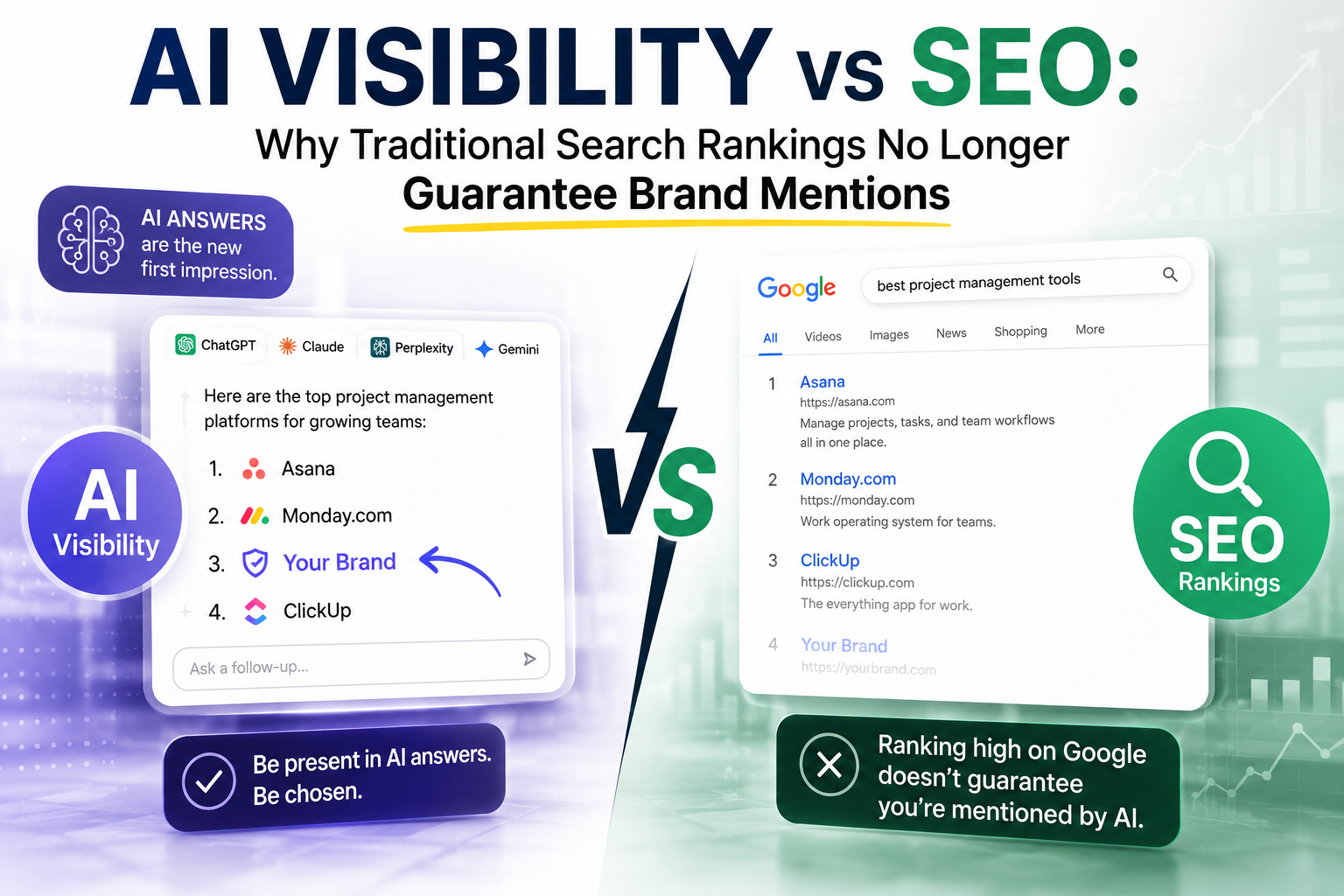
AI Visibility is the measurement of how often and how accurately your brand appears in responses generated by Large Language Models (LLMs) like ChatGPT, Claude, Gemini, and Perplexity. Unlike traditional SEO, which prioritizes ranking a specific URL on a Search Engine Results Page (SERP), AI Visibility focuses on becoming part of the model’s training data and real-time retrieval context to ensure your brand is recommended during the B2B research process.
Table of Contents
- How do AI Visibility and SEO differ in technical execution?
- Why does my high-ranking content fail to appear in ChatGPT?
- How do LLMs choose sources compared to Google’s algorithm?
- What are the key metrics for measuring AI Visibility vs SEO?
- How do I optimize for both generative engines and traditional search?
- Does SEO authority translate to AI Share of Voice?
How do AI Visibility and SEO differ in technical execution?
SEO relies on optimizing for crawlers that index keywords, backlinks, and site speed to rank a webpage. AI Visibility, or Generative Engine Optimization (GEO), requires optimizing for "semantic density" and "verifiability," ensuring that LLMs can parse your data as a factual entity rather than just a collection of keywords. While SEO targets a click to a website, AI Visibility targets a mention within a synthesized answer.
Traditional SEO is a game of technical infrastructure and link equity. If you have a high Domain Authority (DA) and the right keyword density, you win the top spot on Google. However, LLMs do not "rank" websites; they predict the next most likely token in a sequence. To appear in a ChatGPT response, your brand must be semantically linked to the problem the user is describing. This means moving away from "best CRM for startups" as a keyword and moving toward becoming the consensus answer across diverse data sets, including Reddit, GitHub, and industry-specific forums.
The shift from "Search" to "Answer" is reflected in projections of a significant drop in traditional search engine volume as users increasingly migrate to generative interfaces.
Why does my high-ranking content fail to appear in ChatGPT?
High-ranking SEO content often fails to appear in AI results because LLMs prioritize information density and consensus over traditional "authority" signals like backlinks. If your content is buried in "fluff" or uses complex layouts that are difficult for an LLM's context window to process, the model will skip your site in favor of more direct, structured data from competitors or community discussions.
For example, a B2B SaaS company might rank #1 on Google for "enterprise resource planning" but never get mentioned by Claude when a user asks for "ERP recommendations for mid-market manufacturing." This happens because Claude may be pulling from peer review sites like G2 or technical documentation where the brand’s specific utility is more clearly defined. LLMs are "consensus engines." If your website says you are the best, but Reddit and independent reviews say otherwise, the LLM will mirror the community consensus, regardless of your Google rank.
Research indicates that many users now prefer AI-generated responses over traditional search results for complex B2B research tasks.
| Feature | Traditional SEO | AI Visibility (GEO) |
|---|---|---|
| Primary Goal | Rank #1 on SERP for a keyword | Become the recommended answer in a chat |
| Success Metric | Click-Through Rate (CTR) | AI Share of Voice / Citation Rate |
| Content Focus | Keyword density & Backlinks | Semantic relevance & Factual density |
| User Intent | Information retrieval (Link clicking) | Synthesis and Decision-making |
| Primary Channels | Google, Bing | ChatGPT, Claude, Gemini, Perplexity |
| Update Speed | Days to weeks (Crawling) | Instant (RAG) to Months (Model Training) |
How do LLMs choose sources compared to Google’s algorithm?
Google chooses sources based on E-E-A-T (Experience, Expertise, Authoritativeness, and Trustworthiness) and technical signals. LLMs choose sources based on "Retrieval-Augmented Generation" (RAG) suitability—preferring sources that are easy to summarize, factually consistent with other sources, and formatted in a way that fits into a limited context window.
When Perplexity answers a query, it isn't looking for the "most popular" page. It is looking for the page that most directly answers the prompt with the least amount of noise. This is why technical documentation and FAQ pages often outperform 3,000-word "ultimate guide" blog posts in AI citations. If your content is structured with clear H2s that mirror user questions and contains specific data points, it is significantly more likely to be pulled into the "source" box of an AI response.
Generative engine responses are more likely to cite sites with structured FAQ data than those without.
What are the key metrics for measuring AI Visibility vs SEO?
While SEO metrics focus on impressions, clicks, and bounce rates, AI Visibility is measured through AI Share of Voice, Citation Rate, and Sentiment Alignment. You need to track how often your brand is mentioned across ChatGPT, Claude, Gemini, and Perplexity when category-specific prompts are used, and whether those mentions are positive, neutral, or grouped with the wrong competitors.
To measure this effectively, you cannot rely on Google Search Console. You need a platform like monroya.ai to simulate the Buyer Journey across multiple models. You should be looking for:
- Citation Rate: The percentage of time your brand is cited as a source.
- Mention Rate: How often your brand appears in the text of the answer.
- Sentiment Score: Whether the AI describes your product as "expensive," "easy to use," or "legacy."
How do I optimize for both generative engines and traditional search?
Optimization for both requires a "Double-Threat" content strategy: keep the technical SEO for Google (schema, speed, links) but rewrite the content body for LLM extraction. This means using direct, declarative sentences, including "TL;DR" summaries at the top of pages, and ensuring your FAQ sections use the exact phrasing buyers use in chat interfaces.
- Implement FAQ Schema: This is the single fastest way to get cited by Perplexity and Gemini.
- Increase Semantic Density: Remove "marketing fluff" and replace it with specific stats, named integrations, and concrete use cases.
- Optimize Off-Site: Since LLMs weigh community consensus heavily, you must influence the "training set" by being active on Reddit, Quora, and niche industry forums.
- Use monroya.ai: Track your visibility in real-time to see which content pieces are actually being picked up by ChatGPT versus which ones are only ranking on Google.
Does SEO authority translate to AI Share of Voice?
Not necessarily. A high Domain Authority (DA) helps with "Search-enabled" AI like Perplexity or ChatGPT with Search, but it does nothing for the "base knowledge" of models like Claude or Gemini. Many "SEO-rich" brands are finding themselves invisible in AI responses because their content is optimized for bots, not for the semantic synthesis that LLMs perform.
For example, a legacy software provider might own the first page of Google through sheer backlink volume. However, when a buyer asks ChatGPT, "What is the most modern alternative to [Legacy Brand]?", the AI will likely suggest a smaller, more agile competitor that has a higher volume of positive mentions on technical subreddits and developer forums. SEO is about winning the "library catalog"; AI Visibility is about winning the "word of mouth" inside the library.
To bridge this gap, B2B companies must move beyond keyword tracking. You need to understand the specific prompts your buyers are using during the Discovery, Evaluation, and Decision stages. If you aren't monitoring how these four models—ChatGPT, Claude, Gemini, and Perplexity—describe your category, you are essentially flying blind in the new primary search interface.
monroya.ai provides the only buyer-journey intelligence platform that doesn't just monitor these mentions but provides an actionable draft to fix your visibility gaps. With tiers ranging from the Starter plan at $79/month to the Intelligence plan at $299/month, marketing teams can finally see the "invisible" funnel that is happening inside AI interfaces.
Find out where AI ranks you — then fix it.
FAQ
What is the difference between SEO and GEO?
SEO focuses on optimizing websites for traditional search engines like Google to drive traffic via links. GEO (Generative Engine Optimization) focuses on optimizing content so that AI models like ChatGPT and Perplexity include your brand in their generated answers and citations, regardless of whether the user clicks a link.
How do I track my brand's AI Share of Voice?
You can track AI Share of Voice by using specialized tools like monroya.ai, which query ChatGPT, Claude, Gemini, and Perplexity with specific Buyer Journey prompts. These tools measure how often your brand is mentioned and cited compared to your competitors across different stages of the funnel.
Why is Reddit important for AI Visibility?
LLMs are trained on massive datasets that include social media and forum discussions. Reddit is a primary source of "human consensus" for AI models. If your brand is frequently recommended in relevant subreddits, AI models are significantly more likely to suggest your product as a trusted solution in their responses.
Does traditional SEO help with ChatGPT visibility?
Only partially. While "Search-enabled" versions of ChatGPT use Bing to find current information, the core model's knowledge is based on its training data. Traditional SEO helps with the retrieval part of RAG (Retrieval-Augmented Generation), but semantic relevance and community consensus are more important for long-term AI Visibility.
What is a good AI citation rate for B2B SaaS?
A "good" citation rate varies by category, but leading B2B SaaS companies aim to achieve a high citation rate within their specific niche. If your competitors are being cited significantly more often than your brand, you have a GEO gap that needs immediate content optimization.
How long does it take to see results from AI optimization?
For search-enabled models like Perplexity, changes can be seen in as little as a few days once the new content is indexed. For base model knowledge (like Claude), it may take until the next model update or fine-tuning cycle, though RAG-based systems are making this timeline much faster.
Key Takeaways
- AI Visibility is about being the "answer," while SEO is about being the "result."
- LLMs prioritize structured, factual, and consensus-based content over high-backlink, low-density pages.
- Community platforms like Reddit are now as important for AI Visibility as your own blog is for SEO.
- Measuring AI Share of Voice across ChatGPT, Claude, Gemini, and Perplexity is the only way to see your "invisible" funnel.
- Use monroya.ai to identify where you are being left out of the AI-generated shortlist and generate the content needed to fix it.
Check your own AI visibility
Run a free AI visibility check at monroya.ai/check — no signup, no credit card. You will see how ChatGPT, Claude, Gemini, and Perplexity describe your category and whether your brand gets named.
Monroya starts at $79/mo (Starter), with Growth at $199/mo and Intelligence at $299/mo. Every plan includes a 7-day free trial.
Compare the full field
This is one pair out of a category that keeps changing. The AI visibility tools comparison puts the main options side by side on coverage, depth and price, Monroya pricing is public with no call required, and the free AI visibility check gives you a baseline before you buy anything.
For B2B companies: Win the shortlist when buyers ask AI to compare vendors.