Best AI Visibility Tools for Marketing Agencies: A 2026 Buyer's Guide
By Jeremy Unruh, Founder, Monroya · Published June 25, 2026 · Reviewed September 2026
Want this for your company? See how AI assistants answer about your site.
Run the free check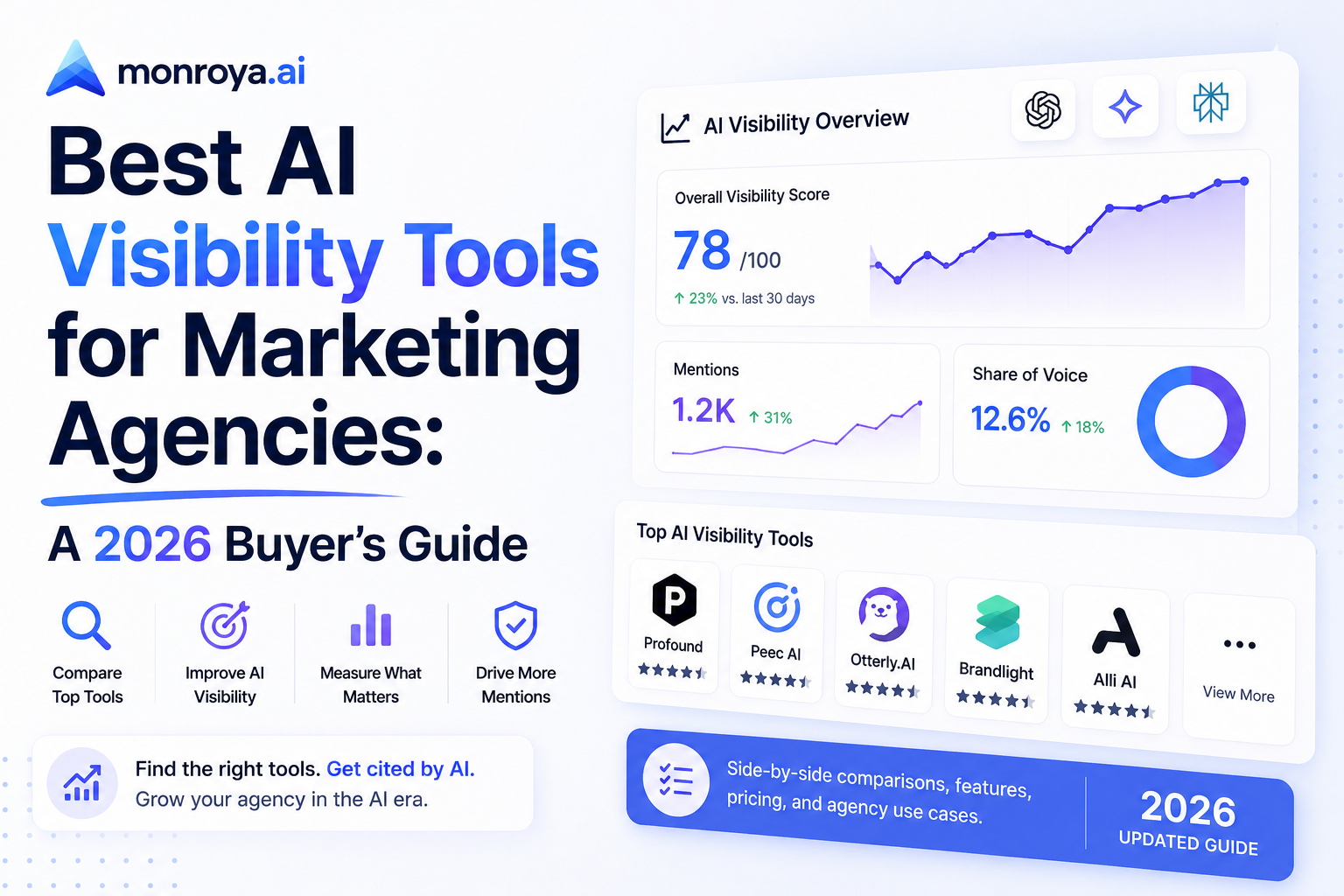
Marketing agencies live or die by results. As buyers shift from Google searches to ChatGPT, Claude, Gemini, and Perplexity for software shortlists, "rank on page one" no longer captures what matters. The new question — do these AI assistants mention my client when a buyer asks? — needs a different toolset.
This guide walks through how to evaluate an AI visibility tool for an agency book of business, what the category actually does, and where Monroya fits.
What an AI visibility tool actually does
An AI visibility tool (sometimes called an AEO platform, GEO platform, or LLM SEO platform) runs realistic buyer prompts across the major AI assistants on a schedule, parses the answers, and tracks four things:
- Inclusion — does the assistant mention your client at all?
- Position — first named, in the comparison set, or buried?
- Sentiment & framing — how is the client described next to competitors?
- Citations — which pages on your client's site (and the wider web) the model is grounding the answer in.
The output is a longitudinal record: here's how ChatGPT described this category last Tuesday, and here's how it describes it today after we shipped these changes. That's the loop agencies need to prove work.
Why agencies should care now
- Buyer behavior has already moved. B2B SaaS buyers routinely start vendor research in an AI assistant before they ever hit Google. If a client isn't named in the first answer, they're not on the shortlist.
- Traditional SEO reporting misses it entirely. Rank trackers don't see AI Overviews, ChatGPT, or Claude. You can be #1 on Google and invisible in the conversations that decide deals.
- It's a defensible retainer line. Most agencies aren't selling this yet. Adding AI visibility tracking + remediation to a retainer is one of the cleanest expansion paths available right now.
What to look for when evaluating tools
Use this checklist when you're shortlisting an AI visibility tool for client work:
- Multi-engine coverage — at minimum ChatGPT, Claude, Gemini, and Perplexity. Single-engine tools give you a partial picture.
- Buyer-journey segmentation — does it separate awareness, evaluation, and decision-stage prompts? A tool that lumps them together hides where you're actually losing.
- Per-client workspaces — can your team manage 5, 20, or 50 clients without prompt soup? Look for isolated workspaces, per-client briefings, and role-based access.
- Actionable opportunities, not just dashboards — the tool should tell you what to change (a missing comparison page, a weak FAQ, a stale review), prioritized by impact.
- Citation tracking — which of the client's URLs are the models pulling from? You'll need this to decide what to rewrite first.
- Competitor tracking — every prompt should run against the client's named competitors, so you can show share-of-voice movement.
- A re-scan loop — after you ship a fix, the tool should automatically re-check the prompt on a sensible cadence and report whether visibility actually moved.
- Briefing exports — weekly or monthly briefings the agency can white-label and forward to the client.
If a tool can't do those eight things, it's a dashboard, not an agency platform.
How Monroya is built for agencies
Monroya was designed around the briefing, not the dashboard. The agency-relevant pieces:
- Multi-client briefings. Each client gets their own scan workspace, prompt library, tracked competitors, and weekly executive briefing — shareable as a link or auto-emailed.
- Buyer-journey matrix. Every prompt is tagged awareness / evaluation / decision, so you can show a client exactly which stage their visibility is leaking at.
- Opportunities with priority math. Every gap becomes an opportunity scored by impact, confidence, and effort. You hand the client a ranked to-do list instead of a 40-tab spreadsheet.
- Automatic re-scan after fixes. When you mark an opportunity complete, Monroya schedules a follow-up scan, confirms whether the change moved the needle, and reschedules if the model hasn't re-crawled yet.
- Citation persistence. Pages cited in previous scans stay tracked even when a single scan misses them — so you can see trend, not just snapshots.
The result: an agency can run a 20-client book and produce a defensible, opportunity-led briefing for each one without manually prompting ChatGPT.
A simple agency rollout
If you're adding AI visibility to a retainer for the first time, this sequence works:
- Baseline scan. Pick 25–50 buyer prompts per client. Run them across all four major assistants.
- Identify the leak. Use the buyer-journey matrix to find which stage the client is missing from. Most B2B SaaS clients leak at evaluation — they exist in awareness answers but get dropped when buyers ask "what's the best X for Y."
- Ship two opportunities per month. Comparison pages, FAQ rewrites, and review-site presence are usually the highest-ROI starting points.
- Re-scan and report. Show the client which prompts now name them, which moved up the comparison set, and which competitors lost ground.
- Expand the prompt set quarterly as the client's category vocabulary evolves.
FAQ
Is AI visibility the same as SEO? No. SEO targets Google's ranking algorithm; AI visibility targets how large language models construct answers. The tactics overlap (citations, schema, authoritative content) but the measurement and remediation loops are distinct.
How often should we scan? Weekly is the sweet spot for active retainers. Daily is overkill for most categories and burns budget; monthly is too slow to catch model updates.
Can we white-label the briefings? Monroya's shareable briefing links are clean and brand-light, so they can sit inside an agency report without friction. Per-agency white-label is on the roadmap.
What about clients outside B2B SaaS? The methodology works for any considered purchase where buyers ask an assistant for a shortlist — professional services, healthtech, fintech, devtools. B2B SaaS is where the signal is densest today.
If you're running an agency book and want to see what a Monroya briefing looks like for one of your clients, the free trial gives you a full scan and the first set of opportunities.
Check your own AI visibility
Run a free AI visibility check at monroya.ai/check — no signup, no credit card. You will see how ChatGPT, Claude, Gemini, and Perplexity describe your category and whether your brand gets named.
Monroya starts at $79/mo (Starter), with Growth at $199/mo and Intelligence at $299/mo. Every plan includes a 7-day free trial.
Related reading
For agencies: Track and improve AI visibility for every client.