Why Your Competitors Own the ChatGPT Shortlist (and How to Take It Back)
By Jeremy Unruh, Founder, Monroya · Published June 23, 2026 · Reviewed September 2026
Want this for your company? See how AI assistants answer about your site.
Run the free check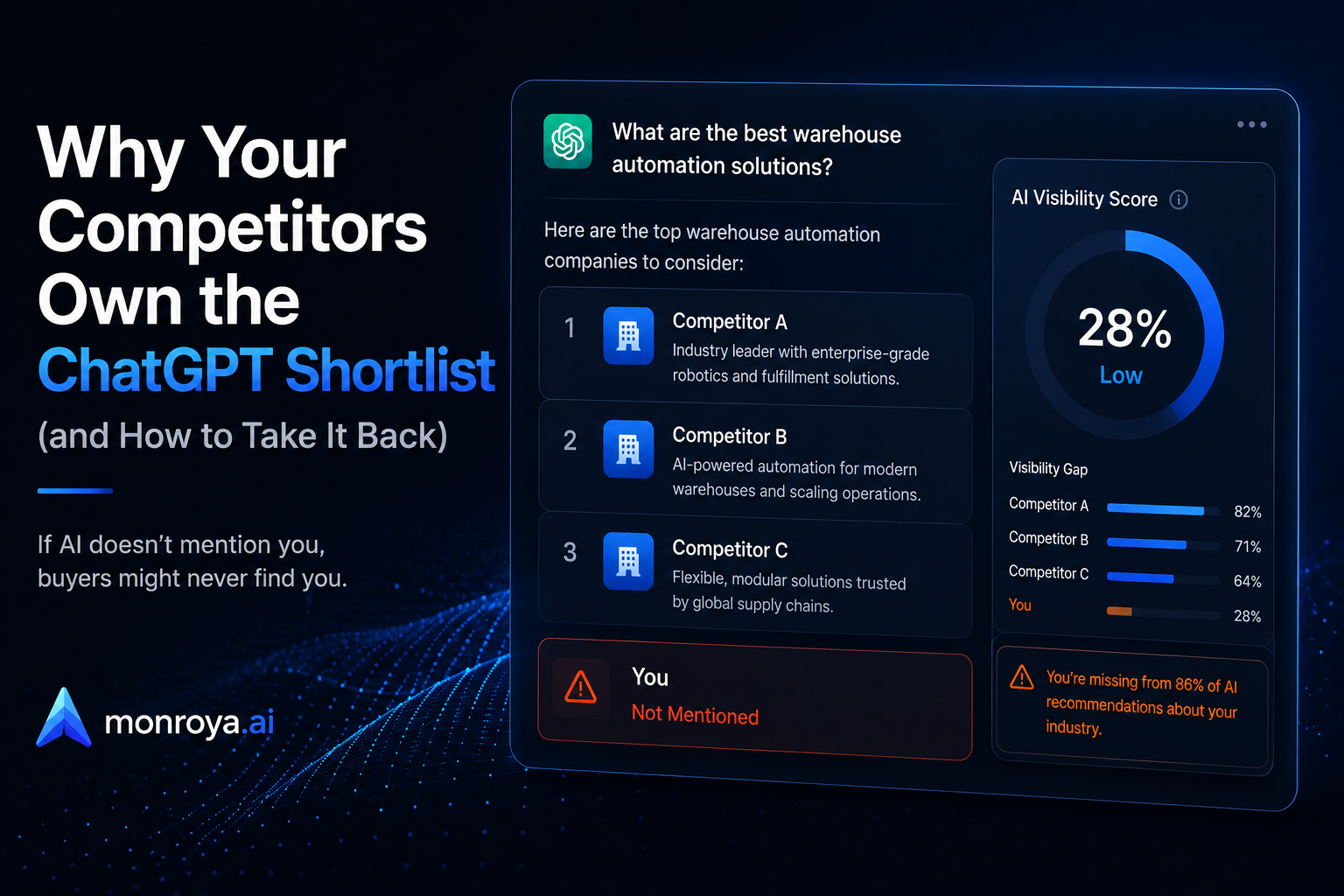
B2B buyers now use AI assistants to bypass the first five pages of Google, moving directly from problem identification to vendor shortlist via ChatGPT, Claude, Gemini, and Perplexity. To win this shift, companies must optimize for high-intent "category-level" prompts by seeding the specific technical proofs and comparative data points that LLMs use to differentiate competitors.
Measurement is the first problem. Across 128 Monroya scan snapshots, a brand's mention rate varies by an average of 36.6 percentage points (standard deviation) between prompt-by-model pairs inside a single scan, and only 13% of those scans used multi-run aggregation. If you checked ChatGPT once and concluded your competitors own the shortlist, you measured one sample, not your position.
Table of Contents
- How do I show up in ChatGPT for category searches?
- Why does Perplexity cite my competitors but not me?
- How do I increase my AI mention rate across different LLMs?
- Why B2B Teams are Switching to Multi-Run Aggregation
- What is the difference between SEO and generative engine optimization?
- How can I track my AI Share of Voice against competitors?
- Key Takeaways
- FAQ
How do I show up in ChatGPT for category searches?
To show up in ChatGPT, you must provide structured, authoritative data that maps your product features to specific user pain points across high-authority domains like GitHub, Reddit, and niche industry forums. ChatGPT prioritizes consensus and technical documentation; therefore, your AI visibility depends on how frequently your brand is associated with "solution" keywords in the training data and real-time web searches.
The traditional B2B Buyer Journey is dead. B2B buyers now spend a strikingly small fraction of their time meeting with any one salesperson. The rest of that time is now being funneled into AI-driven discovery. When a VP of Demand Gen asks ChatGPT, "What are the best attribution tools for a Snowflake-based data stack?", the LLM isn't looking for the prettiest landing page. It is looking for technical compatibility, user sentiment, and third-party validation.
B2B buyers are increasingly likely to trust a vendor recommendation from an AI assistant over a sponsored search result.
If your company is not mentioned in that initial response, you have lost the deal before the buyer even visits your site. This is the new reality of B2B AI search. You must move beyond keyword stuffing and focus on "entity association"—ensuring that every time your category is mentioned online, your brand name is mathematically adjacent to it.
Why does Perplexity cite my competitors but not me?
Perplexity cites competitors when they have clear, factual, and easily extractable data points hosted on high-authority "index-friendly" sites. Unlike ChatGPT, Perplexity is a real-time search engine that prioritizes sources with high factual density, such as documentation, pricing pages, and comparison tables. If your content is gated or buried in PDFs, Perplexity cannot cite it.
Consider the case of a company like Snowflake vs. Databricks. When asked about "data warehousing costs," Perplexity often cites Databricks' own blog because they publish transparent, table-based cost comparisons. Snowflake might have better SEO, but Databricks has better generative engine optimization (GEO) because their data is formatted for extraction.
To fix your AI citation rate, you must audit your "citation-magnet" content. This includes:
- Public-facing documentation: Stop gating your technical specs.
- Comparison tables: Create "Us vs. Them" pages that use clear, non-marketing language.
- Third-party reviews: Ensure your presence on G2 and Capterra is updated, as Perplexity frequently scrapes these for "pros and cons" lists.
| Feature | SEO (Google) | GEO (AI Search) |
|---|---|---|
| Primary Goal | Rank #1 for a keyword | Become the cited answer |
| Content Format | Long-form, keyword-rich | Structured, factual, dense |
| Success Metric | Click-through rate (CTR) | AI Share of Voice / Citation Rate |
| Key Channel | Backlinks and Meta Tags | Entity association and FAQ schema |
| User Intent | Browsing / Researching | Shortlisting / Deciding |
How do I increase my AI mention rate across different LLMs?
Increasing your AI mention rate requires a multi-platform strategy that targets the specific "knowledge retrieval" methods of ChatGPT, Claude, Gemini, and Perplexity. You must distribute technical proof points across Reddit, GitHub, and industry-specific wikis. LLMs use these platforms to gauge "developer sentiment" and "market consensus," which directly influences whether you appear in a recommendation.
For example, if you are a DevOps tool, your AI visibility is heavily influenced by your presence in GitHub READMEs and Stack Overflow answers. If you are a MarTech platform, your mention rate in ChatGPT is tied to how often you are discussed in subreddits like r/marketingops.
The vast majority of B2B sales interactions are projected to occur in digital channels, with a significant portion mediated by AI agents.
To win, you need to seed the "ground truth" that these models rely on. This isn't about fake reviews; it's about ensuring your actual users are talking about your specific features in public spaces. monroya.ai helps you identify these gaps by scanning all four major providers to see exactly where your competitors are being mentioned and why.
Why B2B Teams are Switching to Multi-Run Aggregation
B2B teams are switching to multi-run aggregation because a single query to ChatGPT or Gemini is not a measurement — it is one sample from a probabilistic system. Asking the same buyer prompt twice can produce two different vendor shortlists, so a single-run "we appear in AI answers" check tells you almost nothing about whether you reliably appear.
Three data points from Monroya's own scan data (128 scan snapshots across tracked B2B accounts, as of August 2026) show how unstable single-run measurement is:
- Mention rate varies by an average of 36.6 percentage points (standard deviation) across prompt-by-model pairs within a single scan. The median account sees 41.3 points of spread, and the widest sits at 50.4. A brand named in three of four runs of one prompt can be invisible in the next.
- Only 13% of scans (16 of 128) were run with multi-run aggregation. The remaining 87% relied on one response per prompt-model pair — the same methodology behind most "we checked ChatGPT and we're not there" conclusions.
- 6% of consecutive scan-to-scan comparisons moved share of voice by 10 points or more, while the typical move was 1.4 points (median; 2.6-point average across 112 comparisons). Most apparent week-to-week movement in AI visibility is sampling noise, not a real change in how models see you.
The practical fix is to run each buyer prompt multiple times per model, aggregate the mention rate, and report a confidence band instead of a single number. That turns "ChatGPT mentioned us today" into a metric you can act on — and it is the gap between the qualitative advice ChatGPT and Gemini give about switching AI tools and the measured consistency data those tools cannot produce about your own brand.
What is the difference between SEO and generative engine optimization?
SEO focuses on driving traffic to a website via search engine results pages, whereas generative engine optimization (GEO) focuses on influencing the content of the AI's response itself. In SEO, you want the click; in GEO, you want the mention and the citation. GEO requires a shift from "persuasive copywriting" to "declarative fact-sharing" that LLMs can easily parse and repeat.
If your content is full of marketing fluff—phrases like "best-in-class" or "synergistic solutions"—LLMs will filter it out as low-value noise. They are programmed to extract facts. To improve your B2B AI search optimization, replace your adjectives with nouns and numbers. Instead of saying "Our software is fast," say "Our software processes 10k rows in 200ms." The latter is a "knowledge triplet" that an LLM can use to answer a specific buyer query.
How can I track my AI Share of Voice against competitors?
You track AI Share of Voice by querying ChatGPT, Claude, Gemini, and Perplexity with specific Buyer Journey prompts and measuring the frequency and sentiment of your brand mentions relative to competitors. This is not a static metric; it changes as models are updated and web-browsing capabilities evolve. You must monitor these responses weekly to catch when a competitor's new whitepaper starts influencing the AI's "opinion" of your category.
Using monroya.ai, you can automate this process. The platform doesn't just monitor; it provides a draft of the content you need to publish to fix your visibility gaps. Whether it's a missing FAQ or a lack of technical documentation, you get a playbook for action.
- Identify the Prompts: List the top 50 questions your buyers ask (e.g., "What is the best CRM for mid-market SaaS?").
- Baseline Your Visibility: Run these prompts through all four providers.
- Analyze Citations: See who is being cited. Is it a competitor's blog? A Reddit thread? A Gartner report?
- Close the Gap: Publish content that mirrors the structure of the cited sources but provides better, more updated data.
The transition from search engines to answer engines is the most significant shift in B2B marketing since the invention of the lead magnet. Companies that continue to focus solely on Google rankings will find themselves invisible to the next generation of buyers who start every project with a prompt.
monroya.ai provides the intelligence you need to see what the AI sees. With tiers ranging from a 7-day free Trial to the $299/month Intelligence plan, you can start mapping your Buyer Journey AI impact today. Check out our pricing to find the right fit for your team.
Find out where AI ranks you — then fix it.
Key Takeaways
- AI is the new gatekeeper: Buyers are building shortlists in ChatGPT and Perplexity before they ever visit your website.
- Facts over Fluff: LLMs prioritize structured, factual data over marketing adjectives; use comparison tables and technical specs to get cited.
- Multi-LLM Strategy: You must track visibility across ChatGPT, Claude, Gemini, and Perplexity separately, as they use different retrieval methods.
- Entity Association: Your AI visibility depends on being mathematically linked to your category keywords in high-authority datasets like Reddit and GitHub.
FAQ
How do I show up in ChatGPT?
To show up in ChatGPT, you must ensure your brand is consistently associated with your category in high-authority datasets. This involves publishing structured, factual content on your site and maintaining a strong presence on third-party platforms like Reddit, GitHub, and industry forums, which ChatGPT uses to establish market consensus and "ground truth" for its responses.
What is generative engine optimization (GEO)?
Generative engine optimization (GEO) is the process of optimizing content to be accurately retrieved and cited by AI assistants like ChatGPT and Perplexity. Unlike traditional SEO, which focuses on website rankings, GEO focuses on "entity association" and "knowledge extraction," ensuring that AI models recognize your brand as a leading solution when answering user queries.
How does Perplexity choose which sites to cite?
Perplexity prioritizes sites that offer high factual density and structured data, such as tables, lists, and direct answers to specific questions. It frequently cites documentation, pricing pages, and reputable third-party review sites. To improve your citation rate, ensure your most important product data is ungated and formatted in a way that is easy for AI to extract.
Why is my competitor appearing in AI search but I am not?
Your competitor likely has a higher "mention rate" in the training data or more "extractable" content on the live web. If they have more public-facing technical documentation, active community discussions, or structured comparison pages, AI models will find them more "reliable" as a source of information than a site with generic marketing copy.
How can I measure my AI Share of Voice?
AI Share of Voice is measured by running a set of standardized category prompts through ChatGPT, Claude, Gemini, and Perplexity and calculating the percentage of time your brand is mentioned or cited compared to competitors. Tools like monroya.ai automate this tracking across all four providers to give you a real-time view of your visibility.
Does FAQ schema help with AI visibility?
Yes, FAQ schema is one of the most effective ways to get cited by AI tools. By using structured data, you provide a clear "question-and-answer" pair that LLMs can easily ingest and repeat. This increases the likelihood that your content will be used as the direct answer for a buyer's specific query in an AI search.
Check your own AI visibility
Run a free AI visibility check at monroya.ai/check — no signup, no credit card. You will see how ChatGPT, Claude, Gemini, and Perplexity describe your category and whether your brand gets named.
Monroya starts at $79/mo (Starter), with Growth at $199/mo and Intelligence at $299/mo. Every plan includes a 7-day free trial.
Related reading
For B2B companies: Win the shortlist when buyers ask AI to compare vendors.