Generative Engine Optimization (GEO): The Complete Guide for B2B Marketing Teams
By Jeremy Unruh, Founder, Monroya · Published July 19, 2026 · Reviewed September 2026
Want this for your company? See how AI assistants answer about your site.
Run the free check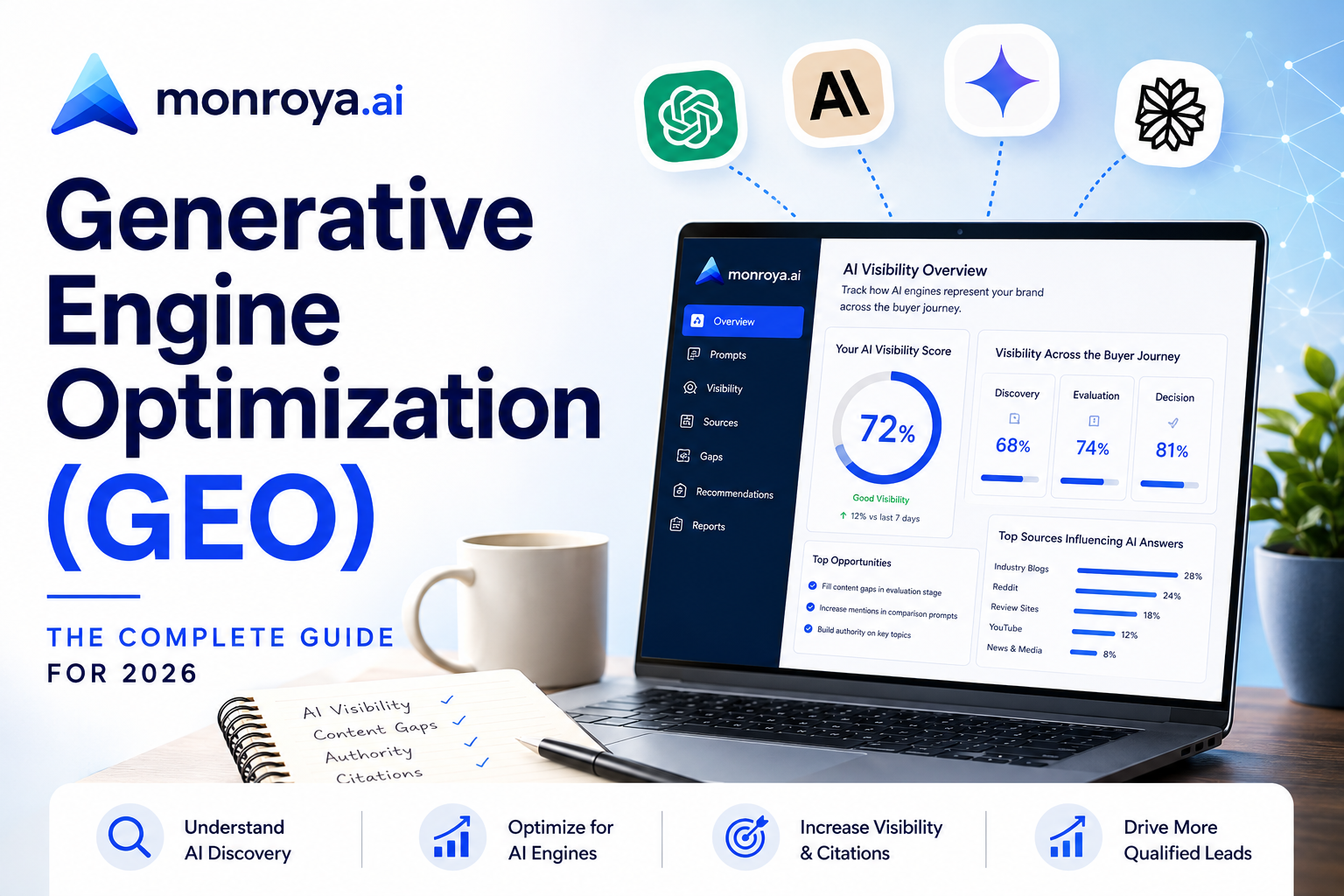
Generative Engine Optimization (GEO) is the process of optimizing brand visibility and citation frequency within Large Language Model (LLM) responses. Unlike traditional SEO which focuses on click-through rates from search engine results pages (SERPs), GEO prioritizes appearing in the synthesized answers provided by ChatGPT, Claude, Gemini, and Perplexity to ensure your brand is included in the AI-generated shortlist during the B2B Buyer Journey.
Table of Contents
- What is the difference between SEO, AEO, and GEO?
- How do ChatGPT, Claude, Gemini, and Perplexity choose sources?
- How to measure AI Share of Voice across the Buyer Journey
- The 7-step GEO playbook for B2B SaaS
- Why Reddit and third-party reviews drive more AI citations than your blog
- Common GEO mistakes that lead to brand exclusion
- FAQ
What is the difference between SEO, AEO, and GEO?
SEO focuses on ranking URLs in a list; AEO (Answer Engine Optimization) focuses on winning featured snippets; GEO focuses on influencing the weights and biases of the model's synthesized response. While SEO values backlink quantity and keyword density, GEO values semantic relevance, technical accuracy, and the consensus of authoritative third-party mentions across the web.
A growing number of B2B buyers now use AI assistants for their initial vendor research before visiting a company website.
| Feature | SEO | AEO | GEO |
|---|---|---|---|
| Primary Goal | Rank #1 on Google | Win the "Position Zero" snippet | Be cited in the LLM answer |
| Success Metric | Organic Traffic / CTR | Impression Share | AI Share of Voice / Citation Rate |
| Content Focus | Keywords & Backlinks | Direct Q&A Schema | Semantic Consensus & Authority |
| User Intent | Information Retrieval | Quick Fact-Checking | Synthesis & Recommendation |
| Primary Platforms | Google, Bing | Google SGE, Alexa | ChatGPT, Claude, Gemini, Perplexity |
How do ChatGPT, Claude, Gemini, and Perplexity choose sources?
LLMs choose sources based on a combination of training data persistence and real-time Retrieval-Augmented Generation (RAG) which prioritizes high-authority, low-bias domains. ChatGPT and Claude lean heavily on established web crawls and reputable documentation, while Perplexity and Gemini prioritize recent, high-traffic news and community-driven platforms like Reddit to provide "fresh" context to their answers.
A significant portion of LLM citations in B2B queries originate from non-vendor websites such as GitHub, Reddit, and independent review platforms.
For example, if a buyer asks Claude for a "CRM for Series B fintechs," the model doesn't just look for keywords. It looks for mentions of your brand in contexts that include "Series B" and "fintech" across its entire training set. If your brand is only mentioned on your own site, the model lacks the "social proof" or consensus required to recommend you with high confidence.
How to measure AI Share of Voice across the Buyer Journey
Measuring AI visibility requires tracking three distinct metrics—Mention Rate, Citation Rate, and Share of Model—across the Discovery, Evaluation, and Decision stages of the Buyer Journey. Discovery prompts are broad ("What are the best AI visibility tools?"), Evaluation prompts are comparative ("monroya.ai vs competitors"), and Decision prompts are specific ("Is monroya.ai worth the price?").
Companies that track AI visibility tend to see a higher inclusion rate in AI-generated shortlists over time.
Using monroya.ai, teams can see exactly how they are described at each stage. If you have a high Mention Rate but a low Citation Rate, the AI knows who you are but doesn't trust your content enough to link to it. This gap is where most B2B companies lose deals before the first demo is even booked.
The 7-step GEO playbook for B2B SaaS
- Audit Current Visibility: Use monroya.ai to scan ChatGPT, Claude, Gemini, and Perplexity for your core category keywords to establish a baseline AI Share of Voice.
- Identify Citation Gaps: Determine which third-party sites (Reddit, G2, industry publications) the models are currently citing for your competitors.
- Optimize Technical Documentation: LLMs prefer structured data. Ensure your documentation is crawlable and uses clear, declarative H2 headings that answer specific buyer questions.
- Seed Community Consensus: Actively participate in niche communities. LLMs weight "human" discussions on Reddit and specialized forums heavily when synthesizing recommendations.
- Implement FAQ Schema: Use JSON-LD FAQ schema on all high-value pages to provide the "direct answer" format that RAG-based engines like Perplexity prefer.
- Refresh "About Us" and Pricing Pages: Ensure your pricing and core features are clearly stated in plain text. Models struggle with pricing hidden behind "Contact Sales" buttons.
- Monitor and Iterate: AI models update their weights and RAG sources frequently. Weekly monitoring is required to catch when a model starts hallucinating about your product or stops citing your site.
Why Reddit and third-party reviews drive more AI citations than your blog
LLMs are programmed to identify and mitigate bias, which leads them to favor third-party "objective" sources over a company's own marketing collateral. When a model synthesizes an answer, it looks for consensus; if five different Reddit threads and three review sites all say your software is "best for mid-market security," the AI will state that as a fact.
Your blog is a primary source, but Reddit is a validation source. In the GEO framework, validation sources are often more valuable for improving your Mention Rate because they provide the "unbiased" data points the models are trained to seek out. If you are invisible on community platforms, you will likely remain invisible in ChatGPT's recommendations.
Common GEO mistakes that lead to brand exclusion
The most frequent mistake is treating GEO like traditional SEO by keyword stuffing or focusing solely on your own domain. Another critical error is failing to provide clear, updated pricing information; if an LLM cannot find your pricing, it will either hallucinate a number or exclude you from "best value" or "budget-friendly" queries.
Furthermore, many B2B teams ignore their technical documentation. LLMs frequently use /docs folders to understand product architecture and integrations. If your documentation is behind a login or poorly structured, you are cutting off a primary data source for the models.
To see how these factors impact your specific brand, you can explore the monroya.ai/how-it-works page. Understanding the mechanics of AI synthesis is the first step toward reclaiming your spot in the Buyer Journey.
For teams ready to move beyond manual prompting and start tracking their AI Share of Voice systematically, check our monroya.ai/pricing for the Growth and Intelligence tiers.
FAQ
How do I show up in ChatGPT results?
To appear in ChatGPT results, you must build semantic authority through consistent mentions across high-authority third-party sites like Reddit, GitHub, and industry-specific news outlets. ChatGPT synthesizes its answers based on its training data and web browsing, so ensuring your brand is associated with specific "problem-solution" keywords in public discussions is critical for inclusion.
What is generative engine optimization?
Generative Engine Optimization (GEO) is a digital marketing strategy focused on increasing a brand's visibility and citation frequency within AI-generated responses from models like ChatGPT and Perplexity. It involves optimizing content for semantic relevance, technical clarity, and third-party consensus rather than just traditional search engine ranking factors like backlinks and keyword density.
How do I measure my brand's AI share of voice?
AI Share of Voice is measured by analyzing the frequency and sentiment of your brand's mentions across multiple LLMs compared to your competitors. Tools like monroya.ai automate this by running standardized prompts across ChatGPT, Claude, Gemini, and Perplexity to calculate your Mention Rate and Citation Rate at different stages of the Buyer Journey.
Why isn't my company showing up in ChatGPT results?
Your company may be missing from ChatGPT results due to a lack of third-party consensus, restricted access to your website for AI crawlers, or a lack of structured data. If the model cannot find "unbiased" mentions of your brand on authoritative sites or within its training data, it will not recommend you to users.
How long does it take to see results from GEO optimization?
GEO results can often be seen faster than traditional SEO, sometimes within weeks if you are optimizing for RAG-based engines like Perplexity or Gemini. However, influencing the core weights of models like ChatGPT or Claude may take longer, as it requires your updated brand information to be picked up in new training cycles or frequent web crawls.
What tools show me what ChatGPT says about my company?
monroya.ai is a dedicated buyer-journey intelligence platform that tracks how ChatGPT, Claude, Gemini, and Perplexity describe your company. Unlike standard SEO tools, it monitors the specific language, citations, and recommendations AI assistants provide to buyers during the Discovery, Evaluation, and Decision phases of their research.
Key Takeaways
- GEO is about influencing model synthesis and consensus, not just ranking a URL.
- Third-party platforms like Reddit and industry reviews are higher-weight signals for LLMs than your own blog.
- The Buyer Journey in AI is split into Discovery, Evaluation, and Decision; your visibility must be tracked across all three.
- Technical documentation and clear pricing are essential data sources for AI crawlers.
- Continuous monitoring with monroya.ai is necessary to manage "Share of Model" as LLMs update.
Find out where AI ranks you — then fix it.
Check your own AI visibility
Run a free AI visibility check at monroya.ai/check — no signup, no credit card. You will see how ChatGPT, Claude, Gemini, and Perplexity describe your category and whether your brand gets named.
Monroya starts at $79/mo (Starter), with Growth at $199/mo and Intelligence at $299/mo. Every plan includes a 7-day free trial.
For B2B companies: Win the shortlist when buyers ask AI to compare vendors.