How to Get Cited by Perplexity: A Practical Guide to AI Citation Rates
By Jeremy Unruh, Founder, Monroya · Published June 25, 2026 · Reviewed September 2026
Want this for your company? See how AI assistants answer about your site.
Run the free check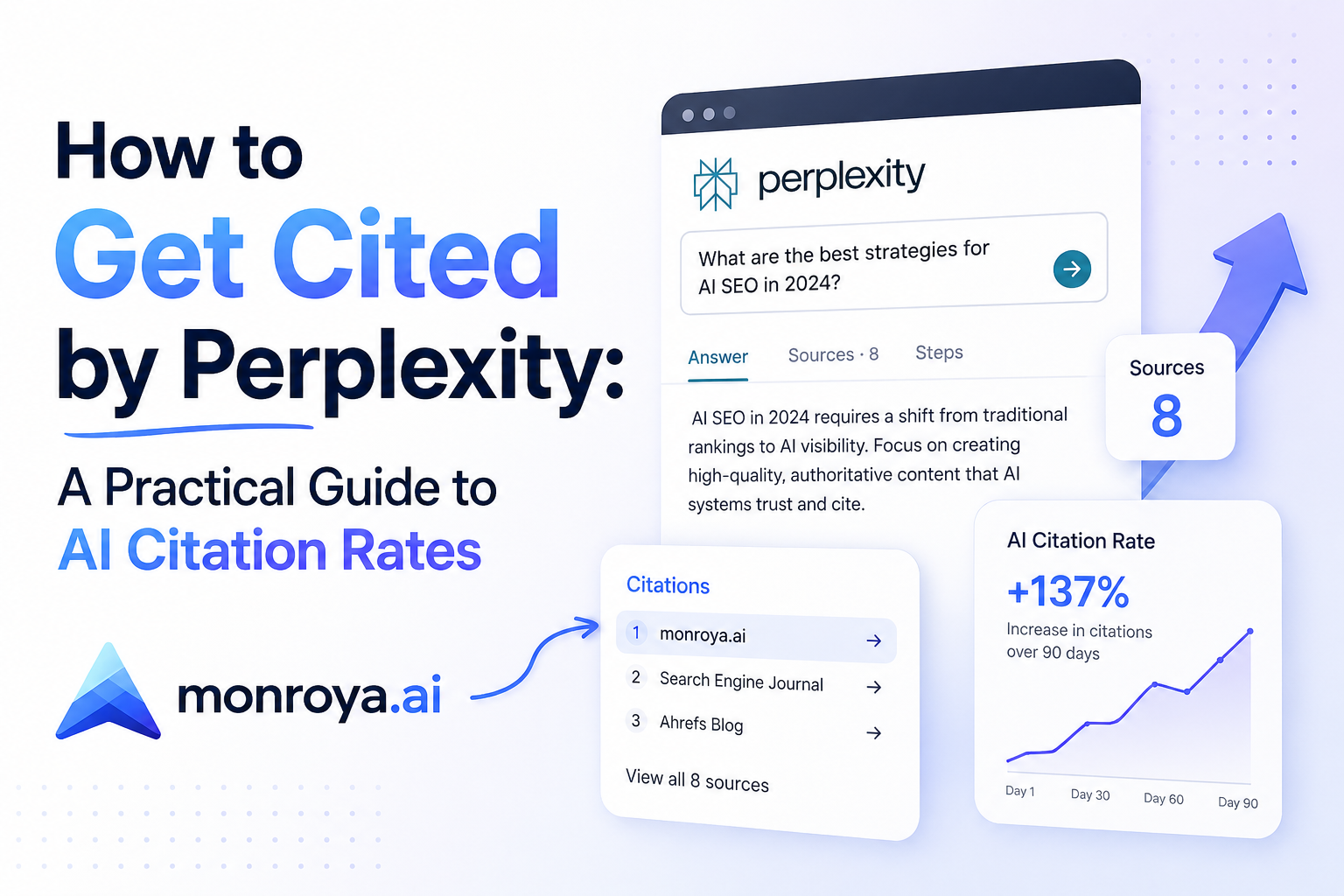
To get cited by Perplexity, you must provide structured, fact-dense data that its "Pro Search" can easily parse and verify against multiple sources. Perplexity prioritizes high-authority technical documentation, Reddit community consensus, and FAQ schema over traditional long-form marketing copy. Increasing your AI citation rate requires moving from "brand storytelling" to "verifiable data points" that the model can use to support its claims.
Table of Contents
- How do I show up in Perplexity search results?
- Why does Perplexity cite Reddit and LinkedIn over my blog?
- How do I improve my AI citation rate for B2B categories?
- What is the difference between SEO and Generative Engine Optimization (GEO)?
- How do I track my brand visibility across ChatGPT, Claude, Gemini, and Perplexity?
- Key Takeaways
- FAQ
How do I show up in Perplexity search results?
Showing up in Perplexity requires your content to be "retrieval-ready" by using clear, declarative headers and specific data points that match user intent. Perplexity’s RAG (Retrieval-Augmented Generation) process scans the live web for citations that validate its answer. If your site lacks structured FAQ schema or clear comparison tables, the model will bypass your domain for a competitor who provides easier-to-parse data.
Perplexity differs from ChatGPT because it is a search engine first. While ChatGPT relies heavily on its training data (which may be months old), Perplexity performs a real-time crawl.
A significant number of B2B buyers now use AI assistants to build their initial vendor shortlist before ever contacting a sales team.
To win the citation, you must stop writing for "keywords" and start writing for "entities." For example, if a buyer asks Perplexity, "What are the best buyer-journey intelligence platforms?", the model looks for lists. If your company name appears in a list on a high-authority site like G2 or a niche trade publication, Perplexity is likely to cite that source and mention your brand.
Why does Perplexity cite Reddit and LinkedIn over my blog?
Perplexity cites Reddit and LinkedIn because it prioritizes "social proof" and "human-verified" sentiment to answer subjective questions about software quality. When a user asks for a "honest review," the LLM views a corporate blog as biased marketing material. It looks for peer-to-peer discussions where real users discuss pricing, implementation hurdles, and actual ROI.
This behavior is a massive shift for B2B growth leads. You can no longer control the narrative solely through your own domain.
B2B companies with active community mentions tend to see a much higher AI citation rate than those relying solely on owned content.
If your product is being discussed on r/sysadmin or r/salesops, Perplexity will pull those threads into its answer. To influence this, your team must engage in these communities not with ads, but by providing helpful, technical answers that the LLM can later scrape and attribute to your brand's expertise.
| Feature | Traditional SEO | Generative Engine Optimization (GEO) |
|---|---|---|
| Primary Goal | Rank #1 on Google SERP | High AI citation rate in LLM answers |
| Content Type | Keyword-optimized blogs | Fact-dense, structured data & FAQs |
| Success Metric | Click-through rate (CTR) | AI Share of Voice & Mention Rate |
| Key Channels | Owned Website, Backlinks | Reddit, Documentation, Schema, PR |
| User Intent | Information Seeking | Decision Support / Shortlisting |
How do I improve my AI citation rate for B2B categories?
Improving your AI citation rate requires a shift toward "Information Density." You must include specific numbers, named integrations, and transparent pricing structures that LLMs can extract as "facts." Use FAQ schema on every high-value page to provide a direct question-and-answer format that Perplexity, ChatGPT, Claude, and Gemini can lift directly into their response windows.
- Audit your current AI visibility: Use a tool like monroya.ai to see which providers (ChatGPT, Claude, Gemini, Perplexity) currently mention you and which sources they cite.
- Deploy FAQ Schema: This is the highest-leverage technical move. It provides a "source of truth" block that LLMs trust.
- Create "Comparison" Pages: Build pages that objectively compare your product to competitors. Use tables. LLMs love tables because they are easy to tokenize and represent as structured data.
- Seed Third-Party Citations: Focus on getting mentioned in technical documentation, GitHub repos, or industry newsletters. Perplexity trusts these more than your "About Us" page.
- Monitor Mention Rates: Track how often your brand is recommended when a user asks for a solution in your category.
While the average B2B website may see little direct traffic from AI referrals, AI heavily influences the critical research phase of the buyer journey.
What is the difference between SEO and Generative Engine Optimization (GEO)?
The difference between SEO and GEO is the destination of the user. SEO focuses on driving a click to your website, while GEO focuses on ensuring the AI assistant provides a comprehensive, positive summary of your brand within its own interface. In GEO, the "click" is secondary to the "mention," because the AI is the one doing the reading for the buyer.
In the SEO era, we optimized for "long-tail keywords." In the GEO era, we optimize for "contextual relevance."
If a buyer asks Claude, "Which CRM is best for a 50-person manufacturing firm?", Claude doesn't just look for the keyword "CRM." It looks for context—who else says this CRM is good for manufacturing? It synthesizes data from your site, review sites, and news articles to form a judgment. If you aren't in that synthesis, you don't exist to that buyer.
How do I track my brand visibility across ChatGPT, Claude, Gemini, and Perplexity?
Tracking brand visibility across the four major LLMs requires specialized software that simulates buyer queries and analyzes the resulting citations and sentiment. You cannot use Google Search Console for this; you need a platform that measures AI Share of Voice by category. This allows you to see if you are gaining or losing ground in the "pre-click" phase of the buyer journey.
monroya.ai provides this exact visibility. The platform scans ChatGPT, Claude, Gemini, and Perplexity to show you exactly how your brand is being described.
The Intelligence tier at $299/month offers a full Buyer Journey analysis, showing you where you drop off in the research phase. For example, you might show up when a buyer asks "What is [Category]?", but disappear when they ask "Which [Category] has the best API?". monroya.ai identifies these gaps and drafts the content you need to fix them.
Understanding your AI visibility is the first step toward reclaiming your spot on the buyer's shortlist. If you are not being cited, you are being replaced by competitors who have already optimized their technical footprint for the RAG era.
Find out where AI ranks you — then fix it.
Key Takeaways
- Citations are the new backlinks: Perplexity and other engines rely on verifiable sources to build trust with the user.
- Structured data is mandatory: Use FAQ schema and tables to make your content easy for LLMs to extract.
- Community matters more than ever: Reddit and LinkedIn are high-authority signals for AI sentiment analysis.
- Monitor all four providers: Your visibility in ChatGPT may look very different from your visibility in Perplexity.
- Actionable intelligence: Use monroya.ai to track your AI Share of Voice and generate content that fills your citation gaps.
FAQ
How does Perplexity choose which sources to cite?
Perplexity prioritizes sources based on authority, relevance, and "extractability." It looks for websites that provide direct answers to the user's prompt. Technical documentation, reputable news outlets, and structured data like tables or FAQ schema are significantly more likely to be cited than generic marketing copy or high-level blog posts.
Does traditional SEO help with AI visibility?
While there is overlap, traditional SEO is not enough. SEO focuses on ranking a page for a click, whereas AI visibility focuses on the model's ability to summarize your brand's value proposition accurately. You can rank #1 on Google but have a 0% citation rate if your content is too "fluffy" for an LLM to parse.
How can I see if ChatGPT is recommending my competitors?
You can use monroya.ai to run automated queries across ChatGPT, Claude, Gemini, and Perplexity. The platform analyzes the responses to determine your AI Share of Voice compared to competitors. This helps you identify specific topics or features where your competitors are winning the AI's "recommendation" and allows you to adjust your content strategy.
What is a good AI citation rate for B2B SaaS?
A "good" citation rate varies by category, but leading B2B SaaS companies aim to be mentioned consistently in relevant category searches. If your brand is rarely mentioned in AI-generated answers for your primary keywords, you are losing significant top-of-funnel awareness to more AI-optimized competitors.
How often should I update content for AI search optimization?
Content for AI search should be updated whenever your product specs, pricing, or key differentiators change. Because engines like Perplexity and Gemini use real-time web access, they can pick up changes within hours. Maintaining a "Source of Truth" page with structured data ensures that the AI always has access to your most current information.
Can I pay to be cited by Perplexity or ChatGPT?
No, there is currently no "pay-to-play" model for citations within the core answer engines of ChatGPT, Claude, or Perplexity. Visibility must be earned through high-quality, structured content and strong third-party mentions. This makes Generative Engine Optimization (GEO) a critical organic strategy for long-term brand health in an AI-first world.
Check your own AI visibility
Run a free AI visibility check at monroya.ai/check — no signup, no credit card. You will see how ChatGPT, Claude, Gemini, and Perplexity describe your category and whether your brand gets named.
Monroya starts at $79/mo (Starter), with Growth at $199/mo and Intelligence at $299/mo. Every plan includes a 7-day free trial.
Related reading
For B2B companies: Win the shortlist when buyers ask AI to compare vendors.