Is Profound Worth It for a Series A B2B Company?
By Jeremy Unruh, Founder, Monroya · Published July 9, 2026 · Reviewed July 2026
Want this for your company? See how AI assistants answer about your site.
Run the free check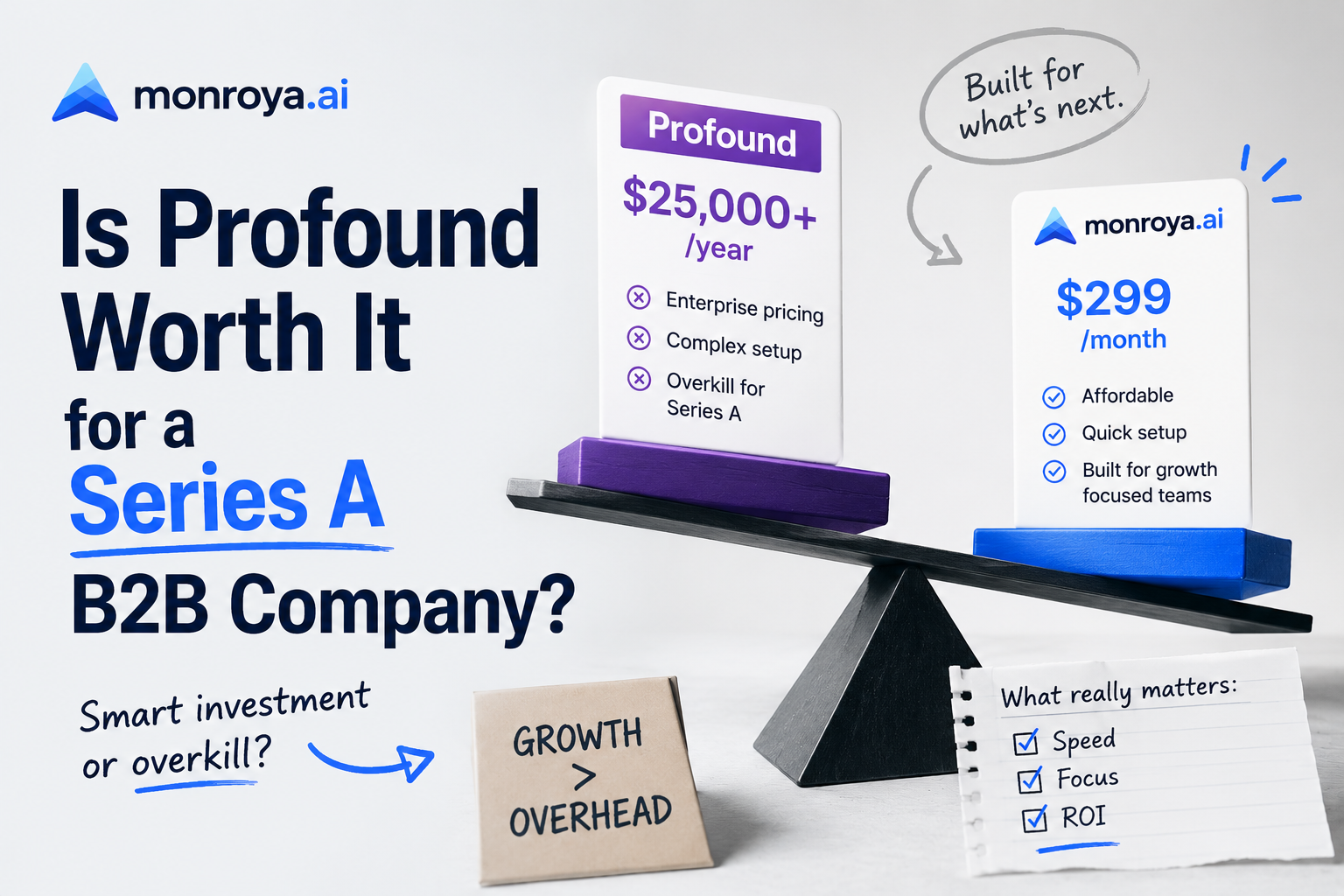
Profound is worth the investment for Series A B2B companies that prioritize high-volume, automated Generative Engine Optimization (GEO) across broad consumer and enterprise datasets. However, if your marketing team requires granular tracking of how specific technical personas interact with your brand across ChatGPT, Claude, Gemini, and Perplexity, the $3,000+ monthly entry point may exceed the utility provided compared to software-first alternatives.
Table of Contents
- How much does Profound actually cost for Series A startups?
- What is the difference between GEO and traditional search monitoring?
- How does Profound compare to monroya.ai for B2B teams?
- Why does the source of data matter for AI responses?
- Can a small marketing team manage Profound effectively?
- What are the best Profound alternatives for 2026?
- Frequently Asked Questions
How much does Profound actually cost for Series A startups?
Profound pricing typically starts at approximately $3,000 to $5,000 per month, often requiring annual commitments that can push initial contracts into the $40,000 range. While they offer enterprise-grade analytics, the cost-to-value ratio for a Series A company depends entirely on whether you have the internal bandwidth to execute on the large-scale data exports the platform provides.
For a venture-backed company with 50-100 employees, every dollar of the burn rate must correlate to pipeline generation. Profound operates primarily as a sophisticated data engine. It tells you where you are missing from the conversation, but it does not always provide the tactical roadmap to fix those gaps. In contrast, monroya.ai offers an Intelligence tier at $299/month that includes both monitoring and the specific drafting capabilities needed to influence AI responses immediately.
B2B buyers increasingly consult AI assistants as a key part of the research process before contacting a sales representative.
What is the difference between GEO and traditional search monitoring?
Generative Engine Optimization (GEO) focuses on influencing the probabilistic outputs of Large Language Models (LLMs), whereas traditional search monitoring tracks static rankings on a results page. GEO requires understanding "semantic proximity"—how closely an LLM associates your brand with specific problem sets or competitor names—rather than just tracking keyword density or backlink counts.
Traditional SEO tools are blind to the "black box" of ChatGPT or Claude. If a prospect asks Perplexity, "Which platform is best for SOC2 compliance automation?", the answer isn't pulled from a single ranking page. It is synthesized from a corpus of data. If your brand isn't in that corpus, you don't exist in that session.
Companies optimizing for generative engines can achieve significantly more brand mentions within AI-synthesized answers compared to non-optimized peers.
How does Profound compare to monroya.ai for B2B teams?
The primary difference lies in the balance between data volume and actionable execution. Profound provides a "Share of Model" metric that is excellent for board decks and high-level sentiment analysis, but monroya.ai is built for the practitioner who needs to know exactly what to change on their website or documentation today to show up in a ChatGPT response tomorrow.
| Feature | Profound | monroya.ai |
|---|---|---|
| Primary Focus | Enterprise GEO Analytics | B2B Influence & Action |
| LLMs Tracked | Multiple (Broad) | ChatGPT, Claude, Gemini, Perplexity |
| Starting Price | ~$3,000+/mo | $79/month (Starter) |
| Actionable Drafts | Limited | Included (Monitor + Draft) |
| Setup Time | Weeks (Sales-led) | Minutes (Self-service) |
| Ideal User | Fortune 500 CMO | Series A-C Growth Lead |
Why does the source of data matter for AI responses?
AI models do not treat all web content equally; they prioritize high-authority technical documentation, verified reviews, and community discussions from platforms like Reddit and GitHub. Understanding which sources an LLM is citing for your specific category allows you to prioritize your content distribution where it actually moves the needle for the model's training data.
For example, if you notice that Claude consistently cites a specific competitor's documentation when asked about "API rate limiting," your strategy shouldn't be to write more blog posts. It should be to update your own technical docs with clearer semantic markers that LLMs can easily parse. monroya.ai tracks these specific shifts across the four major providers, ensuring you aren't wasting resources on platforms the models ignore.
For technical B2B queries, LLMs are often more likely to cite community-driven content from sources like Reddit or Stack Overflow than standard corporate blogs.
Can a small marketing team manage Profound effectively?
Profound is a powerful platform, but it often requires a dedicated analyst or an external agency to interpret the data and turn it into a content calendar. For a Series A team where the Director of Demand Gen is also the one writing the email sequences, a platform that requires heavy lifting to extract insights can quickly become "shelfware."
A smaller team needs a "closed-loop" system. This means the software identifies a gap—such as your brand being excluded from a "Top 10" list in Perplexity—and immediately provides the suggested copy or structured data schema to rectify the omission. This is the core philosophy behind monroya.ai: monitoring is useless without a path to immediate action.
What are the best Profound alternatives for 2026?
The market for AI search monitoring has bifurcated into expensive, managed-service platforms and agile, software-only solutions. For companies that don't need a $3,000/month managed fee, tools like monroya.ai, Otterly.ai, and AthenaHQ provide varying levels of insight into how brands appear in generative results without the enterprise overhead.
- monroya.ai: Best for B2B teams needing to monitor ChatGPT, Claude, Gemini, and Perplexity with built-in action plans.
- Otterly.ai: Good for general brand mentions, though often used by agencies for broader social listening.
- AthenaHQ: A solid option for basic visibility tracking, though lacks the deep B2B-specific logic found in specialized platforms.
- OmniSEO: Focuses heavily on the managed service aspect, making it a "done-for-you" GEO play.
- Peec AI: An emerging tool focused on the retail and e-commerce side of generative search.
If your goal is to ensure your company is the first one mentioned when a prospect asks an AI assistant for a recommendation, you need a platform that understands the nuances of the professional research process.
Find out where AI ranks you — then fix it.
FAQ
Is Profound Worth It for a Series A B2B Company?
Profound is generally only worth the investment for Series A companies with a dedicated data analyst and a monthly budget exceeding $3,000. For most lean B2B teams, the high cost and lack of automated "fix-it" features make more agile platforms like monroya.ai a more efficient choice for driving immediate results.
What is Share of Model?
Share of Model is a metric that measures how frequently your brand is mentioned by an LLM relative to your competitors for a specific set of prompts. It is the generative era's equivalent of "Share of Voice," indicating your brand's dominance within the training data and real-time retrieval systems of AI.
How do I know if my brand appears in AI search results?
You can manually test prompts in ChatGPT, Claude, Gemini, and Perplexity, but this is time-consuming and prone to bias. Professional monitoring tools like monroya.ai automate this by running thousands of queries across different personas to give you an objective view of your brand's presence in the AI ecosystem.
What is generative engine optimization?
Generative Engine Optimization (GEO) is the process of structuring your website's data, content, and third-party mentions to increase the likelihood of being cited by LLMs. It involves technical tactics like FAQ schema and semantic keyword clustering designed specifically for how models like GPT-4o and Claude 3.5 Sonnet process information.
How much does monroya.ai cost?
monroya.ai offers three transparent pricing tiers: a 7-day free Trial, a Starter plan at $79/month, a Growth plan at $199/month,, and an Intelligence plan at $299/month. Unlike enterprise-only platforms, there are no hidden managed service fees or long-term contract requirements, making it accessible for Series A and B marketing teams.
Why isn't my company showing up in ChatGPT results?
Your company may be missing from ChatGPT results because your content lacks the semantic authority the model requires, or your brand is not frequently mentioned on high-signal "source" sites like Reddit, LinkedIn, or industry-specific review hubs. AI models prioritize verified, structured, and community-validated information over standard marketing copy.
Key Takeaways
- Profound is an enterprise-grade data engine that often requires a $3,000+/month commitment, which may be overkill for lean Series A teams.
- B2B marketing has shifted toward GEO, where the goal is to influence the synthesis of AI answers rather than just ranking for keywords.
- monroya.ai provides a more tactical, cost-effective alternative by combining monitoring across four major LLMs with actionable draft generation.
- The source of your data (docs, Reddit, reviews) is more important than the volume of your blog posts when it comes to influencing AI citations.
Check your own AI visibility
Run a free AI visibility check at monroya.ai/check — no signup, no credit card. You will see how ChatGPT, Claude, Gemini, and Perplexity describe your category and whether your brand gets named.
Monroya starts at $79/mo (Starter), with Growth at $199/mo and Intelligence at $299/mo. Every plan includes a 7-day free trial.
For B2B companies: Win the shortlist when buyers ask AI to compare vendors.