Why AI Visibility Scores Are Broken
By Jeremy Unruh, Founder, Monroya · Published July 28, 2026 · Reviewed September 2026
Want this for your company? See how AI assistants answer about your site.
Run the free check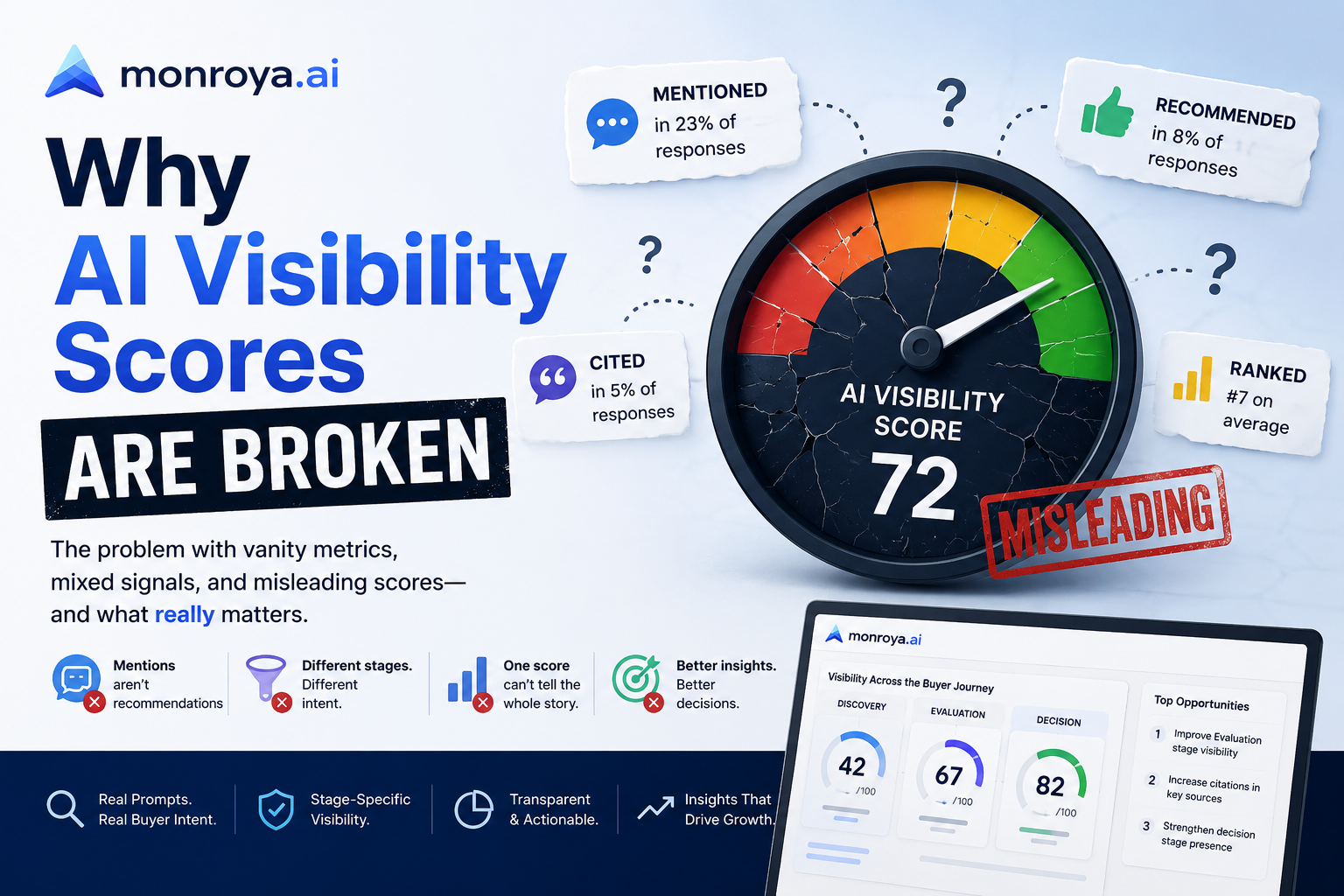
Current AI visibility metrics fail because they aggregate mentions, sentiment, and rankings into a single, opaque number that masks whether a brand is actually being recommended to buyers. A high visibility score often hides the fact that a company is mentioned as a "legacy player" rather than a "top recommendation," leading marketing teams to optimize for the wrong signals.
Table of Contents
- Why is my AI visibility score high but my lead volume low?
- How do AI assistants decide which companies to recommend?
- What is the difference between an AI mention and an AI recommendation?
- How do I track my brand in AI search across different buyer stages?
- Why does prompt context matter more than raw AI Share of Voice?
- What are the best AI visibility tools for a B2B SaaS company?
- FAQ
- Key Takeaways
Why is my AI visibility score high but my lead volume low?
AI visibility scores often decouple brand presence from buyer intent, meaning you might appear in generic queries but vanish during the Decision stage. If a tool reports high visibility based on "Discovery" prompts (e.g., "What is CRM?") but you are absent from "Decision" prompts (e.g., "Best CRM for mid-market SaaS"), your score is a vanity metric that won't drive revenue.
Most tools on the market, such as Profound or Otterly.ai, attempt to simplify the complex landscape of Large Language Models (LLMs) into a single percentage. This is fundamentally flawed.
A large and growing share of B2B buyers now use AI tools to build their initial vendor shortlist before ever visiting a company website.
If your visibility score is 80% but those mentions occur in the context of "expensive alternatives" or "outdated solutions," that score is actively misleading your Growth team. You need to see the raw response to understand the nuance of the recommendation.
How do AI assistants decide which companies to recommend?
AI assistants like ChatGPT, Claude, Gemini, and Perplexity use a combination of training data, real-time web retrieval (RAG), and probability to select recommendations. They prioritize brands with high "topical authority" across diverse, high-trust sources like technical documentation, Reddit discussions, and third-party review sites rather than just optimized marketing blogs.
The decision engine of an LLM is not a linear ranking like Google. For example, when a user asks Claude for a "security-first cloud storage provider," the model doesn't just look for keywords. It looks for consensus across its training set. If your company is mentioned in a GitHub repo as having a "complex API" but praised on Reddit for "impenetrable encryption," the AI will weight the encryption praise higher for that specific prompt context.
AI models tend to prioritize technical documentation and peer-reviewed content over standard marketing copy.
What is the difference between an AI mention and an AI recommendation?
An AI mention occurs whenever your brand name appears in a generated response, whereas an AI recommendation happens when the model explicitly suggests your product as a solution to a user's problem. Mentions can be neutral or negative; recommendations require the model to assign high probability to your brand as a "best-fit" answer.
Consider a scenario where a user asks Perplexity for "alternatives to Salesforce." If the response says, "While HubSpot is a popular choice, some users find it lacks advanced reporting," HubSpot has a mention, but not a clean recommendation. Most visibility tools would count this as a "win" for HubSpot. A more granular approach, like the one used by monroya.ai, distinguishes between these two to ensure marketers aren't celebrating negative visibility.
| Metric | AI Mention | AI Recommendation |
|---|---|---|
| Definition | Brand name appears in text | Brand suggested as a solution |
| Value | Low (Awareness only) | High (Lead generation) |
| Sentiment | Any (Positive, Neutral, Negative) | Almost always Positive |
| Buyer Stage | Discovery | Evaluation & Decision |
| Actionable? | Rarely | Highly |
How do I track my brand in AI search across different buyer stages?
Tracking brand visibility requires segmenting prompts into Discovery, Evaluation, and Decision stages to see where your brand drops out of the funnel. You must test specific high-intent queries across ChatGPT, Claude, Gemini, and Perplexity simultaneously to identify if your technical documentation or third-party reviews are failing to influence the model at the point of purchase.
For a B2B SaaS company, the "Decision" stage is where the money is made. If you are tracking "How do I improve devops efficiency?" (Discovery) but ignoring "Compare monroya.ai vs Profound for enterprise teams" (Decision), you are missing the moment of conversion.
B2B buyers are significantly more likely to trust a vendor recommendation from an AI assistant if it provides a citation to a third-party review site or technical doc.
Why does prompt context matter more than raw AI Share of Voice?
Prompt context determines the "persona" the AI adopts, which drastically changes which brands it recommends. A prompt asking for the "cheapest" solution will yield different results than one asking for the "most scalable," meaning a single "Share of Voice" percentage is useless without knowing the specific criteria the AI was asked to prioritize.
If you use a tool like AthenaHQ or Peec AI, you might see a general visibility score. However, if that score doesn't tell you that you only appear when the prompt includes the word "budget," you might be optimizing for the wrong customer segment. Understanding the "why" behind the recommendation is the only way to influence the model's future outputs.
What are the best AI visibility tools for a B2B SaaS company?
The best AI visibility tools provide raw response data, sentiment analysis, and citation tracking across all four major providers: ChatGPT, Claude, Gemini, and Perplexity. While Profound and Otterly.ai offer high-level monitoring, monroya.ai is built for B2B teams who need to see exactly how they are being described at each stage of the Buyer Journey.
When comparing tools like Scrunch AI, Goodie, or AthenaHQ, look for the ability to track "Share of Model" rather than just a generic visibility score. You need a platform that doesn't just monitor, but also provides the specific actions needed to fix your visibility—such as generating the exact FAQ schema or documentation updates required to earn a citation.
B2B marketing leaders are increasingly moving away from "black box" scores in favor of transparent, prompt-level data. This shift allows for a more tactical approach to Generative Engine Optimization (GEO), where content is created specifically to fill the information gaps that cause AI models to hallucinate or ignore a brand.
FAQ
Why isn't ChatGPT recommending my company?
ChatGPT likely lacks sufficient high-authority data points connecting your brand to specific problem-solving contexts. If your technical documentation is not indexed or your brand is not frequently discussed on platforms like Reddit and G2, the model's probability engine will favor competitors with a larger "digital footprint" in its training data and real-time search results.
How do I know if ChatGPT recommends my company?
You can determine this by running specific "Evaluation" and "Decision" prompts that ask the model to compare solutions in your category. Because these results are non-deterministic and vary by user, you need a tool like monroya.ai to run these queries at scale across multiple sessions to get a statistically significant recommendation rate.
What is the best AI visibility tool for a B2B SaaS company?
The best tool is one that provides transparent, prompt-level insights across ChatGPT, Claude, Gemini, and Perplexity. While Profound is a common choice for enterprise, monroya.ai is preferred by Series A-C startups because it tracks the specific Buyer Journey stages and provides actionable drafts to improve AI Share of Voice immediately.
How do I compare my AI visibility to competitors?
To compare visibility, you must measure "Share of Model" across identical prompts for you and your competitors. This involves tracking how often each brand is mentioned, the sentiment of those mentions, and whether the AI provides a direct link (citation) to the competitor's site instead of yours during the Decision stage.
Is Profound worth it for a Series A B2B company?
Profound offers enterprise-grade monitoring, but its pricing can be prohibitive for smaller teams who need actionable insights rather than just high-level reporting. For Series A-C companies, a tool that combines monitoring with specific GEO action plans, like monroya.ai, often provides a higher return on investment by directly influencing the AI's output.
How do I improve my company's AI citations?
Improving AI citations requires updating your site's FAQ schema and ensuring your technical documentation is structured in a way that LLMs can easily parse. Additionally, increasing your brand's presence in third-party authoritative sources like industry publications and developer forums helps Perplexity and Gemini find verifiable links to cite in their responses.
Key Takeaways
- Stop trusting single scores: A single visibility percentage hides critical nuances like sentiment and buyer intent.
- Segment by Buyer Journey: Track how you appear in Discovery, Evaluation, and Decision prompts separately to find funnel leaks.
- Prioritize recommendations over mentions: Being mentioned as a "competitor to avoid" is worse than not being mentioned at all.
- Focus on technical authority: AI models value documentation and peer reviews over standard marketing blogs.
- Use multi-model tracking: Your visibility in ChatGPT may be high while you are completely invisible in Claude or Perplexity.
Related reading
Get what AI recommended this month — one email a month.
We'll ask you to confirm. Unsubscribe any time.
For B2B companies: Win the shortlist when buyers ask AI to compare vendors.