Why doesn't my company show up when I ask ChatGPT about my industry?
By Jeremy Unruh, Founder, Monroya · Published July 14, 2026 · Reviewed September 2026
Want this for your company? See how AI assistants answer about your site.
Run the free check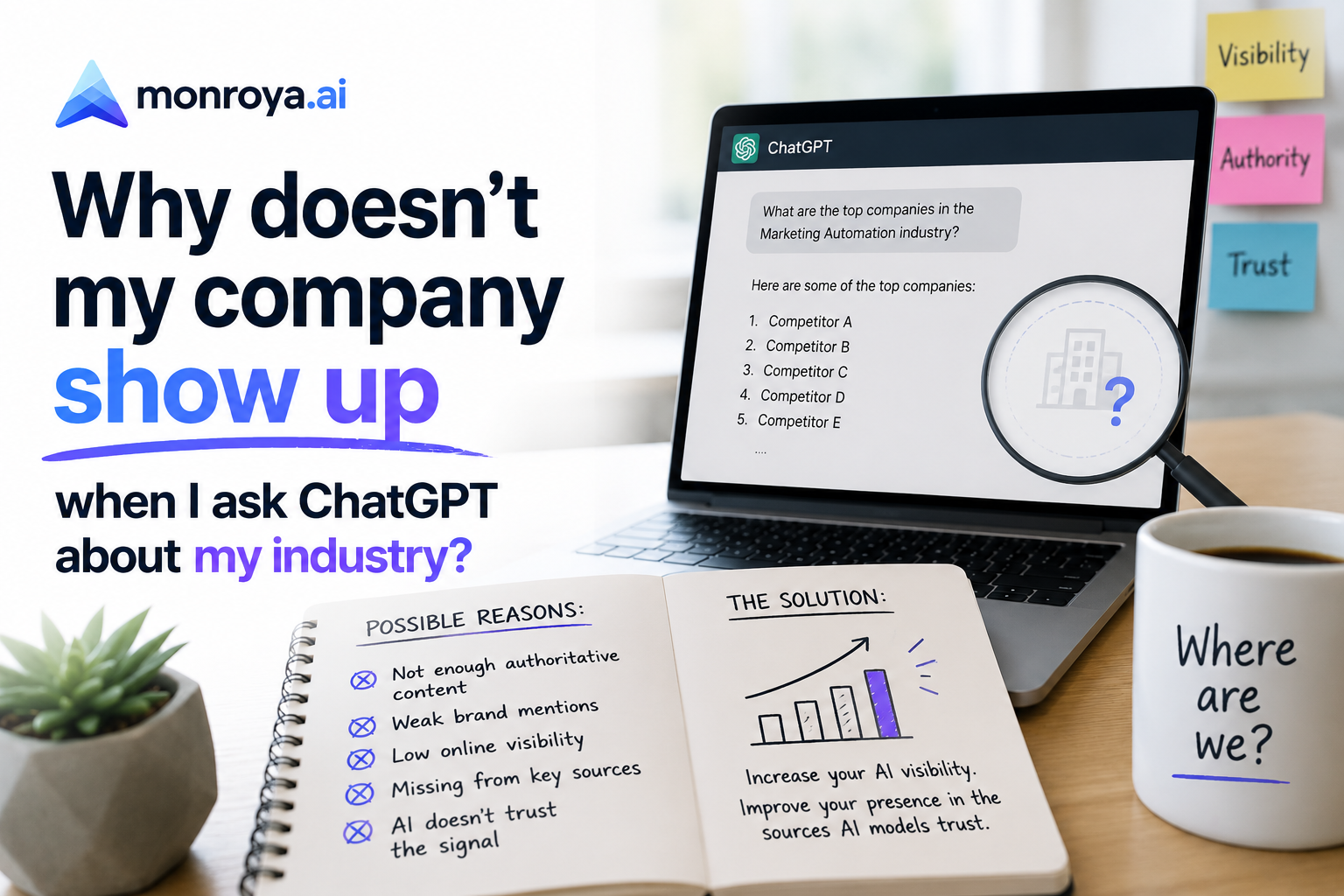
Your company doesn't show up when you ask ChatGPT about your industry because ChatGPT doesn't rank pages — it synthesizes an answer from the sources it can find, trust, and understand. If your brand has a limited web presence, unstructured marketing content, few third-party mentions, or no visible buyer-intent information, the model has nothing to pull you into the answer with. Fixing it is less about SEO and more about giving LLMs the exact evidence they need to include you.
A large and growing share of B2B buyers now use AI assistants to build their initial vendor shortlists before visiting a single company website. If ChatGPT doesn't name you at the shortlist stage, you're not in the deal.
Table of Contents
- 1. Your company has a limited web presence
- 2. Your content isn't structured for LLMs
- 3. You have the wrong content type — marketing vs. informational
- 4. Not enough third-party validation and mentions
- 5. What to do about it
- 6. How to measure whether it's working
- FAQ
1. Your company has a limited web presence
ChatGPT can only mention companies it has seen enough times, in enough different places, to consider them a real entity in your category. If your footprint is limited to your own website plus a few social profiles, the model treats you as low-signal and defaults to competitors with broader coverage across news, forums, review sites, and industry publications.
This is where the split between Named and Cited matters. LLMs "name" companies they recognize as category entities and "cite" the specific URLs they trust to support a claim. Being named requires presence across many sources. Being cited requires one specific page worth quoting. Most invisible companies fail the first test — they're not recognized as belonging to the category at all.
The fix isn't more posts on your own domain. It's presence in the sources ChatGPT actually reads: Reddit threads, G2 and Capterra listings, Substack write-ups, podcast transcripts, and industry newsletters. One mention in a widely-syndicated comparison article moves the needle more than ten posts on your own blog.
2. Your content isn't structured for LLMs
ChatGPT extracts answers, not pages. If your content buries the answer three paragraphs into a hero section — or hides it behind clever framing and marketing prose — the model can't pull a clean sentence out to use. The pages that get cited lead with a direct, declarative answer to a specific question and back it with a verifiable fact.
Companies with high organic search rankings often see little overlap with their visibility in AI-generated answers. Ranking #1 on Google doesn't earn you a mention in ChatGPT — different systems, different signals.
What actually gets extracted:
- A question phrased the way buyers ask it, used as a heading.
- The first sentence directly answers that question in plain language.
- A supporting statistic, number, or specific example immediately after.
FAQPageandArticleJSON-LD schema on the page so the model can parse structure without guessing.
This post itself follows that pattern. Every H2 is a real question, every answer opens with a declarative sentence, and the FAQ block at the bottom emits structured data.
3. You have the wrong content type — marketing vs. informational
ChatGPT prefers implementation guides, comparison tables, technical documentation, and objective explainers over homepages, feature pages, and hero-copy landing pages. Marketing pages are optimized to convert a visitor who already knows they want you. LLMs are optimized to help a buyer who doesn't.
Take a Series B fintech ranking #1 on Google for "automated accounts payable." When a buyer asks ChatGPT, "Which AP tool has the fastest implementation for a 200-person team?", the model cites a competitor with a public implementation guide and three Reddit threads describing onboarding speed. The #1-ranked fintech loses the mention because its top page is a marketing landing page — it doesn't answer the specific constraint.
The pattern to move from marketing to informational:
- Turn every feature into a "how it works" document with real timings, real integrations, and real edge cases.
- Publish comparison pages against named competitors (
/vs/*). - Publish pricing openly on a public pricing page.
- Publish specific customer outcomes with numbers, not adjectives.
4. Not enough third-party validation and mentions
ChatGPT weighs third-party sources heavily because they reduce hallucination risk. If only your own site says you're a leading vendor, the model discounts it. If Reddit users, G2 reviewers, and an industry analyst all mention you in the same category, the model treats you as verified and safe to recommend.
The high-leverage third-party surfaces:
- Reddit — category subreddits and problem-specific threads. LLMs weight Reddit unusually high because it's messy, unpaid, and specific.
- G2 / Capterra / TrustRadius — structured review data with named competitors.
- Comparison hubs — "Best X for Y" listicles from independent publishers.
- Podcast and newsletter mentions — transcripts get indexed and quoted.
- Wikipedia and Wikidata — the entity backbone many models fall back to.
If your brand isn't in these places, no on-site SEO change will fix your ChatGPT visibility.
5. What to do about it
The fix is a repeatable loop: measure where you're missing, publish the specific answer that closes the gap, seed it into the third-party surfaces LLMs read, then measure again. Do this per buyer stage, not per keyword.
Prompts split cleanly across three stages:
- Discovery: "What are the top AI visibility tools?"
- Evaluation: "Compare monroya.ai vs profound for a B2B marketing team."
- Decision: "What is the pricing for monroya.ai Intelligence tier?"
Most invisible companies optimize only for Discovery and lose the buyer as soon as the question gets specific. The Buyer Journey Intelligence model in Monroya is built around this — track Mention Rate at each stage, and fix the stage where the drop-off is.
The 30-day checklist:
- Publish or rewrite one "how it works" implementation page per core feature.
- Publish one
/vs/{competitor}page for every competitor you actually lose to. - Seed three specific answers into Reddit threads where the exact question is being asked.
- Claim and complete G2 / Capterra listings with named-competitor comparisons.
- Add
FAQPageJSON-LD to every question-shaped page. - Rewrite meta descriptions and page leads to open with a direct declarative answer.
6. How to measure whether it's working
Manual searches won't tell you. ChatGPT personalizes results by session, history, and location; two people asking the same question get different answers. The only reliable measurement is systematic tracking: run the same buyer-intent prompts across ChatGPT, Claude, Gemini, and Perplexity on a schedule and watch how your Mention Rate moves per stage.
B2B brands that actively monitor their AI visibility tend to see a higher citation rate over time compared to those using traditional SEO alone.
The metrics that matter:
| Metric | What it tells you |
|---|---|
| Mention Rate by buyer stage | Whether you're named at Discovery, Evaluation, and Decision. |
| Citation Rate | Whether a specific URL of yours is used as a source. |
| Share of Voice | Your named-share vs. named competitors in the same prompt set. |
| Provider split | Which model surfaces you and which one doesn't (they differ a lot). |
| Stage drop-off | Where in the funnel you go invisible — this is where to publish next. |
The difference between "named" and "cited" is the actionable one: if you're named but not cited, you have a content gap on a specific page. If you're not named at all, you have a presence gap in third-party sources.
Understanding why you're missing from these results is the first step. The second is deploying a strategy targeted at the specific stage where you drop off. Whether you're evaluating OmniSEO alternatives or comparing Peec AI vs monroya.ai, the goal is the same: when a buyer asks an AI for a solution, your name is in the answer.
Find out where AI ranks you — then fix it.
FAQ
How do I know if my brand appears in AI search results?
Use a dedicated tracking tool like monroya.ai to run automated queries across ChatGPT, Claude, Gemini, and Perplexity. Manual searching is unreliable because LLM responses vary based on user history, location, and session context. Automated tracking gives you a baseline Mention Rate per buyer stage and identifies the exact prompts where competitors are named instead of you.
What structured data does ChatGPT actually read?
FAQPage, Article, Product, and Organization JSON-LD are the schemas most consistently extracted. Add them to every page where the URL structure implies a question or a comparison. Plain semantic HTML (h1, h2, clean lists, tables) matters almost as much as the schema itself.
How do I get mentioned on Reddit and G2 without spamming?
On Reddit, find the specific threads where the exact buyer question is being asked and answer it with a specific, useful, non-promotional reply that names your product once at the end. On G2 and Capterra, claim your listing, complete every field, and ask your happiest customers directly for a review that names the alternative they compared against.
How long does it take to see results from GEO optimization?
Results typically appear within 2 to 4 weeks for models with real-time browsing (Perplexity and ChatGPT Search) and 3 to 6 months for base-model changes. Real-time surfaces move first because they re-index continuously. Base-model recall moves on training-cycle schedules.
What is Share of Model?
Share of Model is the percentage of times your brand is mentioned or cited by an LLM in response to category-specific queries compared to your competitors. It's the AI-era successor to Share of Search. High Share of Model signals the model treats you as a primary authority in your niche.
What is the difference between AI visibility and SEO?
SEO prioritizes site authority and link equity to drive traffic to a URL. AI visibility prioritizes information density and third-party validation to drive brand mentions inside an LLM's response. SEO is about being the destination; AI visibility is about being the answer, whether or not the user ever clicks through.
What is the difference between monroya.ai and Otterly.ai?
monroya.ai is built specifically for the B2B Buyer Journey — tracking Mention Rate across Discovery, Evaluation, and Decision stages and generating drafts to fix visibility gaps. Otterly.ai is positioned more for agencies and general brand monitoring. monroya.ai focuses on the monitoring-plus-action workflow so B2B teams can move from data to fix immediately.
Check your own AI visibility
Run a free AI visibility check at monroya.ai/check — no signup, no credit card. You will see how ChatGPT, Claude, Gemini, and Perplexity describe your category and whether your brand gets named.
Monroya starts at $79/mo (Starter), with Growth at $199/mo and Intelligence at $299/mo. Every plan includes a 7-day free trial.
Related reading
For B2B companies: Win the shortlist when buyers ask AI to compare vendors.