Can small companies compete with big brands in AI search results?
By Jeremy Unruh, Founder, Monroya · Published July 19, 2026 · Reviewed July 2026
Want this for your company? See how AI assistants answer about your site.
Run the free check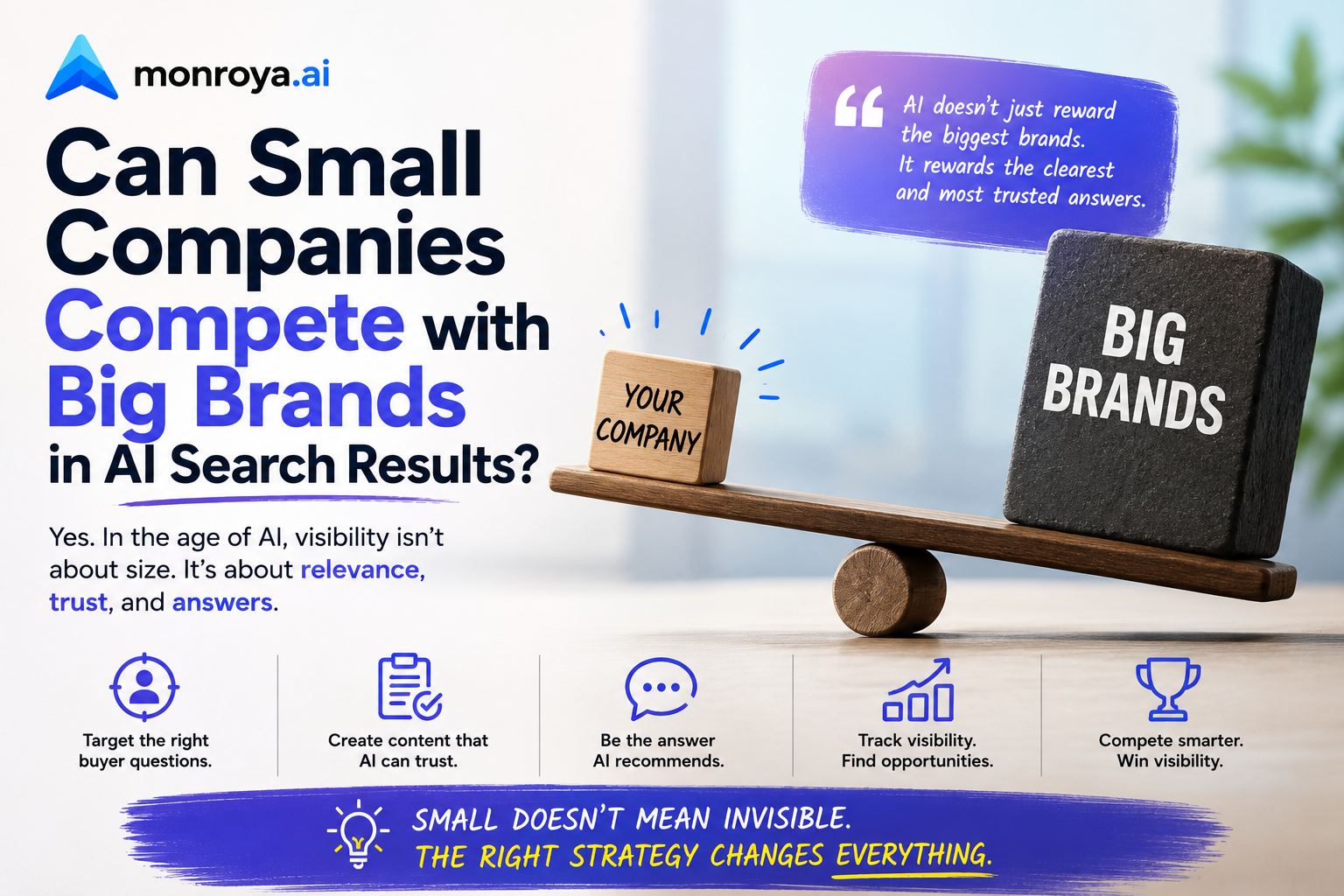
Small companies can outperform enterprise brands in AI search results by optimizing for high-intent, long-tail queries where LLMs prioritize technical accuracy over brand recognition. Because models like ChatGPT and Perplexity value information density and structured data, a Series A startup with superior documentation and active community presence can achieve a higher AI Share of Voice than a legacy incumbent relying on outdated PDF case studies.
Table of Contents
- How do I show up in ChatGPT against larger competitors?
- Why does information density beat brand authority in AI search?
- What is the difference between AI visibility and traditional SEO?
- How do I track my brand's AI visibility across ChatGPT and Perplexity?
- Which AI visibility tool fits a B2B team?
- FAQ
How do I show up in ChatGPT against larger competitors?
To show up in ChatGPT against larger competitors, small companies must provide structured, verifiable data that directly answers complex user prompts. While Google rewards domain authority and backlink volume, LLMs prioritize "source-grounding," meaning they favor content that is easy to parse, frequently cited in developer forums, and formatted in FAQ schema or technical documentation.
A growing number of B2B buyers now use AI assistants to generate initial vendor shortlists before engaging with a sales representative.
For a Series A company, the path to visibility isn't outspending the incumbent on Google Ads; it is out-informing them in the training data. When a user asks Perplexity for "the best SOC2 compliant payroll tool for startups under 50 people," the model looks for specific feature matches and pricing transparency. If the enterprise competitor hides their pricing behind a "Request a Demo" wall and you publish a detailed breakdown of Profound Pricing: What It Actually Costs (And What's Not Included), the LLM is statistically more likely to cite your brand as the definitive answer for that specific segment.
Why does information density beat brand authority in AI search?
Information density beats brand authority because LLMs are designed to minimize "hallucination" by relying on the most explicit and structured data available. Large brands often have "thin" web presences characterized by vague marketing copy, whereas smaller, agile teams can publish dense, data-rich technical guides that provide the specific tokens the model needs to generate a confident response.
Companies that implement structured FAQ schema tend to see a higher citation rate in Perplexity and Gemini compared to those using standard blog formats.
Consider a comparison between a legacy player and a challenger like monroya.ai. A legacy brand might have a high domain rating, but if their content is gated or written in "fluff-heavy" corporate speak, Claude and Gemini will struggle to extract facts. Conversely, a challenger that publishes a direct AthenaHQ vs monroya.ai: Feature and Pricing Comparison provides the model with a ready-made data structure. The model doesn't care about the size of your marketing team; it cares about the utility of your text.
What is the difference between AI visibility and traditional SEO?
AI visibility focuses on the probability of being mentioned or cited in a generated response, whereas traditional SEO focuses on ranking in a list of links. SEO relies on keywords and backlinks; AI visibility, or Generative Engine Optimization (GEO), relies on semantic relevance, sentiment in community discussions (like Reddit), and the ability of the model to synthesize your content into a summary.
| Feature | Traditional SEO | AI Visibility (GEO) |
|---|---|---|
| Primary Goal | Rank #1 on Page 1 | Be the cited source in the answer |
| Key Metric | Click-Through Rate (CTR) | AI Share of Voice / Citation Rate |
| Content Type | Keyword-optimized blogs | Structured data, FAQs, Reddit threads |
| Authority Source | Backlinks from high DR sites | Mentions in training data & live search |
| User Intent | Discovery via keywords | Evaluation via natural language prompts |
Small teams often ask, Is AthenaHQ Worth It for a Small Marketing Team? or Is OmniSEO Worth It If You Don't Need a Managed Service? The answer depends on whether you are trying to win the "link war" or the "answer war." In 2026, winning the answer war is more cost-effective for smaller budgets because it requires better writing, not more backlinks.
How do I track my brand's AI visibility across ChatGPT and Perplexity?
Tracking AI visibility requires monitoring how different models describe your category and which sources they cite for specific Discovery, Evaluation, and Decision prompts. You must use a tool that scans ChatGPT, Claude, Gemini, and Perplexity simultaneously to identify where your brand is being omitted or misrepresented in the generated buyer journey.
B2B companies that actively monitor AI search results can identify significantly more competitive threats than those relying on traditional keyword tracking.
If you are evaluating Otterly.ai Alternatives: 6 Tools for AI Visibility Tracking, you need to look beyond simple mention counting. A tool like monroya.ai doesn't just tell you that you were mentioned; it shows you the specific prompt that triggered the mention and provides a draft of the content needed to fix a negative or missing citation. This is critical for small teams who don't have time to manually prompt every LLM every day.
Which AI visibility tool fits a B2B team?
The right AI visibility tool for a B2B team must map the entire buyer journey, from high-level category discovery to specific "vs" comparisons. While some tools are built for agencies to manage hundreds of small local SEO clients, B2B SaaS teams need deep intelligence on how AI models influence technical decision-makers and procurement leads.
When comparing Otterly.ai vs monroya.ai: GEO Monitoring vs Buyer Journey Tracking, the distinction lies in the actionability of the data. Small teams should avoid "software-plus-agency" models that charge high retainers for manual reporting. Instead, look for software-only solutions that provide automated insights. For example, if you are looking at OmniSEO vs monroya.ai: Software-Only vs Software-Plus-Agency, the software-only approach allows you to scale your AI visibility efforts without the $3,000/month managed service fee often associated with legacy SEO agencies.
For a Series A founder, the question is often: Is Profound Worth It for a Series A B2B Company? or Is Otterly.ai Right for B2B SaaS, or Built for Agencies? If the tool doesn't show you the exact citations your competitors are getting in Perplexity, it isn't providing the level of detail needed to compete with the big brands.
Small companies have a unique window of opportunity. Big brands move slowly, tied to legacy SEO strategies and legal-heavy content approval processes. By the time an enterprise incumbent realizes they are losing "Share of Model," a smaller competitor using monroya.ai has already optimized their technical docs, dominated the relevant Reddit threads, and secured the primary citation in ChatGPT for the most lucrative category keywords.
Find out where AI ranks you — then fix it.
FAQ
How do I know if my brand appears in AI search results?
To know if your brand appears in AI search results, you must run specific prompts across ChatGPT, Claude, Gemini, and Perplexity that mimic a buyer's research process. Manual checking is inefficient; B2B teams use platforms like monroya.ai to automate this tracking and receive alerts when their AI Share of Voice changes or when competitors gain new citations.
What is Share of Model?
Share of Model is a metric that measures the frequency and prominence of your brand's mentions within AI-generated responses compared to your competitors. Unlike Share of Voice in traditional media, Share of Model accounts for the likelihood of a brand being recommended as a solution when a user asks an LLM for advice.
Why isn't my company showing up in ChatGPT results?
Your company may not show up in ChatGPT results if your content lacks structured data, is blocked by robots.txt, or if your brand sentiment in community forums like Reddit is neutral or non-existent. LLMs prioritize sources that are easily parsed and frequently validated by third-party discussions rather than just your own website copy.
How do B2B companies monitor their presence in ChatGPT and Perplexity?
B2B companies monitor their presence by using AI visibility tools that simulate the B2B buyer journey across multiple LLMs. These tools track which sources the models cite, the sentiment of the mentions, and how the brand is positioned against competitors in "Discovery" and "Evaluation" stage prompts.
What is generative engine optimization?
Generative engine optimization (GEO) is the process of configuring your website and external content to be more easily indexed, understood, and cited by large language models. This includes using FAQ schema, improving information density, and ensuring your brand is mentioned positively in the datasets LLMs use for real-time web searching.
Is AI visibility tracking worth it for B2B SaaS companies?
Yes, AI visibility tracking is essential for B2B SaaS because AI assistants are increasingly the first point of research for technical buyers. Failing to monitor these results means you are invisible during the most critical stage of the vendor selection process, allowing competitors to define the narrative before you even know a lead exists.
Check your own AI visibility
Run a free AI visibility check at monroya.ai/check — no signup, no credit card. You will see how ChatGPT, Claude, Gemini, and Perplexity describe your category and whether your brand gets named.
Monroya starts at $79/mo (Starter), with Growth at $199/mo and Intelligence at $299/mo. Every plan includes a 7-day free trial.
For B2B companies: Win the shortlist when buyers ask AI to compare vendors.