Discovery vs Evaluation vs Decision prompts: How AI influences every stage of the B2B buying cycle
By Jeremy Unruh, Founder, Monroya · Published July 7, 2026 · Reviewed September 2026
Want this for your company? See how AI assistants answer about your site.
Run the free check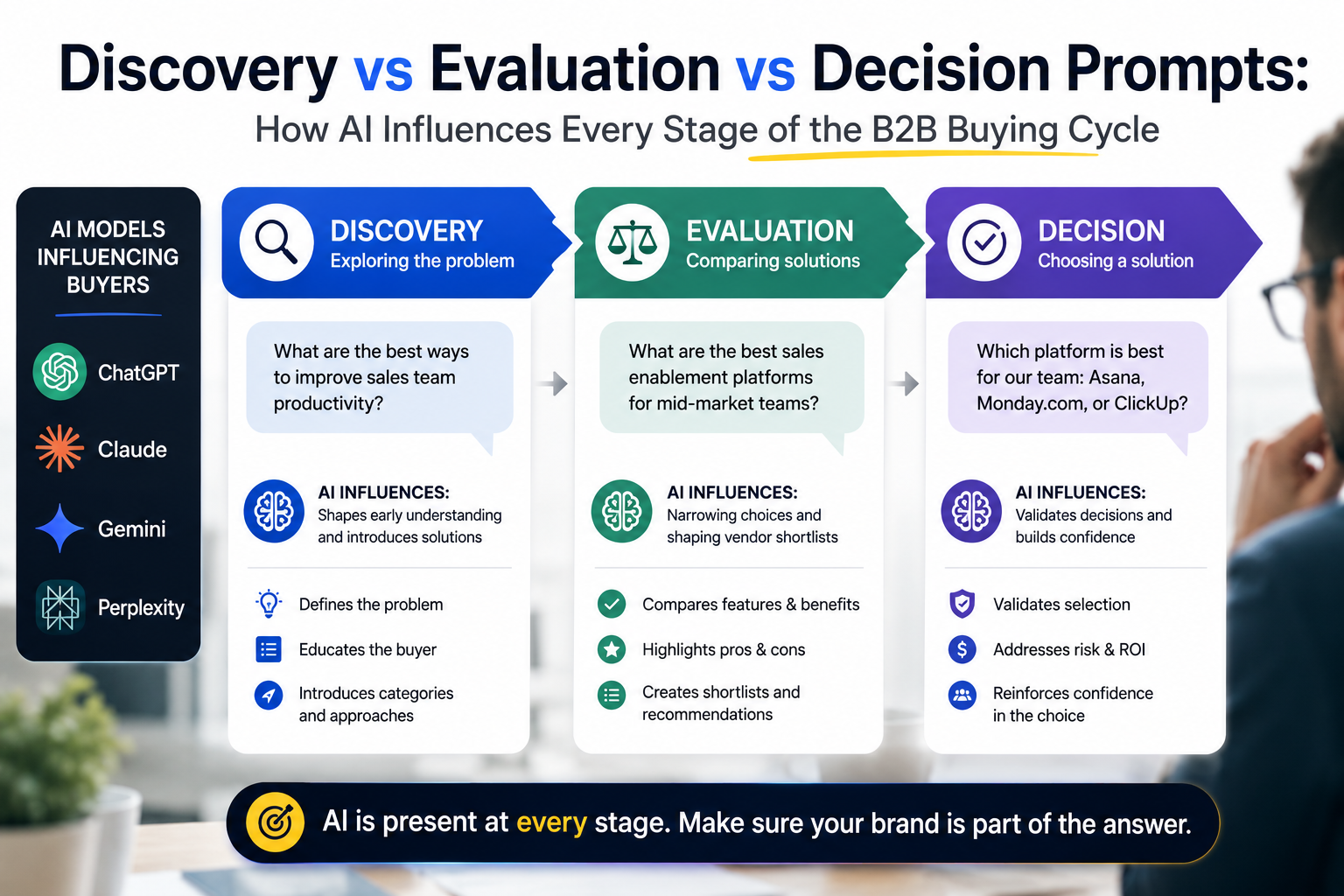
Discovery, Evaluation, and Decision prompts represent the three distinct phases of the AI-driven buyer journey where users transition from broad category exploration to specific vendor comparisons and final validation. To influence these results, B2B companies must align their technical documentation and third-party mentions with the specific intent of each prompt type to ensure they appear in the LLM's generated shortlist.
Table of Contents
- How do Discovery prompts shape the initial vendor shortlist?
- How do Evaluation prompts change how LLMs compare competitors?
- How do Decision prompts impact the final brand perception?
- What is the difference between AI visibility across the buyer journey?
- How can I optimize my content for different prompt stages?
How do Discovery prompts shape the initial vendor shortlist?
Discovery prompts are top-of-funnel queries where a buyer asks an AI assistant to define a category or list the "best tools" for a specific problem without naming a brand. In this stage, ChatGPT, Claude, Gemini, and Perplexity rely on high-authority aggregators, industry analysts, and "best of" lists to populate their initial response, making third-party validation more critical than owned media.
A significant and growing number of B2B buying journeys now involve at least one interaction with a generative AI interface before a vendor is contacted.
When a user asks Perplexity, "What are the best cloud cost management tools for AWS?" the engine isn't just looking for keywords. It is looking for consensus. If your brand is mentioned on G2, featured in a Gartner Magic Quadrant, and discussed on Reddit, the LLM assigns a high probability score to your brand as a relevant "node" for that category. If you only talk about yourself on your own blog, you will likely be excluded from the Discovery phase.
How do Evaluation prompts change how LLMs compare competitors?
Evaluation prompts occur when a buyer has a shortlist and asks the AI to compare specific features, pricing models, or user sentiment between two or more named companies. At this stage, LLMs extract data from technical documentation, pricing pages, and community forums to build a side-by-side analysis that often determines which vendor gets the demo request.
Companies that optimize their technical documentation for LLM readability can improve their chances of being cited in comparative "Vendor A vs Vendor B" queries.
Take the example of a buyer asking Claude, "Compare Datadog and New Relic for Kubernetes monitoring." The LLM will parse the documentation of both companies. If Datadog has clear, structured tables and FAQ sections, and New Relic has gated PDFs or unstructured prose, the AI will likely provide a more detailed and favorable summary for Datadog simply because the data was easier to ingest. This is where Generative Engine Optimization (GEO) becomes a competitive necessity.
How do Decision prompts impact the final brand perception?
Decision prompts are high-intent, bottom-of-funnel queries where the buyer asks for "pros and cons," "red flags," or "implementation risks" regarding a single specific vendor. These prompts are heavily influenced by unvarnished peer reviews on platforms like Reddit and Stack Overflow, which LLMs weight heavily to provide a "balanced" view that avoids sounding like a marketing brochure.
For many B2B buyers, AI-generated summaries of peer reviews are becoming more influential than traditional case studies.
If a buyer asks ChatGPT, "What are the biggest complaints about using Salesforce for a 50-person startup?" the AI will bypass the Salesforce homepage. It will instead scrape subreddits and review sites. If your brand has a "Reddit problem," it will manifest here as a "Decision" risk, potentially killing the deal before the buyer even talks to your sales team. Monitoring these prompts via monroya.ai allows you to see exactly which negative sentiments are being echoed by the models.
What is the difference between AI visibility across the buyer journey?
The way a brand appears changes significantly as the buyer moves from broad category questions to specific technical inquiries. The following table illustrates how the four major providers—ChatGPT, Claude, Gemini, and Perplexity—treat these stages differently.
| Journey Stage | Prompt Example | Primary Data Source | Goal for Marketers |
|---|---|---|---|
| Discovery | "Top 5 CRM for SaaS" | Analyst reports, "Best of" lists | Maximize category association |
| Evaluation | "HubSpot vs Pipedrive pricing" | Pricing pages, feature tables | Ensure data accuracy in LLM |
| Decision | "Is [Brand] hard to implement?" | Reddit, G2, Peer reviews | Neutralize negative sentiment |
How can I optimize my content for different prompt stages?
To capture AI Share of Voice at every stage, you must move beyond traditional SEO and adopt a GEO framework that prioritizes structured data and third-party presence. This requires a three-pronged approach: seeding the category, structuring the facts, and managing the sentiment.
- Seed the Category (Discovery): Ensure your brand is mentioned in the top 10 results of "best [category] tools" searches. If you aren't there, the LLM won't find you.
- Structure the Facts (Evaluation): Use clear H2 headings and tables on your product and pricing pages. LLMs often prefer extracting data from tables over long-form paragraphs.
- Manage the Sentiment (Decision): Actively participate in community forums. When an LLM sees a brand representative answering a question on Reddit, it often cites that interaction as a sign of "active support" or "transparency."
Traditional SEO focuses on getting a click to your website. AI search optimization focuses on ensuring the model summarizes your brand correctly so the buyer trusts you enough to eventually click. You can track these shifts in real-time using the Intelligence tier at monroya.ai/pricing to see if your optimization efforts are actually moving the needle on your AI mention rate.
The shift from search engines to answer engines means your brand is being judged in a "black box" of LLM training data and real-time web retrieval. If you are not actively monitoring how ChatGPT, Claude, Gemini, and Perplexity describe your product during the Discovery, Evaluation, and Decision phases, you are essentially letting the models—and your competitors—write your brand narrative for you.
Find out where AI ranks you — then fix it.
FAQ
What is the difference between Discovery and Evaluation prompts?
Discovery prompts are broad, category-level queries where a user asks for a list of solutions to a problem (e.g., "What are the best EDR tools?"). Evaluation prompts are specific comparisons between named vendors (e.g., "CrowdStrike vs SentinelOne for small teams"). Discovery requires broad web presence, while Evaluation requires highly structured, factual technical data.
Why does Reddit matter for Decision-stage prompts?
LLMs like ChatGPT and Claude prioritize Reddit for Decision-stage prompts because it provides "authentic" human sentiment. When a buyer asks for "pros and cons" or "red flags" about a company, the AI looks for peer discussions to provide a balanced answer. Negative threads on Reddit can directly lead to an AI warning a buyer against your product.
How do I improve my brand's visibility in Discovery prompts?
To improve Discovery visibility, you must increase your presence on third-party "authority" sites that LLMs use as sources. This includes industry analyst reports, "top 10" listicles, and high-traffic review platforms. LLMs use these sources to determine which brands are the "consensus" leaders in any given B2B SaaS category.
Can I use FAQ schema to influence AI search results?
Yes, implementing FAQ schema is one of the most effective ways to get cited by AI tools. Structured data helps LLMs quickly parse and extract direct answers to buyer questions. This is particularly effective for Evaluation prompts where buyers are looking for specific feature or pricing information that can be easily summarized.
How does monroya.ai track the buyer journey?
monroya.ai uses a proprietary Buyer Journey feature to categorize AI responses into Discovery, Evaluation, and Decision stages. By scanning ChatGPT, Claude, Gemini, and Perplexity, the platform identifies which stage of the funnel your brand is winning—and where you are being left out of the conversation or misrepresented by the model.
Is AI visibility more important than traditional SEO?
For B2B SaaS, AI visibility is becoming more critical because it influences the "zero-click" shortlist. While SEO drives traffic, AI visibility drives the narrative before a buyer ever visits your site. If an LLM doesn't include you in its recommended shortlist, you lose the deal before the SEO traffic even has a chance to convert.
Check your own AI visibility
Run a free AI visibility check at monroya.ai/check — no signup, no credit card. You will see how ChatGPT, Claude, Gemini, and Perplexity describe your category and whether your brand gets named.
Monroya starts at $79/mo (Starter), with Growth at $199/mo and Intelligence at $299/mo. Every plan includes a 7-day free trial.
Compare the full field
This is one pair out of a category that keeps changing. The AI visibility tools comparison puts the main options side by side on coverage, depth and price, Monroya pricing is public with no call required, and the free AI visibility check gives you a baseline before you buy anything.
For B2B companies: Win the shortlist when buyers ask AI to compare vendors.