How AI models decide which companies to mention in answers
By Jeremy Unruh, Founder, Monroya · Published July 11, 2026 · Reviewed July 2026
Want this for your company? See how AI assistants answer about your site.
Run the free check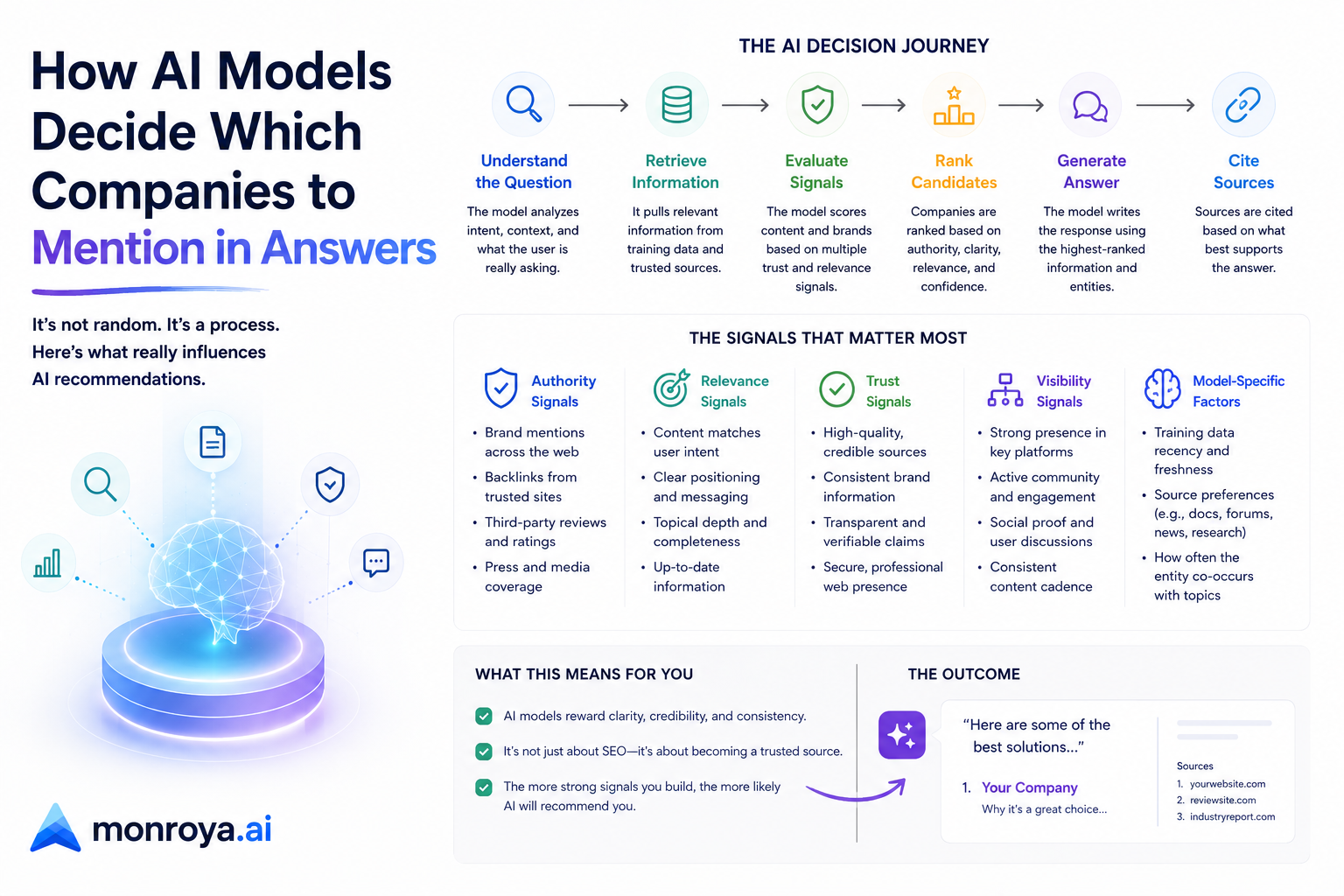
AI models like ChatGPT, Claude, Gemini, and Perplexity select company mentions based on a combination of source authority, semantic relevance to the specific prompt, and the frequency of brand associations within their training data or real-time search indices. They prioritize entities that appear consistently in high-trust environments like technical documentation, reputable review sites, and community-driven platforms like Reddit.
Table of Contents
- How do AI models select brand mentions?
- Why does source authority matter for AI citations?
- How does semantic proximity influence vendor shortlists?
- What role does Reddit play in AI-generated recommendations?
- How do different LLMs compare in brand selection?
- Is Profound vs monroya.ai the right comparison for your team?
- FAQ
How do AI models select brand mentions?
AI models select brand mentions by calculating the probability that a specific company name is the most relevant "token" to follow a user's query about a product category. This selection is driven by Generative Engine Optimization (GEO) factors, including the brand's presence in the model’s training set and its visibility in the top-cited search results used during Retrieval-Augmented Generation (RAG).
A growing number of users are starting to use AI assistants for product research, in some cases bypassing traditional search engines entirely.
When a buyer asks Perplexity for the "best CRM for mid-market manufacturing," the engine doesn't just look for keywords. It analyzes the relationship between the "manufacturing" intent and the "CRM" category. If your brand is frequently mentioned alongside manufacturing-specific pain points on sites like G2, Capterra, or specialized industry forums, the model's weights will favor your inclusion. Unlike traditional SEO, which prioritizes backlink quantity, AI selection prioritizes the context of the mention.
Why does source authority matter for AI citations?
Source authority in the age of AI is defined by the reliability and factual density of the domain where your brand is mentioned. Models like Gemini and Claude are trained to favor "knowledge-rich" sources—such as whitepapers, official documentation, and verified case studies—over shallow marketing blogs that lack unique data or technical depth.
AI models are more likely to cite sources containing structured data and specific technical specifications over those with generic marketing copy.
For example, if a developer asks ChatGPT how to integrate a payment gateway, the model will likely mention Stripe or Adyen because their documentation is vast, publicly accessible, and highly structured. If your company’s technical documentation is gated or poorly indexed, the model cannot "learn" your product's capabilities, leading to a zero-percent AI Share of Voice in technical queries.
How does semantic proximity influence vendor shortlists?
Semantic proximity is the mathematical distance between your brand name and specific "buying intent" keywords within an LLM's latent space. If your brand name frequently appears within the same paragraph as terms like "enterprise security," "SOC2 compliance," or "low latency," the model builds a permanent association that triggers your mention when those specific requirements are prompted.
To influence this, B2B teams must move beyond keyword stuffing and focus on "entity-attribute" mapping. If you want to be the "cheapest AI visibility tool in 2026," your digital footprint must consistently link your brand name to specific pricing tables and "value-for-money" discussions. monroya.ai tracks these associations across ChatGPT, Claude, Gemini, and Perplexity to show you exactly which attributes the models currently associate with your brand.
What role does Reddit play in AI-generated recommendations?
Reddit has become a primary "truth source" for LLMs because it represents unfiltered human sentiment, which models use to weight the "helpfulness" of a recommendation. When a user asks an AI for "honest reviews," the model heavily weights data from subreddits where users discuss real-world implementation hurdles and pricing transparency.
Many of Perplexity's "Shopping" and "Product Recommendation" citations now include links to Reddit threads or community forums.
If your brand is being criticized on Reddit, or worse, not mentioned at all, AI models will exclude you from "best of" lists. This is a critical component of ChatGPT SEO. You cannot optimize this through traditional PR; it requires active community participation and ensuring that your users are talking about your product in public, indexable spaces.
How do different LLMs compare in brand selection?
Each LLM has a distinct "personality" and source preference based on its reinforcement learning from human feedback (RLHF) and its search integration. Perplexity is heavily biased toward recent news and forum data, while Claude tends to be more conservative, favoring established brands with extensive public documentation.
| Feature | ChatGPT | Claude | Gemini | Perplexity |
|---|---|---|---|---|
| Primary Source Bias | General Web / Reddit | Technical Docs / Books | Google Ecosystem / News | Real-time Web / Social |
| Citation Style | Inline Footnotes | Narrative Mentions | Source Cards | Numbered List / Images |
| Update Frequency | High (SearchGPT) | Moderate | Very High | Real-time |
| B2B Preference | Established Leaders | Technical/Niche | Enterprise/Legacy | Emerging/Trending |
For a Series A company, appearing in Perplexity is often easier and faster than appearing in Claude, as Perplexity prioritizes "freshness" and can index a new product launch or a viral LinkedIn post within minutes.
Is Profound vs monroya.ai the right comparison for your team?
When choosing between Profound vs monroya.ai, the decision rests on whether you need a broad "Share of Model" metric or a granular map of the Buyer Journey. Profound typically focuses on high-level visibility scores, which are useful for CMO reporting but often lack the tactical depth required for a PMM to change how a model describes a specific feature.
Companies using dedicated AI visibility tracking can increase their brand mentions by implementing GEO-specific content updates.
monroya.ai is built specifically for B2B SaaS operators who need to see the "why" behind the mention. While you might look at Otterly.ai alternatives for agency-style reporting, monroya.ai provides the draft responses and specific content gaps you need to fill to flip a "not recommended" result into a "top choice." If you are a Series A-C company, you don't just need to know you're missing; you need the playbook to show up.
The shift from traditional search to AI-driven discovery is not a future trend—it is the current reality for B2B procurement. If you are not actively monitoring how these models perceive your brand, you are effectively invisible to the most qualified segment of your market.
Find out where AI ranks you — then fix it.
FAQ
How do I know if my brand appears in AI search results?
You can manually test by prompting ChatGPT or Perplexity with "What are the best [Category] tools for [Use Case]?" However, manual testing is unreliable due to personalization and "hallucination" variances. Professional tools like monroya.ai automate this by running thousands of prompts across ChatGPT, Claude, Gemini, and Perplexity to provide a statistically significant AI Share of Voice.
What is Share of Model?
Share of Model is a metric that measures the percentage of time an AI assistant mentions your brand compared to your competitors for a specific set of category keywords. Unlike Share of Search, which measures what people type, Share of Model measures what the AI recommends, making it a critical KPI for modern demand generation.
Why isn't my company showing up in ChatGPT results?
If your company is missing, it is likely due to a "data gap." This happens if your site's robots.txt blocks AI crawlers, your content lacks structured FAQ schema, or your brand is not mentioned on high-authority "seed" sites like Reddit, G2, or major industry publications that the model uses to verify facts.
How long does it take to see results from GEO optimization?
Results from Generative Engine Optimization (GEO) can appear in as little as 48 hours on real-time engines like Perplexity or Gemini. For models with static training sets like Claude or standard ChatGPT, visibility changes may take longer, occurring when the model’s search index is updated or a new version of the model is released.
Is $299 per month reasonable for AI search monitoring for a B2B marketing team?
For a Series A-C B2B company, $299 per month (the monroya.ai Intelligence tier) is highly cost-effective compared to the lost revenue of being excluded from vendor shortlists. Traditional SEO tools cost similar amounts but fail to track the AI-driven Buyer Journey where modern software decisions are actually made.
What is the difference between AI visibility and SEO?
Traditional SEO focuses on ranking a specific URL in a list of blue links based on keywords and backlinks. AI visibility (or GEO) focuses on influencing the narrative and citations of an LLM. While SEO helps you get clicks, AI visibility ensures your brand is part of the AI's synthesized answer.
Check your own AI visibility
Run a free AI visibility check at monroya.ai/check — no signup, no credit card. You will see how ChatGPT, Claude, Gemini, and Perplexity describe your category and whether your brand gets named.
Monroya starts at $79/mo (Starter), with Growth at $199/mo and Intelligence at $299/mo. Every plan includes a 7-day free trial.
For B2B companies: Win the shortlist when buyers ask AI to compare vendors.