Should I be tracking AI Overviews separately from regular SEO?
By Jeremy Unruh, Founder, Monroya · Published July 19, 2026 · Reviewed July 2026
Want this for your company? See how AI assistants answer about your site.
Run the free check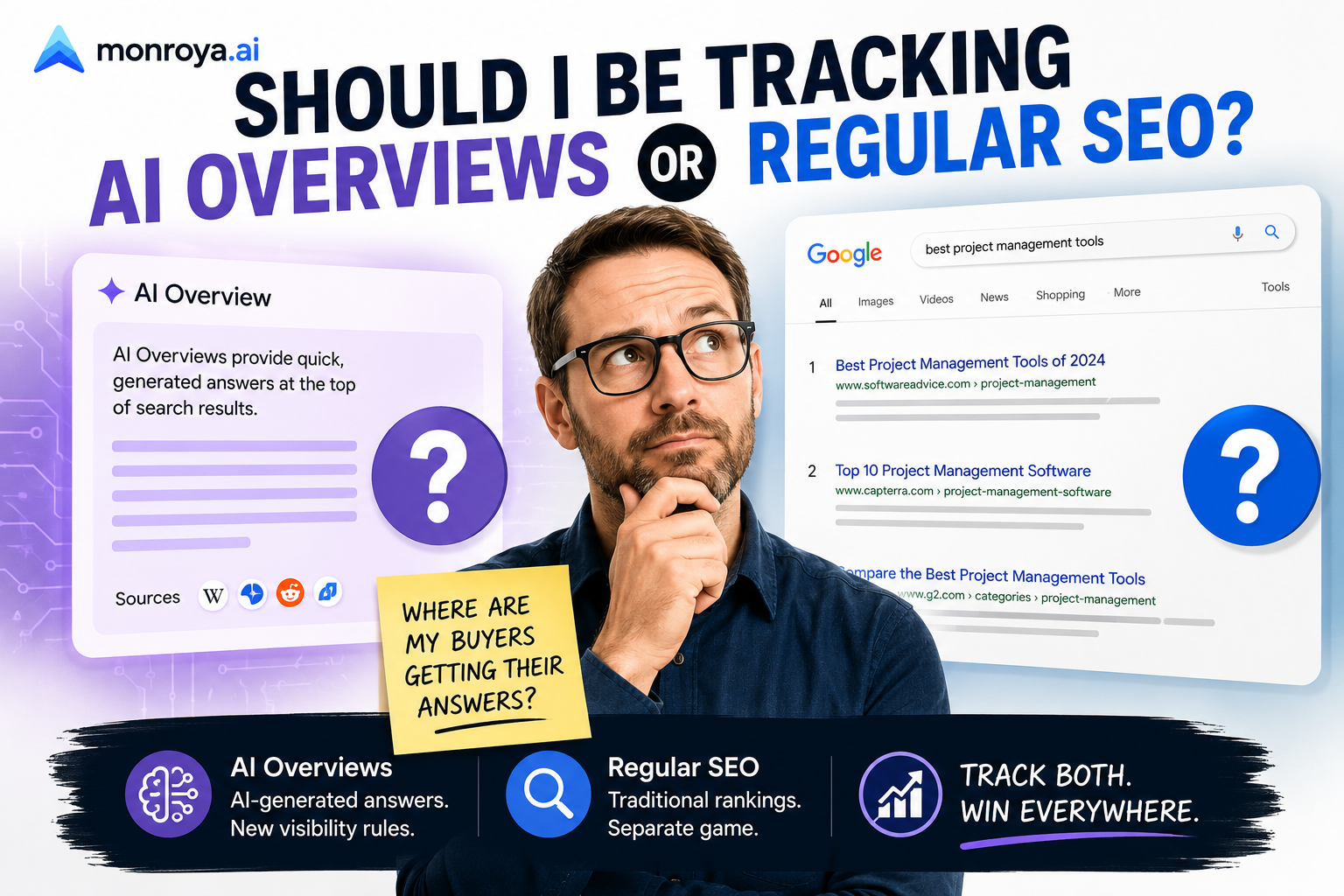
Yes, you must track AI Overviews (AIOs) as a distinct performance channel because the ranking factors for generative responses differ fundamentally from traditional blue-link SEO. While SEO focuses on click-through rates and keyword positions, AI visibility is measured by citation frequency and the sentiment of the generated summary, requiring a unique Generative Engine Optimization (GEO) strategy.
Table of Contents
- How do AI Overviews differ from traditional search results?
- Why is Share of Model more important than keyword ranking?
- How do I measure the ROI of AI visibility?
- What is the difference between SEO and GEO?
- Which tools track AI visibility for B2B SaaS?
- Key takeaways
- FAQ
How do AI Overviews differ from traditional search results?
AI Overviews differ from traditional search results by prioritizing information synthesis over site authority, often citing niche technical documentation or community discussions rather than high-DR landing pages. Traditional SEO optimizes for a list of links; AI search optimization focuses on becoming the "knowledge source" that the LLM uses to construct its narrative answer.
In a traditional search environment, a B2B buyer searching for "best CRM for mid-market manufacturing" sees a list of ads and listicles. In an AI-driven environment, Google Gemini or Perplexity synthesizes those results into a single recommendation. If your brand is not part of that synthesis, you are invisible to the buyer before they ever click a link.
A growing number of B2B buyers now use AI assistants to narrow down vendor shortlists before visiting a company website.
This shift means that tracking "position 3" for a keyword is useless if the AI Overview at "position 0" summarizes your three competitors and excludes you. You are essentially competing for a spot in the LLM's training data and its real-time retrieval context, not just a spot on a page.
Why is Share of Model more important than keyword ranking?
Share of Model is the percentage of time an AI assistant includes your brand in its response for a specific category query compared to your competitors. Unlike keyword rankings, which are static, Share of Model accounts for the probabilistic nature of LLMs, measuring how often your brand is perceived as a "top-of-mind" solution by the model.
For a Series A company, tracking Share of Model across ChatGPT, Claude, Gemini, and Perplexity is the only way to see if your brand awareness efforts are actually penetrating the AI layer. If you have high SEO rankings but zero AI citations, your content is likely too generic or lacks the structured data that LLMs prefer for extraction.
Companies that optimize specifically for AI citations can see a significant increase in brand mentions within generative responses.
When you use monroya.ai, you aren't just looking at a rank. You are looking at the specific sentences the AI uses to describe you. If ChatGPT says your "pricing is opaque" or "implementation is difficult," no amount of SEO ranking will fix that perception problem. You need to track the sentiment and the specific claims being made.
How do I measure the ROI of AI visibility?
Measuring ROI for AI visibility requires tracking the correlation between AI citation rates and direct-traffic or branded-search increases, as buyers often move from an AI chat to a direct site visit. You must attribute leads to the "AI Discovery" phase by monitoring how often your brand appears in the Evaluation and Decision stages of the Buyer Journey.
Traditional attribution models fail here because the "click" often doesn't happen. The buyer gets the answer they need from Perplexity and then types your URL directly into their browser. To prove value to a CFO, you need to show the "AI Mention Rate."
| Metric | Traditional SEO | AI Visibility (GEO) |
|---|---|---|
| Primary Goal | Clicks to Website | Inclusion in AI Answer |
| Success Metric | Keyword Position | AI Share of Voice / Citations |
| Content Focus | Keyword Density | Information Density / Facts |
| Primary Source | Backlinks / Authority | Reddit / Docs / FAQ Schema |
| Measurement Tool | Google Search Console | monroya.ai |
If you are evaluating AthenaHQ vs monroya.ai, the difference lies in the depth of this measurement. While some tools just show if you appear, monroya.ai tracks the entire Buyer Journey, showing you how the AI describes you at the "Discovery" stage versus the "Decision" stage.
What is the difference between SEO and GEO?
The difference between SEO and GEO is that SEO optimizes for search engine crawlers and click-through algorithms, while GEO (Generative Engine Optimization) optimizes for LLM token prediction and factual extraction. GEO requires high-authority citations, structured data, and "citable nuggets"—concise, factual statements that an AI can easily lift and repeat.
For example, a blog post titled "10 Reasons to Use Our Software" is good for SEO. However, a technical FAQ page with clear schema that answers "How does [Product] integrate with Salesforce?" is better for GEO. The AI wants the answer, not the fluff.
B2B companies that shift their content budget toward GEO-specific formats can achieve a higher citation rate in AI assistants compared to those sticking to traditional SEO.
If you are looking at Otterly.ai vs monroya.ai, you'll find that Otterly.ai is often built for agencies doing broad monitoring, whereas monroya.ai is built for B2B teams who need to take action on these GEO insights. monroya.ai doesn't just tell you that you're missing; it helps you draft the content needed to get cited.
Which tools track AI visibility for B2B SaaS?
The best AI visibility tools for B2B SaaS companies are those that monitor multiple LLMs (ChatGPT, Claude, Gemini, Perplexity) and provide actionable insights into the Buyer Journey. While tools like Profound or AthenaHQ offer visibility tracking, B2B teams often require deeper analysis of how their specific category is being synthesized by AI.
When comparing Profound vs monroya.ai, B2B marketers should look at whether the tool tracks the specific prompts buyers use. A buyer doesn't just search for "software"; they ask, "Which tool has the best API for a Series B fintech?" monroya.ai is designed to track these complex, long-tail prompts that define the modern B2B Buyer Journey.
Harvard Business Review notes that the shift to generative search will require brands to manage their "digital twin" in the eyes of the AI.
If you are currently evaluating OmniSEO Alternatives, consider whether you want a managed service or a software-only approach. OmniSEO Pricing often includes a heavy managed fee, whereas monroya.ai provides the Intelligence tier at $299/month, giving you the software to manage it in-house without the agency markup.
Tracking AI Overviews separately is no longer optional for B2B teams. If you treat AI as just another part of SEO, you will miss the nuance of how ChatGPT and Perplexity are reshaping your brand's reputation. You need a dedicated view of your AI Share of Voice to ensure that when a buyer asks for a recommendation, your name is the one the AI provides.
Find out where AI ranks you — then fix it.
FAQ
What is Share of Model?
Share of Model is a metric that calculates how frequently a specific brand or product is mentioned by an AI model (like ChatGPT or Gemini) in response to queries within a specific category. It is the generative era's equivalent of "Share of Voice," focusing on the probability of being cited as a top solution.
How do I know if my brand appears in AI search results?
You can manually test prompts in ChatGPT, Claude, Gemini, and Perplexity, but for scale, you need a tool like monroya.ai. These platforms automate the process by running hundreds of buyer-intent prompts and tracking whether your brand is cited, how it is described, and which sources the AI uses.
What is generative engine optimization (GEO)?
GEO is the practice of optimizing digital content so that Large Language Models (LLMs) are more likely to cite and recommend a brand. This involves using structured data, participating in community platforms like Reddit, and creating "citable" content that provides direct, factual answers to complex buyer questions.
Why isn't my company showing up in ChatGPT results?
ChatGPT may not show your company if your content lacks clear factual structures, if you have no presence on high-authority citation sources (like industry wikis or Reddit), or if your site's robots.txt blocks the OAI-Searchbot. AI models prioritize information that is easily synthesized and verified across multiple sources.
How do B2B companies monitor their presence in ChatGPT and Perplexity?
B2B companies use AI visibility platforms like monroya.ai to monitor their mention rate and sentiment across the four major providers. These tools track how the brand appears at different stages of the Buyer Journey—from initial category discovery to final vendor comparison and decision-making.
Is AI visibility tracking worth it for B2B SaaS companies?
Yes, because AI tools are now the primary research interface for technical buyers. If your competitors are being recommended by Perplexity and you are not, you are losing leads before they even enter your CRM. Tracking allows you to identify gaps in your content and fix them.
Key takeaways
- Track AI separately: SEO and GEO have different ranking factors; you cannot manage both with the same metrics.
- Focus on Citations: LLMs rely on specific sources; if you aren't being cited, you don't exist in the AI's answer.
- Monitor the Journey: Use monroya.ai to see how ChatGPT describes you during Discovery vs. Decision prompts.
- Optimize for Facts: Replace marketing fluff with structured, citable data to increase your Share of Model.
Check your own AI visibility
Run a free AI visibility check at monroya.ai/check — no signup, no credit card. You will see how ChatGPT, Claude, Gemini, and Perplexity describe your category and whether your brand gets named.
Monroya starts at $79/mo (Starter), with Growth at $199/mo and Intelligence at $299/mo. Every plan includes a 7-day free trial.
For B2B companies: Win the shortlist when buyers ask AI to compare vendors.