What is a "hallucination" and how does it affect brand visibility?
By Jeremy Unruh, Founder, Monroya · Published July 19, 2026 · Reviewed July 2026
Want this for your company? See how AI assistants answer about your site.
Run the free check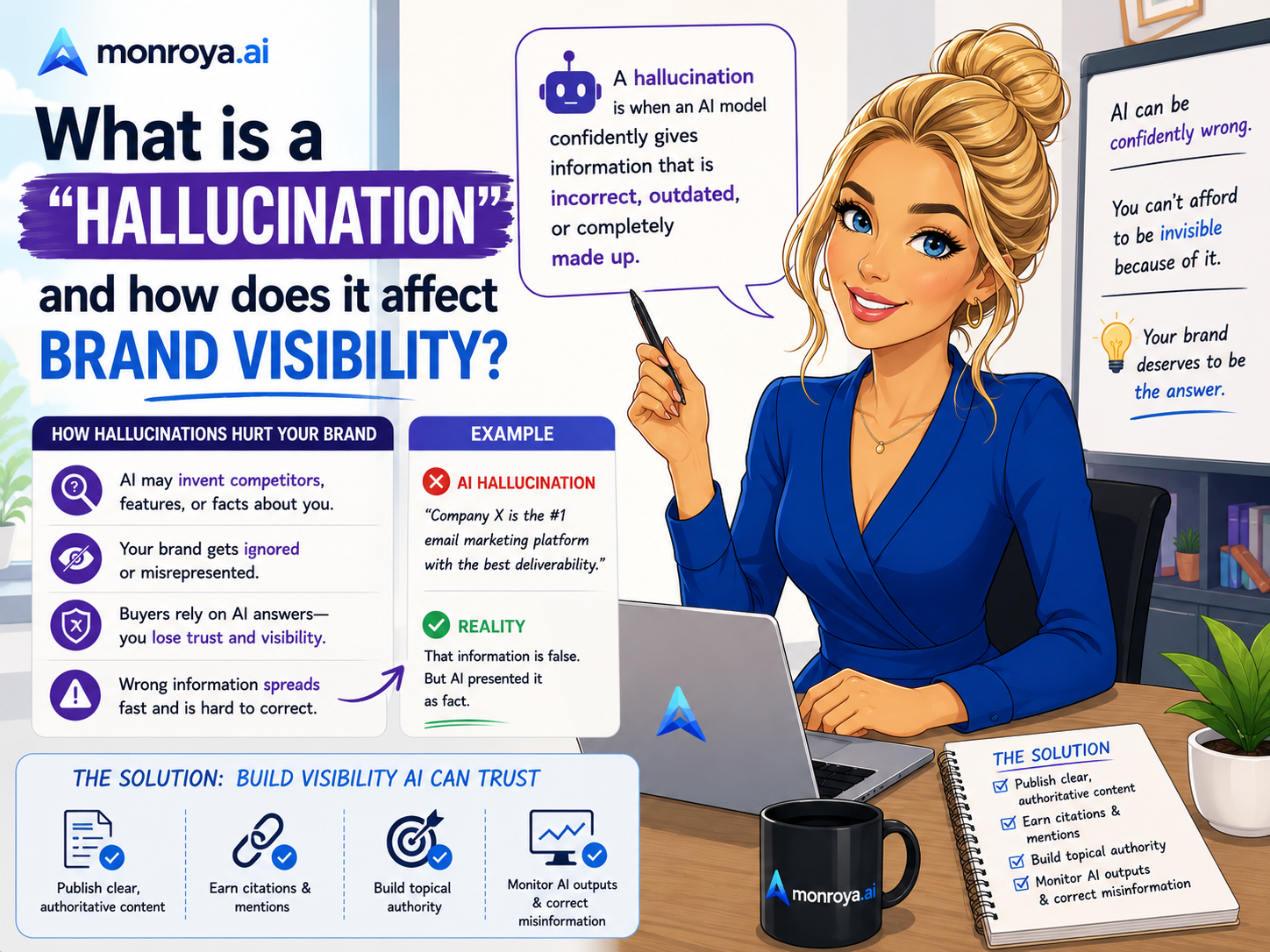
AI hallucinations occur when a Large Language Model (LLM) generates factually incorrect information about your company, pricing, or features with high confidence. For B2B brands, this results in "negative visibility" where ChatGPT or Perplexity provides buyers with outdated pricing, non-existent features, or false comparisons against competitors.
Table of Contents
- How do AI hallucinations impact B2B brand visibility?
- What causes ChatGPT and Perplexity to hallucinate brand data?
- How can I measure the rate of AI misinformation for my company?
- What is the difference between a hallucination and a citation error?
- How do I prevent AI models from hallucinating my product features?
- Which AI visibility tools track brand accuracy in 2026?
How do AI hallucinations impact B2B brand visibility?
Hallucinations degrade brand visibility by inserting friction into the Buyer Journey before a prospect ever reaches your website. When an LLM claims your software lacks a specific SOC2 compliance or integrates with a defunct API, it effectively removes you from the buyer's shortlist during the Evaluation stage.
A large and growing share of B2B buyers now use generative AI to research vendors before contacting sales.
If ChatGPT tells a VP of Demand Gen that your product starts at $50,000 when your actual entry point is $15,000, you have a visibility problem that traditional SEO cannot solve. This is not a ranking issue; it is a factual integrity issue. Because LLMs prioritize "helpfulness" and "fluency" over absolute truth, they often bridge gaps in their training data with plausible-sounding lies.
What causes ChatGPT and Perplexity to hallucinate brand data?
LLMs hallucinate brand data when they encounter conflicting information across the web, outdated PDF data sheets, or a lack of structured data (like JSON-LD) on your primary domain. Models like Claude and Gemini use probabilistic next-token prediction, meaning they choose the most "likely" word rather than the most "accurate" one if the source material is thin.
Studies of RAG-based systems show that generated responses often contain some form of factual inconsistency.
A common example occurs with pricing. If a third-party review site from 2021 lists your price as $99/mo, but your 2026 pricing is $299/mo, the model may average these or hallucinate a middle ground. Perplexity SEO is particularly sensitive to this, as it crawls live web results; if your old pricing is still indexed on a forgotten landing page, it will likely be cited as current truth.
How can I measure the rate of AI misinformation for my company?
Measuring misinformation requires tracking your AI Share of Voice and then auditing the "sentiment accuracy" of those mentions across ChatGPT, Claude, Gemini, and Perplexity. You must run Discovery and Evaluation prompts—such as "What are the limitations of [Your Brand]?"—to see if the AI is inventing weaknesses that do not exist.
Companies that monitor AI visibility tend to achieve a faster correction rate in LLM outputs compared to those who only focus on traditional SEO.
At monroya.ai, we track how these models describe your product across the entire Buyer Journey. If the AI is consistently hallucinating that your product is "built for agencies" when you are a B2B SaaS platform, that is a signal that your positioning in the training set is diluted by old PR or incorrect third-party reviews.
What is the difference between a hallucination and a citation error?
A hallucination is a pure fabrication by the model's internal weights, whereas a citation error occurs when the AI correctly identifies a source but misinterprets the data within it. Perplexity and ChatGPT (with Search) are more prone to citation errors, while "offline" models like Claude are more prone to hallucinations based on stale training data.
| Feature | AI Hallucination | Citation Error |
|---|---|---|
| Source | Internal model weights | External web source |
| Cause | Lack of data or "creativity" | Poor site structure or conflicting web data |
| Visibility Impact | High (Total fabrication) | Medium (Misattributed facts) |
| Fix Strategy | Feed new data via API/Index | Update FAQ schema and structured data |
| Detection | Hard (Requires prompt testing) | Easy (Check the cited link) |
How do I prevent AI models from hallucinating my product features?
To prevent hallucinations, you must saturate the "Generative Engine" with high-authority, structured data that uses clear, declarative language. Use "Is/Is Not" frameworks in your FAQ sections. For example, explicitly stating "monroya.ai is a software platform, not a managed service agency" helps the model's self-attention mechanism categorize you correctly.
- Update FAQ Schema: Use JSON-LD to define your product's core specs.
- Prune Old Content: Delete or 301 redirect outdated pricing pages and press releases.
- Optimize for Perplexity SEO: Ensure your most important facts are in the first 200 words of your high-traffic pages.
- Monitor Mentions: Use monroya.ai to see when a model starts hallucinating a competitor's feature as your own.
- Leverage Reddit: AI models weight community discussions heavily; ensure your brand is accurately described in relevant subreddits.
Which AI visibility tools track brand accuracy in 2026?
The market for AI visibility tools has split between "monitoring-only" tools and "action-oriented" platforms. While some tools just show you a screenshot of a ChatGPT result, B2B teams need platforms that categorize results by Buyer Journey stage and provide the exact content needed to fix the hallucination.
- monroya.ai: Focuses on the B2B Buyer Journey across ChatGPT, Claude, Gemini, and Perplexity. It provides monitoring, action plans, and pre-written drafts to fix visibility gaps.
- Profound: A high-end enterprise tool often used for broad market sentiment. Is Profound worth it for a Series A B2B company? Usually not, as the pricing starts much higher than the monroya.ai Growth tier ($199/mo).
- Otterly.ai: Primarily built for agencies managing multiple small brand accounts. Is Otterly.ai right for B2B SaaS? It lacks the deep Buyer Journey tracking required for complex sales cycles.
- AthenaHQ: A newer entrant focused on small marketing teams. Is AthenaHQ worth it for a small marketing team? It offers basic tracking but lacks the "action and draft" features of monroya.ai.
- OmniSEO: A managed service that combines software with agency hours. Is OmniSEO worth it if you don't need a managed service? No, you'll be paying a $3k+ monthly premium for labor you might already have in-house.
If you aren't tracking what these models say, you are essentially letting a black box write your brand's narrative. Hallucinations aren't just "bugs"—they are lost revenue.
Find out where AI ranks you — then fix it.
FAQ
What is a hallucination in AI search?
An AI hallucination occurs when a model like ChatGPT or Claude generates a response that is grammatically correct and confident but factually false. In a B2B context, this often manifests as the AI inventing product features, pricing tiers, or integration capabilities that your company does not actually offer.
How do hallucinations affect B2B sales?
Hallucinations create "hidden churn" in your sales funnel. If a prospect asks Perplexity for a "SOC2 compliant CRM" and the AI incorrectly states your CRM is not compliant, that prospect will never fill out your demo form. You lose the lead before you even know they were looking.
Can I sue an AI company for hallucinating about my brand?
Legal precedents regarding AI "defamation" are still evolving in 2026. Most LLM providers include disclaimers that their outputs may be inaccurate. The more effective route is Generative Engine Optimization (GEO) to ensure the models have access to the correct, authoritative data to minimize these errors.
Does monroya.ai fix hallucinations?
monroya.ai identifies where hallucinations are occurring across ChatGPT, Claude, Gemini, and Perplexity. It then provides a specific action plan and the exact copy or schema updates you need to publish on your site to "re-train" the models' understanding of your brand via their web-crawling components.
Why does ChatGPT think my competitor has my features?
This is often a result of "training data bleed." If your competitor has better SEO or more mentions on high-authority sites like Reddit and G2, the LLM may associate the entire category's features with the most "visible" brand. Improving your AI Share of Voice helps correct this association.
How long does it take to fix an AI hallucination?
For models with live web access like Perplexity and ChatGPT Search, corrections can appear in as little as 48 hours after you update your site's structured data. For "static" models, it may take until the next major weight update or fine-tuning cycle, though RAG (Retrieval-Augmented Generation) is making these updates faster.
Check your own AI visibility
Run a free AI visibility check at monroya.ai/check — no signup, no credit card. You will see how ChatGPT, Claude, Gemini, and Perplexity describe your category and whether your brand gets named.
Monroya starts at $79/mo (Starter), with Growth at $199/mo and Intelligence at $299/mo. Every plan includes a 7-day free trial.
For B2B companies: Win the shortlist when buyers ask AI to compare vendors.