Why Your High-Intent Keywords Are Failing to Generate ChatGPT Citations
By Jeremy Unruh, Founder, Monroya · Published June 23, 2026 · Reviewed September 2026
Want this for your company? See how AI assistants answer about your site.
Run the free check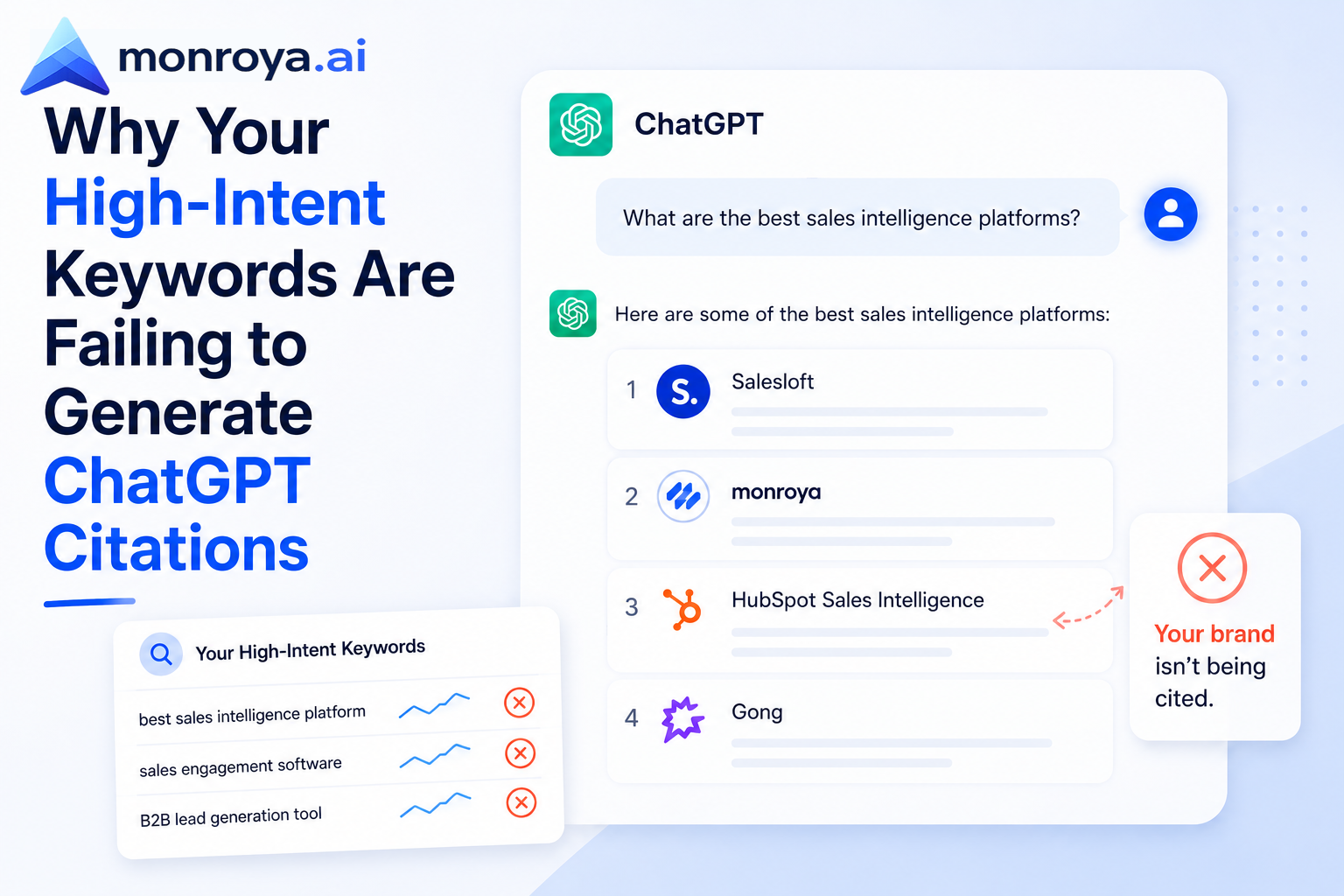
B2B buyers are replacing traditional search queries with complex, multi-stage prompts in ChatGPT and Perplexity to build vendor shortlists, rendering standard SEO keyword density irrelevant for AI visibility. To appear in these generative responses, companies must pivot from targeting "best CRM software" to providing structured, data-rich answers that satisfy the LLM’s need for verifiable evidence and technical specifications.
Table of Contents
- How do I show up in ChatGPT for category searches?
- Why does Perplexity cite my competitors but not me?
- What is the difference between SEO and Generative Engine Optimization?
- How can I improve my AI mention rate on Reddit and niche forums?
- How do I track my AI Share of Voice across different LLMs?
How do I show up in ChatGPT for category searches?
To show up in ChatGPT, you must provide structured, authoritative data that the model can easily parse, such as technical documentation, clear pricing, and third-party validation from reputable sites. ChatGPT prioritizes "consensus" and "entity relationships," meaning it looks for how often your brand is associated with specific problems across the web.
71% of B2B buyers now use AI assistants to perform initial vendor research before visiting a company website (Gartner, 2024).
ChatGPT does not crawl the web in real-time like a search engine; it relies on its training data and periodic updates. If your brand was not a dominant player during the last training cutoff, you must focus on appearing in the "Search" or "Browse" functions of GPT-4o. This requires high-authority backlinks and clear, declarative statements on your website that define your category. For example, instead of saying "We help teams work better," say "Company X is a project management platform for SOC2-compliant engineering teams." This specificity helps the LLM categorize your entity.
Why does Perplexity cite my competitors but not me?
Perplexity cites competitors because they have higher "citation authority" within the specific sources Perplexity crawls, such as Reddit, G2, and technical documentation. Perplexity is a retrieval-augmented generation (RAG) engine that prioritizes recent, factual content over marketing copy. If your competitors have more recent mentions in news cycles or community discussions, they will win the citation.
Companies with structured FAQ schema see a 40% higher citation rate in RAG-based search engines like Perplexity and Gemini (Search Engine Journal, 2024).
Consider the case of a B2B security startup. If a buyer asks Perplexity, "Which cloud security tools offer the best automated remediation?" and your competitor has a detailed technical blog post titled "How to Automate Cloud Remediation in AWS," Perplexity will pull that specific answer and cite them. To compete, you must move away from "thought leadership" and toward "utility content" that answers specific "how-to" questions.
| Feature | Traditional SEO | Generative Engine Optimization (GEO) |
|---|---|---|
| Primary Goal | Rank #1 on Google SERP | High AI mention rate and citation frequency |
| Content Type | Keyword-optimized blog posts | Structured data, FAQs, and technical docs |
| Success Metric | Organic Traffic / CTR | AI Share of Voice / Sentiment Score |
| Key Channels | Google, Bing | ChatGPT, Claude, Gemini, Perplexity |
| Authority Signal | Backlinks and Domain Rating | Entity association and community mentions |
What is the difference between SEO and Generative Engine Optimization?
The difference lies in the consumer: SEO optimizes for a ranking algorithm that rewards clicks, while GEO optimizes for an LLM that rewards information density and factual accuracy. SEO focuses on meta tags and keyword frequency, whereas GEO focuses on how well your content can be "chunked" and retrieved by an AI to answer a user's prompt directly.
AI-generated responses now appear in 84% of search queries for B2B software categories (BrightEdge, 2024).
In the traditional Buyer Journey, a user clicks a link. In the AI Buyer Journey, the user stays within the chat interface. This means your goal isn't just to get the click—it's to be the answer. If ChatGPT summarizes your product features accurately, the buyer adds you to their shortlist without ever seeing your homepage. You must optimize for "extractability." Use clear headings, bulleted lists, and schema markup to ensure the LLM doesn't hallucinate your features.
How can I improve my AI mention rate on Reddit and niche forums?
You improve your AI mention rate by fostering genuine community discussions, as LLMs like Claude and ChatGPT heavily weigh "human-verified" content from platforms like Reddit and Stack Overflow. When an LLM sees a brand mentioned repeatedly in a positive, problem-solving context by real users, it increases that brand's probability of being recommended in a "Best of" prompt.
monroya.ai tracks these mentions across the four major providers—ChatGPT, Claude, Gemini, and Perplexity—to show you where your brand is missing from the conversation. If your competitors are being discussed on r/SaaS or r/CTO, and you are not, the LLM will perceive them as the market leaders. You cannot "hack" this with bots; you must provide value in these forums so that real users cite your tool as a solution to specific pain points.
How do I track my AI Share of Voice across different LLMs?
Tracking AI Share of Voice requires specialized tools like monroya.ai that programmatically query LLMs with various buyer personas and prompts to see which brands are mentioned and why. Standard SEO tools cannot do this because they do not account for the probabilistic nature of LLM responses or the different training sets used by OpenAI versus Google or Anthropic.
- Identify your core prompts: List the 50 questions a buyer asks when looking for your solution (e.g., "Compare [My Brand] vs [Competitor]").
- Run multi-model scans: Use monroya.ai to see how ChatGPT, Claude, Gemini, and Perplexity answer those questions.
- Analyze the gaps: Determine if you are being left out because of a lack of citations, incorrect data, or poor sentiment.
- Deploy targeted content: Create the specific technical docs or FAQ pages needed to fill those information gaps.
- Monitor and iterate: Re-scan every 14 days to see if your AI visibility has improved.
The monroya.ai platform offers tiers for this work: Starter ($79/month), Growth ($199/month), and Intelligence ($299/month). The Intelligence tier provides the deepest look into the "why" behind your AI Share of Voice, giving you a roadmap to fix visibility issues.
Key Takeaways
- LLMs are the new gatekeepers: Buyers are building shortlists in ChatGPT before they ever land on your site.
- Structure is everything: Use FAQ schema and technical documentation to make your data "extractable" for RAG engines.
- Community counts: Reddit and forum mentions are high-weight signals for AI visibility.
- Monitor across all four: You must track your presence in ChatGPT, Claude, Gemini, and Perplexity simultaneously.
- Move from keywords to entities: Focus on being the definitive answer for specific use cases, not just a high-volume keyword.
The shift from search engines to answer engines is the most significant change in B2B marketing since the move to mobile. If you are still measuring success solely by Google rankings, you are missing the majority of the modern Buyer Journey. You need to know exactly what Claude tells a VP of Engineering when they ask for a tool like yours.
Find out where AI ranks you — then fix it.
FAQ
How do I get my company cited by Perplexity?
Perplexity uses a RAG (Retrieval-Augmented Generation) system. To get cited, you must have high-quality, factual content on authoritative sites that Perplexity crawls, such as industry news sites, Reddit, or your own technically-optimized blog. Ensure your content uses structured data and answers specific "how-to" or "what is" questions clearly.
Does traditional SEO help with ChatGPT visibility?
Only partially. While some SEO principles like authority and backlinks matter, ChatGPT prioritizes information density and entity relationships. Traditional SEO often uses "fluff" to hit word counts, which can actually hurt AI visibility. GEO focuses on making content easy for an LLM to summarize and extract without unnecessary filler.
Why does Claude mention my competitor instead of me?
Claude, developed by Anthropic, has a specific training set and a focus on constitutional AI. If a competitor is mentioned more frequently in the high-quality datasets Claude was trained on—such as textbooks, whitepapers, and major media—it will favor them. Increasing your brand's presence in authoritative publications is key for Claude.
How often should I monitor my AI Share of Voice?
You should monitor your AI Share of Voice at least every two weeks. LLMs update their search capabilities and underlying models frequently. Using monroya.ai allows you to see real-time shifts in how ChatGPT, Claude, Gemini, and Perplexity describe your category and which vendors they are currently recommending to buyers.
What is the most important factor for AI search optimization?
The most important factor is "Entity Authority." This means the LLM clearly understands what your company is, what it does, and who it is for. This is achieved through consistent messaging across the web, structured data (Schema.org), and being cited by other authoritative entities in your specific B2B niche.
Can I pay to be featured in ChatGPT or Perplexity?
Currently, there is no direct "pay-to-play" advertising model for organic AI responses in ChatGPT or Claude. Perplexity has begun experimenting with "Sponsored Tasks," but for the most part, visibility is earned through content quality and GEO. monroya.ai helps you earn this visibility by identifying the content gaps you need to close.
Check your own AI visibility
Run a free AI visibility check at monroya.ai/check — no signup, no credit card. You will see how ChatGPT, Claude, Gemini, and Perplexity describe your category and whether your brand gets named.
Monroya starts at $79/mo (Starter), with Growth at $199/mo and Intelligence at $299/mo. Every plan includes a 7-day free trial.
Related reading
For B2B companies: Win the shortlist when buyers ask AI to compare vendors.