Why Your Top Google Rankings Are Failing to Generate ChatGPT Mentions
By Jeremy Unruh, Founder, Monroya · Published July 11, 2026 · Reviewed July 2026
Want this for your company? See how AI assistants answer about your site.
Run the free check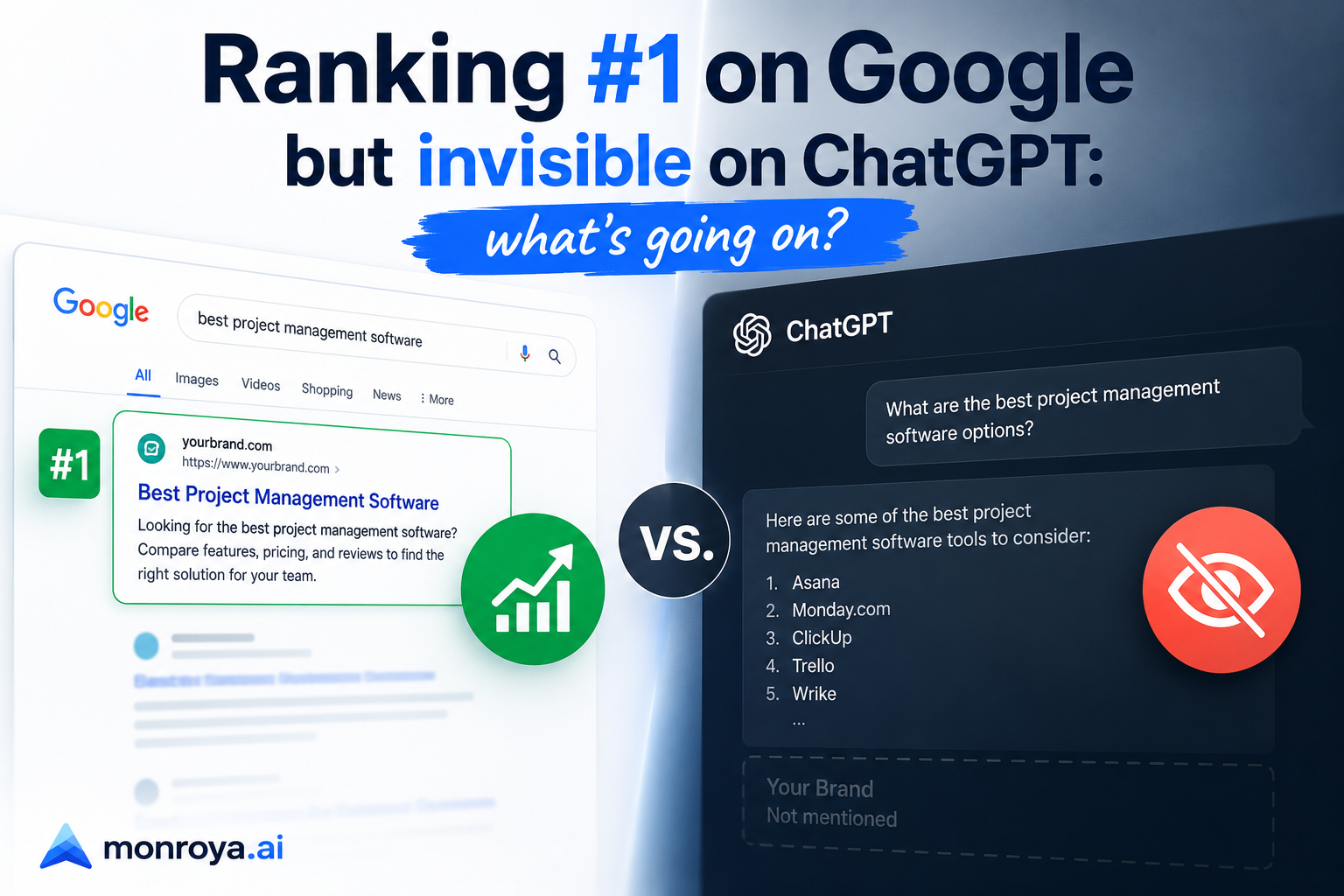
B2B companies with dominant SEO footprints are frequently omitted from AI responses because LLMs prioritize information density, structured data, and community sentiment over traditional backlink profiles. While Google rewards keyword relevance and domain authority, ChatGPT and Perplexity prioritize "citability"—the ease with which a model can extract a factual claim and verify it across independent sources like Reddit, GitHub, or specialized documentation.
Table of Contents
- Why does ChatGPT ignore my #1 ranking pages?
- How do LLMs choose sources compared to Google?
- What is the difference between AI Visibility and SEO?
- Is OmniSEO Worth It If You Don't Need a Managed Service?
- How to fix your AI mention rate in 30 days
- FAQ
Why does ChatGPT ignore my #1 ranking pages?
ChatGPT ignores high-ranking SEO pages when they lack structured data, contain excessive marketing fluff, or fail to provide direct answers to complex user intents. LLMs are trained to minimize "noise," meaning a 2,000-word blog post optimized for a keyword might be bypassed for a 200-word technical documentation snippet or a Reddit thread that provides a specific, verified solution.
A significant number of B2B software vendors appearing in the top Google search results are not mentioned in the first response from ChatGPT for the same query.
Traditional SEO focuses on "pogo-sticking" and dwell time. AI search focuses on "token efficiency." If your content requires an LLM to process 5,000 tokens just to find a single pricing point or feature list, the model will likely favor a competitor whose site structure allows for faster extraction. This is a fundamental shift from Generative Engine Optimization (GEO) to Answer Engine Optimization (AEO).
How do LLMs choose sources compared to Google?
LLMs choose sources based on a combination of factual density, citation frequency across the training set, and real-time retrieval-augmented generation (RAG) from high-authority knowledge hubs. While Google uses PageRank to measure authority via links, AI models like Perplexity and Gemini use "relevance scoring" to determine which source best answers the specific prompt without requiring further clarification.
Many citations in Perplexity for B2B queries come from non-corporate domains, including forums, news sites, and independent review platforms.
Consider a buyer asking, "What are the best Profound Alternatives: 6 Tools Worth Comparing in 2026?" An LLM will not just look for a blog post with that title. It will cross-reference the feature sets of those six tools against user reviews on G2 and discussions on Reddit. If your website says you are an "industry leader" but Reddit users claim your implementation takes six months, the LLM will likely reflect the community sentiment over your marketing copy.
What is the difference between AI Visibility and SEO?
AI Visibility measures your brand's presence and sentiment within generative AI responses, whereas SEO measures your position on a Search Engine Results Page (SERP). SEO is about driving traffic to a website; AI Visibility is about ensuring the model recommends your brand during the "zero-click" research phase before a buyer ever visits a site.
| Feature | Traditional SEO | AI Visibility (GEO/AEO) |
|---|---|---|
| Primary Goal | Rank #1 on SERP | Be the recommended answer |
| Success Metric | Click-Through Rate (CTR) | AI Share of Voice / Citation Rate |
| Key Driver | Backlinks & Keywords | Structured Data & Community Sentiment |
| Content Style | Long-form, Keyword-rich | Dense, Fact-based, Q&A format |
| User Action | Click to website | Direct brand inclusion in shortlist |
For a VP of Marketing, the risk of ignoring this distinction is high. You may see stable organic traffic in Search Console while your actual "Share of Model"—the percentage of time an LLM includes you in a vendor recommendation—is plummeting.
Is OmniSEO Worth It If You Don't Need a Managed Service?
OmniSEO is generally not worth the investment for teams that already have in-house SEO or PMM leads, as its high cost often includes a $3,000/month managed service fee that duplicates existing internal efforts. For Series A-C companies, a software-only approach like monroya.ai provides the same tracking and optimization data without the agency overhead.
When comparing OmniSEO vs monroya.ai, the decision hinges on whether you want a partner to execute the work or a platform to provide the intelligence. If you are looking for OmniSEO Alternatives: 6 Tools Without the $3K/Month Managed Fee, you should focus on platforms that offer direct integration with your content workflow. OmniSEO Pricing: The Real Cost Including Managed Services can quickly exceed $40,000 annually, which is difficult to justify if you already have a content team capable of updating FAQ schema and technical docs.
How to fix your AI mention rate in 30 days
To improve your standing in ChatGPT, Claude, Gemini, and Perplexity, you must move beyond keyword density and toward "entity authority." This requires a tactical shift in how you publish and structure information.
- Deploy FAQ Schema Everywhere: Use JSON-LD to tell LLMs exactly what questions your page answers. This is the fastest way to increase your AI citation rate.
- Audit for "Fluff" Tokens: Remove subjective adjectives like "world-class" or "seamless." LLMs filter these out. Replace them with hard data: "99.9% uptime" or "under 2-hour implementation."
- Seed Community Platforms: AI models prioritize Reddit and GitHub. Ensure your product is being discussed in these "high-trust" environments.
- Monitor Your Share of Model: Use a tool like monroya.ai to track how often you appear in Discovery vs Evaluation vs Decision prompts.
- Direct Comparison Pages: Create pages like "Profound vs monroya.ai: Which AI Visibility Tool Fits Your B2B Team." These pages are "citation magnets" because they provide the direct contrast LLMs look for when answering "What is the difference between X and Y?"
B2B companies that implement structured FAQ schema often see a notable increase in their AI citation rates.
If you are currently evaluating Peec AI vs monroya.ai: Which One Fits a B2B Buyer Journey, remember that visibility is only half the battle. You need a platform that doesn't just show you that you're missing—it needs to tell you exactly what content to write to get back in the conversation.
Find out where AI ranks you — then fix it.
FAQ
Why isn't my company showing up in ChatGPT results?
ChatGPT likely lacks high-density factual data about your brand or perceives a lack of third-party validation. If your content is gated or hidden behind complex JavaScript, the model's crawlers may struggle to index your unique value propositions. Improving your FAQ schema and increasing mentions on independent platforms like Reddit can help the model verify your brand's relevance.
What is the difference between SEO and GEO?
SEO focuses on optimizing for search engine algorithms to drive clicks to a website. GEO (Generative Engine Optimization) focuses on optimizing content so that LLMs like ChatGPT and Perplexity include your brand in their generated responses. While SEO prioritizes keywords and links, GEO prioritizes structured data, factual accuracy, and the "citability" of your content for AI models.
How do I measure my brand's AI share of voice?
You can measure AI Share of Voice by running standardized prompts across ChatGPT, Claude, Gemini, and Perplexity to see how often your brand is mentioned compared to competitors. Tools like monroya.ai automate this process, providing a percentage-based score of how often you appear in the "Discovery" and "Evaluation" phases of the B2B Buyer Journey.
Is $299 per month reasonable for AI search monitoring for a B2B marketing team?
Yes, $299 per month is a standard entry point for professional-grade AI visibility tracking. For a B2B marketing team, this cost is negligible compared to the potential loss of revenue if a competitor captures the "Share of Model" for your primary category. Platforms like monroya.ai offer an Intelligence tier at this price point that includes full Buyer Journey tracking.
What are the best AI visibility tools for B2B SaaS companies?
The best tools for B2B SaaS include monroya.ai for buyer journey tracking, Profound for enterprise-level monitoring, and Otterly.ai for agency-focused reporting. B2B teams should prioritize tools that analyze all four major providers—ChatGPT, Claude, Gemini, and Perplexity—and provide actionable insights on how to improve citation rates rather than just showing a dashboard of mentions.
How long does it take to see results from GEO optimization?
Results from GEO optimization typically appear within 2 to 6 weeks, depending on the crawl frequency of the LLM's search components (like Bing for ChatGPT or Google for Gemini). Unlike traditional SEO, which can take months to build authority, updating your FAQ schema or technical documentation can lead to near-immediate changes in how AI assistants retrieve and present your brand information.
Check your own AI visibility
Run a free AI visibility check at monroya.ai/check — no signup, no credit card. You will see how ChatGPT, Claude, Gemini, and Perplexity describe your category and whether your brand gets named.
Monroya starts at $79/mo (Starter), with Growth at $199/mo and Intelligence at $299/mo. Every plan includes a 7-day free trial.
For B2B companies: Win the shortlist when buyers ask AI to compare vendors.