Does ranking well on Google mean I'll show up in AI answers too?
By Jeremy Unruh, Founder, Monroya · Published July 15, 2026 · Reviewed September 2026
Want this for your company? See how AI assistants answer about your site.
Run the free check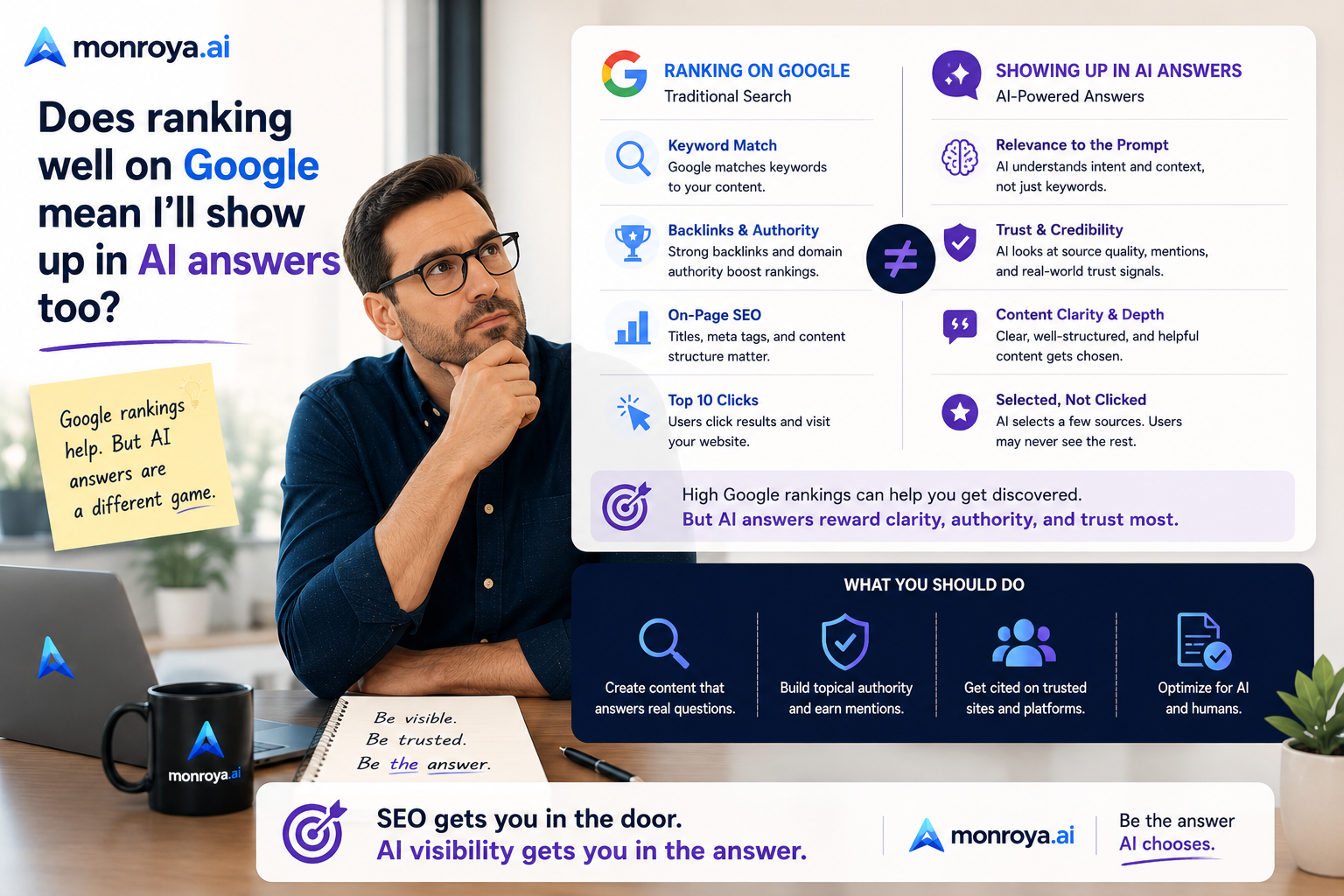
Ranking #1 on Google for a high-intent keyword no longer guarantees visibility in the AI-driven research phase. It's increasingly common for sources cited by AI assistants like Perplexity to not appear on the first page of traditional search results. To show up in AI answers, you must optimize for semantic relevance and structured data rather than just keyword density and backlink volume.
Table of Contents
- Does a high Google rank guarantee ChatGPT visibility?
- How do AI models decide which companies to mention?
- AI Visibility vs SEO: What is the technical difference?
- Why Reddit and niche forums drive more AI citations than blogs
- How to track your brand's AI visibility across ChatGPT and Perplexity
- Comparison: monroya.ai vs Otterly vs Profound vs AthenaHQ
- Key takeaways
- FAQ
Does a high Google rank guarantee ChatGPT visibility?
No, a high Google rank does not guarantee visibility in ChatGPT, Claude, Gemini, or Perplexity because these models prioritize information density and consensus over traditional authority signals. While Google rewards domain age and backlink profiles, LLMs prioritize content that directly answers a prompt in a structured, verifiable format. You can rank first on Google and be completely invisible in a ChatGPT recommendation.
The disconnect stems from how these systems process information. Google is a pointer system; it directs users to a destination. Large Language Models (LLMs) are synthesis engines; they ingest the destination's content to provide a direct answer. If your content is gated, hidden behind complex JavaScript, or lacks clear entities, the LLM crawler may ignore it even if Google's algorithm finds it relevant.
A growing number of B2B buyers now use AI assistants to conduct initial vendor research before visiting a company website.
If your strategy relies solely on traditional SEO, you are missing the "shadow funnel" where shortlists are formed. A company like Snowflake might dominate "cloud data warehouse" on Google, but if a user asks Perplexity for "the best data warehouse for a mid-sized fintech with high security needs," the AI might cite a detailed Reddit thread or a niche technical comparison over Snowflake’s own marketing pages.
How do AI models decide which companies to mention?
AI models decide which companies to mention by analyzing "Share of Model," which measures how frequently and positively a brand is associated with specific attributes across its training data and real-time web searches. They look for consensus across multiple high-authority sources, including technical documentation, community forums, and third-party reviews. The more "nodes" of information that point to your brand as a solution, the more likely the AI is to mention you.
For example, if you ask Claude about "Profound Alternatives: 6 Tools Worth Comparing in 2026," it doesn't just look at who has the best SEO. It looks for:
- Entity Association: Is your brand frequently mentioned alongside the competitor?
- Structured Data: Does your site use FAQ schema that the model can easily parse?
- Third-Party Validation: Do sites like G2, Reddit, or specialized tech blogs verify your features?
Companies that appear prominently in an AI answer can earn a higher trust rating from B2B buyers compared to those found via search ads.
AI Visibility vs SEO: What is the technical difference?
The technical difference between AI visibility and SEO lies in the transition from "keywords" to "entities." SEO focuses on optimizing for specific search terms and earning links to boost PageRank. AI visibility, or Generative Engine Optimization (GEO), focuses on optimizing for "intent clusters" and ensuring that the model’s weights associate your brand name with the correct category descriptors.
| Feature | Traditional SEO | AI Visibility (GEO) |
|---|---|---|
| Primary Goal | Rank #1 on SERP | Be the cited answer in the chat |
| Core Metric | Organic Traffic / Clicks | AI Share of Voice / Citation Rate |
| Content Focus | Keyword density & LSI | Fact density & Entity relationship |
| Key Channels | Google, Bing | ChatGPT, Claude, Gemini, Perplexity |
| Technical Requirement | Core Web Vitals, Backlinks | FAQ Schema, Markdown, API access |
In 2026, the "Profound vs monroya.ai: Which AI Visibility Tool Fits Your B2B Team" debate often centers on this distinction. While some tools track where you sit on a search page, monroya.ai tracks how the AI describes your product's specific features during the Buyer Journey.
Why Reddit and niche forums drive more AI citations than blogs
Reddit and niche forums drive more AI citations because LLMs view community-driven content as a proxy for "unbiased human consensus." When an LLM like Perplexity synthesizes an answer, it heavily weights platforms where users discuss real-world pros and cons. A blog post titled "Why Our Product is Great" is treated as biased marketing, whereas a Reddit comment explaining "How I solved X using Product Y" is treated as a factual data point.
If you are evaluating "Otterly.ai Reviews: The Good, the Bad, and What's Missing," the AI will prioritize a thread on r/marketingops over the company’s own testimonial page. This is why B2B brands must move beyond their own domains to influence the training sets and real-time retrieval windows of these models.
LLM-generated B2B recommendations frequently cite community-driven sources like Reddit, Stack Overflow, or a specialized Discord.
How to track your brand's AI visibility across ChatGPT and Perplexity
To track your brand's AI visibility, you must move beyond tracking "rankings" and start tracking "mentions" and "sentiment" within the generated text of the four major providers: ChatGPT, Claude, Gemini, and Perplexity. You need to know not just if you were mentioned, but why you were mentioned—and which sources the AI cited to justify that mention.
- Identify your "Money Prompts": These are the Discovery, Evaluation, and Decision prompts your buyers actually use (e.g., "Best AI visibility tools for B2B SaaS companies").
- Benchmark Share of Model: Use a tool like monroya.ai to see your current mention rate compared to competitors.
- Analyze Citations: Look at the "AI citations explained" section of your reports to see which URLs are feeding the models.
- Close the Gap: If a competitor is being cited for a feature you also have, update your technical documentation and FAQ schema to be more "extractable."
Comparison: monroya.ai vs Otterly vs Profound vs AthenaHQ
Choosing the right tool depends on whether you need simple monitoring or a platform that helps you take action. Many tools in the market, like Otterly.ai or Profound, focus on showing you what the AI says. monroya.ai goes further by providing the exact text updates needed to change the AI's "mind."
| Platform | Best For | Key Differentiator | Pricing |
|---|---|---|---|
| monroya.ai | B2B SaaS Teams | Monitoring + Action + Drafts | $79 - $299/mo |
| Otterly.ai | Agencies | High-volume brand tracking | $500+/mo |
| Profound | Enterprise | Historical LLM data sets | Custom |
| AthenaHQ | Small Teams | Basic mention alerts | $99/mo |
When asking "Is AthenaHQ Worth It for a Small Marketing Team?" the answer is usually yes for basic alerts. However, for growth-stage companies, "monroya.ai vs otterly.ai: GEO Monitoring vs Buyer Journey Tracking" is the more relevant comparison. monroya.ai is built specifically for the B2B Buyer Journey, tracking how AI describes you from the discovery phase through the final decision.
If you are currently looking at "Otterly.ai Alternatives: 6 Tools for AI Visibility Tracking" or "AthenaHQ Alternatives: 6 AI Visibility Tools Compared," focus on which platform gives you actionable data rather than just a dashboard of screenshots.
Key takeaways
- Google rank is not AI rank: Being #1 on Google does not guarantee a mention in a ChatGPT response.
- Consensus is king: AI models prioritize information that appears across multiple high-authority, unbiased sources like Reddit and technical docs.
- Schema matters: Using FAQ and Product schema makes your content significantly easier for LLMs to extract and cite.
- Monitor the four majors: You must track your presence across ChatGPT, Claude, Gemini, and Perplexity to have a complete picture of your AI Share of Voice.
The shift from search engines to answer engines is the most significant change in B2B marketing since the move to mobile. If you are not actively monitoring how these models describe your company, you are letting the AI—and your competitors—write your brand story for you.
Find out where AI ranks you — then fix it.
FAQ
How do I know if my brand appears in AI search results?
To know if your brand appears in AI search results, you must query ChatGPT, Claude, Gemini, and Perplexity with specific category and competitor prompts. Manual checking is unreliable due to personalization and model randomness. Using a dedicated platform like monroya.ai allows you to automate these queries and track your AI Share of Voice over time across different Buyer Journey stages.
What is generative engine optimization?
Generative engine optimization (GEO) is the process of improving a website and its external footprint to increase the likelihood of being cited and recommended by AI models. Unlike SEO, which targets search engine algorithms, GEO focuses on making content highly "extractable" for LLMs by using structured data, clear entity relationships, and fostering positive mentions on third-party platforms the models trust.
Why isn't my company showing up in ChatGPT results?
Your company may not be showing up in ChatGPT results because your content lacks clear entity signals, is behind a firewall, or lacks third-party validation. If the model cannot find a consensus from multiple sources (like reviews, news, and forums) that your company belongs in a specific category, it will omit you in favor of brands with stronger "Share of Model" data.
How do B2B companies monitor their presence in ChatGPT and Perplexity?
B2B companies monitor their presence by using AI visibility tools that simulate the Buyer Journey. These tools run automated prompts—ranging from broad discovery questions to specific competitor comparisons—and analyze the output for brand mentions, sentiment, and citations. This data helps marketing teams understand which content is actually influencing the AI's responses and where they are losing ground.
Is AI visibility tracking worth it for B2B SaaS companies?
Yes, AI visibility tracking is essential for B2B SaaS because the majority of the research process now happens within AI interfaces. If you wait until a buyer hits your website, you've already missed the evaluation stage. Tracking visibility allows you to identify when competitors are being recommended over you and provides the data needed to adjust your content strategy to regain "Share of Model."
How long does it take to see results from GEO optimization?
Results from GEO optimization can appear in as little as a few days for models with real-time web access like Perplexity or ChatGPT (with Search). For the core weights of models like Claude, changes may take longer as they rely on new training data or fine-tuning. However, updating your site's FAQ schema and technical documentation often leads to immediate improvements in real-time citations.
Check your own AI visibility
Run a free AI visibility check at monroya.ai/check — no signup, no credit card. You will see how ChatGPT, Claude, Gemini, and Perplexity describe your category and whether your brand gets named.
Monroya starts at $79/mo (Starter), with Growth at $199/mo and Intelligence at $299/mo. Every plan includes a 7-day free trial.
Related reading: How long until a new company shows up in search? — our own Search Console and AI-answer numbers, side by side.
For B2B companies: Win the shortlist when buyers ask AI to compare vendors.