What is GEO (generative engine optimization)?
By Jeremy Unruh, Founder, Monroya · Published July 14, 2026 · Reviewed July 2026
Want this for your company? See how AI assistants answer about your site.
Run the free check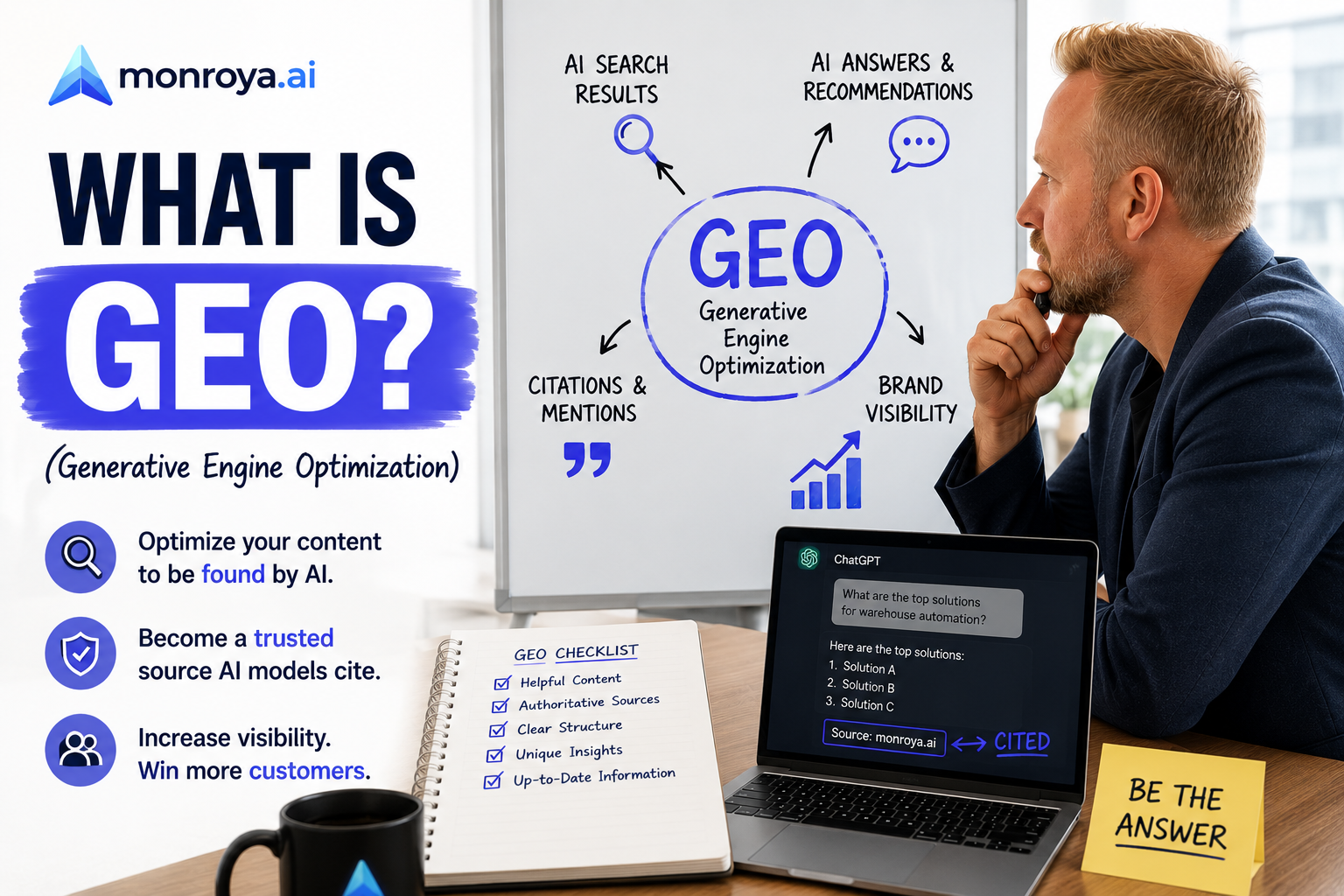
Generative Engine Optimization (GEO) is the technical and strategic process of influencing Large Language Models (LLMs) like ChatGPT, Claude, Gemini, and Perplexity to include your brand in their generated responses. Unlike traditional SEO which focuses on click-through rates from a list of links, GEO prioritizes becoming the "latent knowledge" the model uses to synthesize an answer, ensuring your company appears in the citations and recommendations that form a buyer's initial shortlist.
Table of Contents
- How does GEO differ from traditional SEO?
- What are the core ranking factors for Generative Engine Optimization?
- How do I show up in ChatGPT and Perplexity results?
- Why is AI Share of Voice the new primary metric for B2B?
- Which AI visibility tools should I use to track GEO performance?
- How do I build a GEO playbook for a B2B marketing team?
- Frequently Asked Questions
How does GEO differ from traditional SEO?
Traditional SEO is built on the "ten blue links" model where the goal is to rank for a specific keyword to drive a click to a website. GEO shifts the focus to "answer engine" dominance, where the goal is to have the AI model synthesize your brand's value proposition directly into its response. In GEO, the model is the interface, and the website is merely a data source used to build trust and provide citations.
Increasingly, users are turning to AI search tools to perform initial brand research before visiting a vendor website.
In the old world, you optimized for Google’s crawler to understand your hierarchy. In the GEO world, you optimize for the model’s weights and its ability to retrieve your information during a "Retrieval-Augmented Generation" (RAG) cycle. This means your content must be structured not just for readability, but for extractability. If ChatGPT cannot summarize your pricing or features in a single pass, you are invisible.
What are the core ranking factors for Generative Engine Optimization?
The core ranking factors for GEO include citation frequency across authoritative domains, technical formatting like FAQ schema, and the "sentiment density" of third-party mentions on platforms like Reddit and G2. AI models prioritize sources that provide high-density information with clear, verifiable facts. They favor content that directly answers the user's intent without requiring the model to filter through marketing fluff or excessive adjectives.
LLMs are more likely to cite a source that uses structured data and clear, declarative headers.
For example, when a buyer asks Perplexity for "Best AI Visibility Tools for B2B SaaS Companies," the engine looks for consensus. It scans recent reviews, technical documentation, and community discussions. If your brand is mentioned frequently on Reddit but lacks a clear pricing page with structured data, the model might mention you but fail to provide the "Decision" stage data the buyer needs, leading them to a competitor like Otterly.ai or Profound.
How do I show up in ChatGPT and Perplexity results?
To show up in ChatGPT and Perplexity, you must move beyond keyword stuffing and focus on "entity-based" content that defines your brand's relationship to a category. This involves securing mentions in high-authority industry publications, maintaining an active presence in community forums where AI models scrape data, and ensuring your technical documentation is crawlable. You must also optimize for specific prompt types: Discovery, Evaluation, and Decision.
| Optimization Factor | Traditional SEO Focus | GEO Focus (monroya.ai) |
|---|---|---|
| Primary Goal | Clicks to Website | Mention & Citation Rate |
| Content Structure | Long-form Blog Posts | Fact-Dense, Modular Data |
| Key Platforms | Google Search | ChatGPT, Claude, Gemini, Perplexity |
| Authority Signal | Backlinks | Citations & Community Consensus |
| Success Metric | Keyword Rankings | AI Share of Voice |
A concrete example: If you are competing against OmniSEO or AthenaHQ, simply having a better blog isn't enough. You need to ensure that when a user asks "OmniSEO vs monroya.ai," the model has enough structured data to explain that monroya.ai is a software-only solution while OmniSEO includes a $3k/month managed service fee.
Why is AI Share of Voice the new primary metric for B2B?
AI Share of Voice measures the percentage of time your brand is mentioned or cited by an LLM compared to your competitors for a specific set of category prompts. Because buyers are increasingly using AI to build their shortlists, a high Google ranking is useless if ChatGPT ignores you during the research phase. Tracking this metric allows you to see exactly where you are losing ground in the "dark funnel" of AI conversations.
A higher AI Share of Voice often correlates with an increase in high-intent demo requests.
If you are a VP of Marketing at a Series B company, you need to know if your brand appears when a buyer asks for "Profound Alternatives." If the AI only lists Otterly.ai and Peec AI, you have a GEO gap. monroya.ai tracks these specific mentions across ChatGPT, Claude, Gemini, and Perplexity to give you a real-time view of your market presence.
Which AI visibility tools should I use to track GEO performance?
The best AI visibility tools for B2B teams are those that provide both monitoring and actionable playbooks. While tools like Profound or Otterly.ai offer visibility tracking, B2B operators often find themselves asking: "Is Profound Worth It for a Series A B2B Company?" or "Is Otterly.ai Right for B2B SaaS, or Built for Agencies?" The choice depends on whether you need a managed service or a platform that helps you fix the gaps yourself.
- monroya.ai: Best for B2B teams who need to track the Buyer Journey and get drafted content to fix visibility gaps.
- OmniSEO: Best for companies that want a fully managed service and have the $3k+ monthly budget to support it.
- AthenaHQ: Often used by smaller teams, though users frequently ask "Is AthenaHQ Worth It for a Small Marketing Team?" due to its feature set.
- Peec AI: Focused on search monitoring but often lacks the deep Buyer Journey integration required for complex SaaS sales.
How do I build a GEO playbook for a B2B marketing team?
A successful GEO playbook starts with identifying the "money prompts" your buyers use during the Discovery and Evaluation phases. Once identified, you must audit how ChatGPT, Claude, Gemini, and Perplexity currently answer those prompts. The next step is creating "citation-magnet" content—highly specific, data-rich pages that use FAQ schema to make it easy for LLMs to extract your brand's key differentiators.
- Audit current visibility: Use monroya.ai to scan your category prompts across all four major LLMs.
- Identify "Invisible" stages: Determine if you are missing from Discovery (category queries) or Evaluation (competitor comparisons).
- Optimize technical debt: Implement FAQ schema and clean up your pricing page. (Check "Profound Pricing" or "Otterly.ai Pricing" to see how competitors structure their data).
- Seed community data: Engage in Reddit and niche forums to create the third-party consensus LLMs crave.
- Monitor and iterate: AI models update their training data and search indexes constantly; GEO is not a "set it and forget it" tactic.
If you find that your competitors are appearing in ChatGPT and you’re not, it is likely because your content is too "fluffy." AI models cannot cite a "holistic approach" or a "seamless experience." They cite "a 22% increase in efficiency" or "pricing starting at $79/month." To win in 2026, you must provide the hard data that LLMs use to build their answers.
Find out where AI ranks you — then fix it.
FAQ
What is the difference between GEO and AEO?
Generative Engine Optimization (GEO) is the broader strategy of influencing LLM outputs, while Answer Engine Optimization (AEO) specifically focuses on providing direct answers to user queries. GEO includes brand sentiment, citation rates, and presence in training data, whereas AEO is more focused on the immediate retrieval of a specific fact or answer.
How long does it take to see results from GEO optimization?
Results from GEO can appear in as little as 24 to 72 hours on search-enabled models like Perplexity or ChatGPT with Search. For the core model weights in tools like Claude or Gemini, changes may take longer as they rely on periodic model updates or the indexing of high-authority third-party sites.
Why is my company not showing up in ChatGPT?
Your company may be missing from ChatGPT because your content lacks structured data, your brand entity isn't clearly defined in the model's training set, or you lack third-party citations. If your website blocks AI crawlers via robots.txt, search-enabled AI features will also be unable to find and cite your brand.
Is GEO more expensive than traditional SEO?
GEO often requires a lower volume of content but a higher level of technical precision and authority building. While you may spend less on "filler" blog posts, you will invest more in high-authority placements and specialized tools like monroya.ai to track your AI Share of Voice across different models.
Does Reddit impact my AI visibility?
Yes, Reddit is one of the most significant sources of "human-verified" data for AI models. Models like ChatGPT and Perplexity frequently cite Reddit threads to provide "real-world" opinions on B2B software. A lack of presence in relevant subreddits can lead to a lower citation rate in AI answers.
What is a good AI citation rate for a B2B SaaS company?
A healthy AI citation rate depends on your category maturity, but leading B2B SaaS companies typically aim for a strong citation rate in "Evaluation" stage prompts. Monitoring this via monroya.ai allows you to see how you compare to competitors like Profound or AthenaHQ in real-time.
Check your own AI visibility
Run a free AI visibility check at monroya.ai/check — no signup, no credit card. You will see how ChatGPT, Claude, Gemini, and Perplexity describe your category and whether your brand gets named.
Monroya starts at $79/mo (Starter), with Growth at $199/mo and Intelligence at $299/mo. Every plan includes a 7-day free trial.
For B2B companies: Win the shortlist when buyers ask AI to compare vendors.