Do AI models get their information from Google, or somewhere else?
By Jeremy Unruh, Founder, Monroya · Published July 15, 2026 · Reviewed September 2026
Want this for your company? See how AI assistants answer about your site.
Run the free check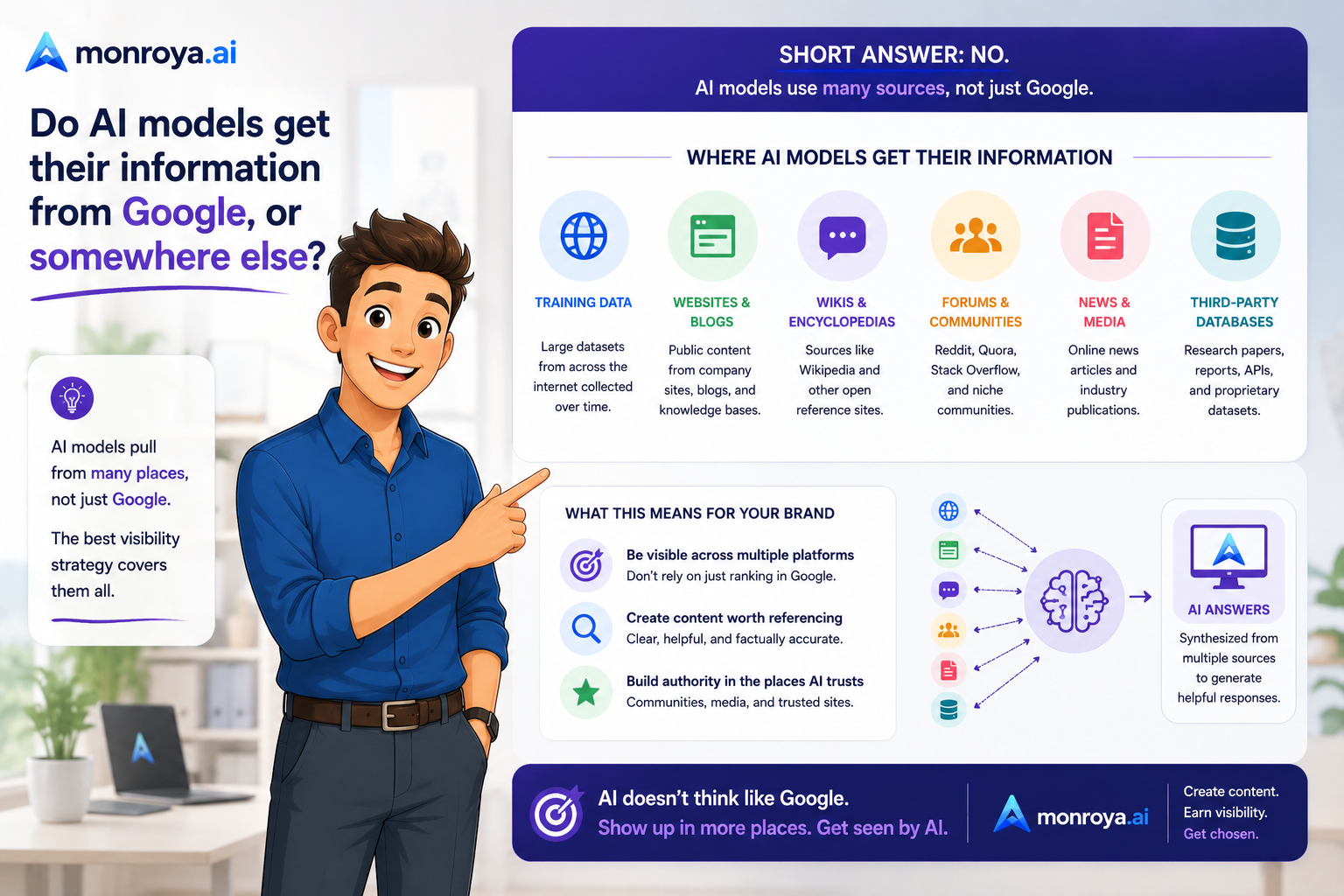
AI models like ChatGPT, Claude, and Gemini do not "get" their information from Google; they are trained on massive, independent datasets including Common Crawl, Wikipedia, and specialized web scrapes. While Perplexity and Gemini use search engines to ground real-time queries, the underlying knowledge of an LLM is a frozen snapshot of the internet that exists independently of Google’s search index or ranking algorithms.
Table of Contents
- Where do LLMs actually source their training data?
- Does ranking #1 on Google guarantee visibility in AI search?
- How Perplexity and Gemini use search engines differently
- Why Reddit and GitHub carry more weight than SEO blogs
- Comparison: Traditional Search vs. AI Knowledge Retrieval
- How to optimize for AI sources beyond Google
- FAQ
Where do LLMs actually source their training data?
Large Language Models (LLMs) source their primary knowledge from massive, curated datasets like Common Crawl, which contains petabytes of web data collected over years. They also prioritize high-authority repositories such as Wikipedia, scientific journals (PubMed, arXiv), and code repositories like GitHub to build a foundational understanding of logic, facts, and language patterns.
For a B2B SaaS company, this means your visibility is determined by the "persistence" of your brand across these datasets. If your company is mentioned in a 2024 industry report or a widely-cited whitepaper, that data is baked into the model's weights during the pre-training phase. This is why a company can appear in ChatGPT results even if their website has zero SEO authority. The model isn't "searching" for you; it "remembers" you from its training data.
A significant and growing share of B2B buyers now use AI assistants to conduct initial vendor research before visiting a company website.
Does ranking #1 on Google guarantee visibility in AI search?
Ranking #1 on Google does not guarantee visibility in AI search because LLMs prioritize information density, semantic relevance, and consensus over traditional SEO signals like backlink quantity or keyword density. AI models often bypass top-ranking marketing pages in favor of technical documentation, forum discussions, or third-party reviews that provide more objective, structured data for the model to synthesize.
In many cases, a "rank inversion" occurs where the third or fourth result on Google is the one cited by Perplexity or Claude. This happens because the AI is looking for a specific answer to a prompt, not a list of links. If your competitor has a detailed FAQ section or a structured comparison table that answers a "Discovery" stage prompt, the AI will pull from them even if your homepage has a higher Domain Authority.
AI models are significantly more likely to cite structured data and FAQ sections than standard marketing copy.
How Perplexity and Gemini use search engines differently
Perplexity and Gemini use search engines as "retrieval tools" to supplement their internal knowledge with real-time data, whereas ChatGPT and Claude rely more heavily on their pre-trained weights unless a specific web-search tool is triggered. Gemini uses Google’s index to verify facts, while Perplexity acts as a broker, searching the live web and then using an LLM to summarize the top results it finds.
This distinction is critical for B2B teams. If you are tracking AI Share of Voice, you must realize that being invisible in the training data (Claude) is a different problem than being invisible in the search-augmented results (Perplexity). One requires a long-term content strategy to get into future model updates; the other requires immediate Generative Engine Optimization (GEO) to ensure your current pages are "crawlable" and "summarizable" by AI agents.
| Feature | Traditional Google Search | AI Search (Perplexity/Gemini) | LLM (ChatGPT/Claude) |
|---|---|---|---|
| Primary Goal | Link navigation | Answer synthesis | Conversational reasoning |
| Data Source | Live web index | Live web + LLM weights | Pre-trained weights |
| Ranking Factor | Backlinks & UX | Semantic match & Citations | Training data frequency |
| Update Speed | Minutes/Hours | Real-time | Months (Training cycles) |
| User Intent | Find a website | Get an answer | Solve a problem |
Why Reddit and GitHub carry more weight than SEO blogs
Reddit and GitHub carry more weight in AI training because they represent "human-verified" information and peer-to-peer consensus, which LLMs use to determine the quality of a brand. Models are trained to value the sentiment found in community discussions over the self-reported claims found on a B2B company’s own blog or product pages.
If a buyer asks ChatGPT, "What are the Profound Alternatives: 6 Tools Worth Comparing in 2026?", the model is more likely to pull those names from a Reddit thread where users debated the pros and cons of Profound vs monroya.ai than from a paid listicle. For Series A-C companies, this means your AI visibility is often earned in communities you don't control.
AI-generated B2B recommendations frequently include at least one source from a community forum or developer platform.
How to optimize for AI sources beyond Google
To optimize for AI sources beyond Google, you must transition from keyword-based SEO to entity-based GEO, focusing on creating high-density information nodes that AI models can easily parse. This includes implementing comprehensive FAQ schema, contributing to open-source or public datasets, and ensuring your brand is mentioned in high-authority third-party contexts like industry benchmarks and news archives.
- Audit your AI Share of Voice: Use a tool to see how ChatGPT, Claude, Gemini, and Perplexity describe your category and who they cite.
- Identify Citation Gaps: Look for prompts where competitors are mentioned but you are not. Are they being pulled from a specific review site or a technical doc?
- Deploy Structured Content: Rewrite key "Evaluation" stage pages to use clear H2 questions and 50-word answer blocks that LLMs can easily lift.
- Monitor the Buyer Journey: Track how AI answers change from "Discovery" (What is AI visibility?) to "Decision" (Is Otterly.ai Right for B2B SaaS, or Built for Agencies?).
- Fix the Narrative: If an LLM is hallucinating about your pricing or features, update your public-facing documentation and press releases to provide the model with "fresher" data for its next crawl.
Understanding how these models ingest data is the first step toward influencing what they say about your company. If you rely solely on your Google rankings, you are ignoring the datasets that actually power the assistants your buyers are using. You need to know exactly which sources are feeding the models that influence your pipeline.
Find out where AI ranks you — then fix it.
FAQ
Do AI models crawl my website like Google does?
AI models do not crawl websites in real-time like Googlebot; instead, they use data from massive web-scale scrapes like Common Crawl. However, tools like Perplexity and Gemini's search feature do perform real-time lookups using search indices to find current information, making traditional crawlability still relevant for AI visibility.
Why does ChatGPT mention my competitor but not me?
ChatGPT likely mentions your competitor because they appear more frequently or with higher authority in the model's training data, such as in news articles, Reddit discussions, or industry reports. If your brand lacks a "digital footprint" in these high-value datasets, the model will not include you in its responses.
Can I pay to be recommended by AI assistants?
There is currently no direct "pay-to-play" model for AI recommendations in tools like Claude or ChatGPT. Visibility is earned through semantic relevance and presence in the training data. However, some search-augmented models may eventually include sponsored citations, similar to how Google Search operates today.
How often do AI models update their knowledge?
Foundational AI models like GPT-4 or Claude 3 only update their core knowledge during massive retraining or fine-tuning cycles, which can happen months apart. Search-augmented models like Perplexity update their "knowledge" of current events in real-time by pulling from live web search results.
Does FAQ schema help with AI visibility?
Yes, FAQ schema is highly effective for AI visibility because it provides structured, clear data that LLMs can easily parse and cite. By using FAQ schema, you increase the likelihood that an AI assistant will lift your specific answer when a user asks a related question.
What is the difference between AI visibility and SEO?
SEO focuses on ranking a website in search engine results pages to drive clicks, while AI visibility focuses on ensuring a brand is mentioned and cited accurately within AI-generated answers. AI visibility prioritizes being the "source of truth" rather than just a high-ranking link.
Check your own AI visibility
Run a free AI visibility check at monroya.ai/check — no signup, no credit card. You will see how ChatGPT, Claude, Gemini, and Perplexity describe your category and whether your brand gets named.
Monroya starts at $79/mo (Starter), with Growth at $199/mo and Intelligence at $299/mo. Every plan includes a 7-day free trial.
For B2B companies: Win the shortlist when buyers ask AI to compare vendors.